Best Stability Ball Exercises for Seniors: Safe Home Workout Guide
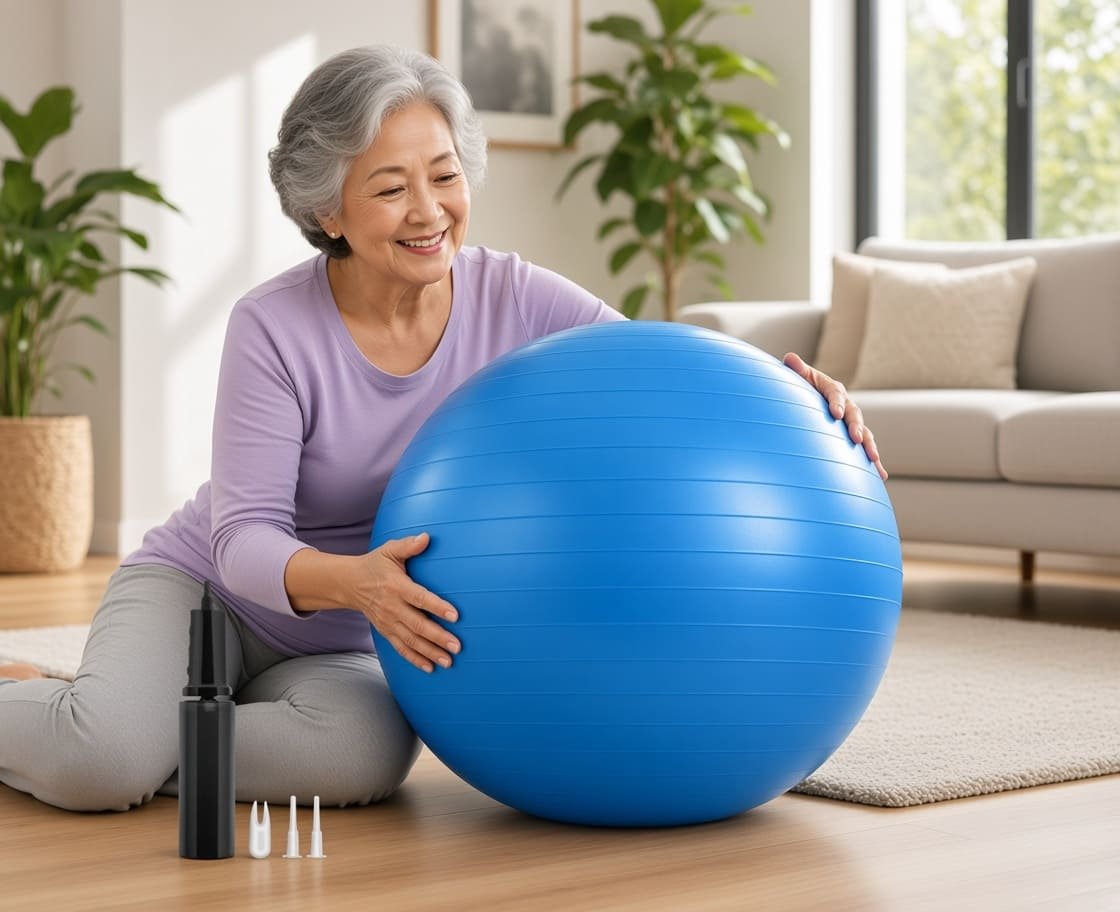
Stability balls can be a useful addition to a gentle home exercise routine, especially when you want to work on balance, core strength, flexibility, and controlled movement without relying on complicated gym equipment.
For older adults, however, choosing the right ball and using it correctly matters. A stability ball that is too large, too small, or poorly inflated can make exercises unnecessarily difficult.
In this guide, we’ll look at the best stability ball exercises for seniors, how to choose the right stability ball, and what to consider before buying one for home use.
Safety note: Stability-ball exercises require balance. If you are new to exercise, have significant balance problems, or have an injury or medical condition, consider asking a healthcare professional or qualified exercise professional whether these exercises are appropriate for you. Start with simple movements and use a stable support nearby.
What Is a Stability Ball?
A stability ball is a large inflatable exercise ball designed for activities such as stretching, strengthening, balance training, and mobility exercises. You may also see them called:
- Exercise balls
- Balance balls
- Fitness balls
- Swiss balls
- Physio balls
- Therapy balls
They come in different sizes, commonly around 45 cm, 55 cm, 65 cm, and 75 cm.The correct size depends mainly on your height, body position, and the particular exercise you plan to perform.
Looking for a stability ball for home exercise?
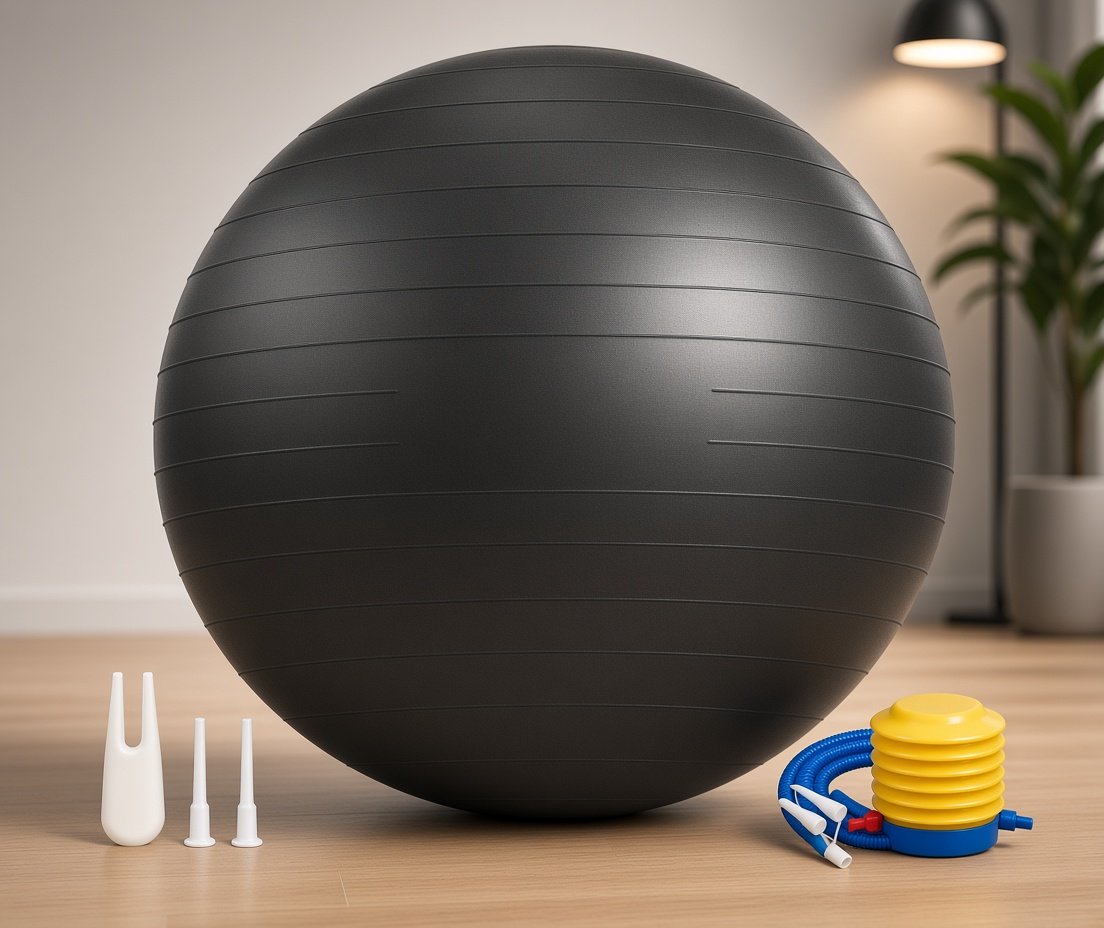
If you are shopping for your first exercise ball, compare the size, weight capacity, anti-burst construction, surface grip, and included accessories before making a purchase.

Trideer Yoga Ball for Exercise- Pump Included
Wide Range of Sizes & Colors,Versatile for Multiple Activities,Non-Slip Frosted Surface,Quick Inflation with Pump Included.Brand-Trideer; Material -PVC; Color-Black(also have Turkis & Royal blue); Age Range (Description)-Adult; Item Weight -2.2 pounds;size-XXS,S,M,L,XL,XXL;support up to 330 pounds in weight; the birthing ball prevents a sudden blast; gradual air release mechanism ensures safety.meticulously manufactured to be free from harmful heavy metals such as Pb, Cd, Hg, and 10 other heavy metals; safe for pregnant women and children.Trideer exercise ball comes with a quick inflation pump (45/55/65cm equipped with a hand pump; 75/85cm equipped with a foot pump), 2 air stoppers, and detailed instructions; available in 5 sizes to meet all your needs.
Are Stability Balls Good for Seniors?
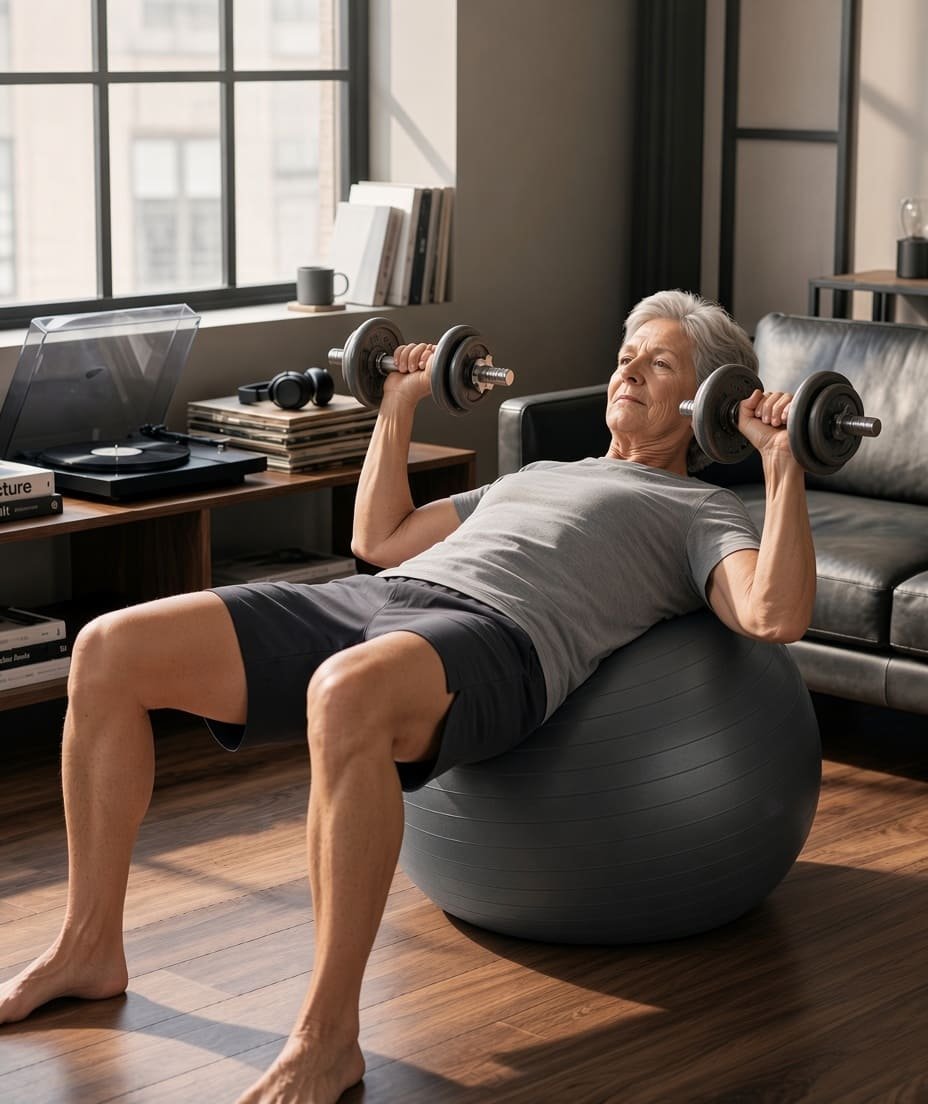
They can be, provided they are used appropriately.A stability ball creates an unstable surface, which means your body has to make small adjustments to maintain control. Depending on the exercise, this can involve the abdominal and back muscles as well as the muscles around the hips and legs. For seniors, a stability ball may be useful for:
- Gentle core exercises
- Seated mobility movements
- Balance practice
- Stretching
- Posture-focused exercises
- Low-impact strength exercises
- Flexibility routines
The important point is that a stability ball isn’t automatically safer simply because an exercise is low impact. Balance and control should come first.
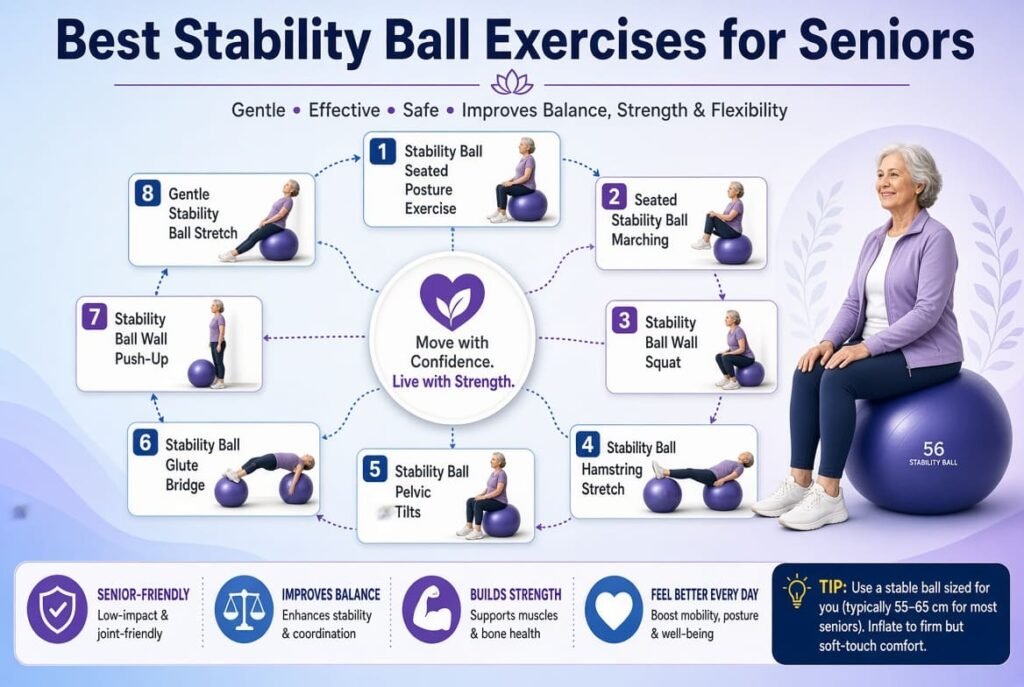
Best Stability Ball Exercises for Seniors
You don’t need to perform every exercise in one workout. Start with a few movements that feel comfortable and gradually build your routine.
1. Stability Ball Seated Posture Exercise
Sit on the stability ball with your feet flat on the floor and positioned about shoulder-width apart.
Keep your back comfortably upright and your shoulders relaxed. Hold the position for a short period while maintaining steady breathing.
This simple exercise can help you become familiar with sitting on the ball and maintaining controlled posture.
Beginner tip: Place the ball near a sturdy surface that you can hold if necessary.
2. Seated Stability Ball Marching
Once you are comfortable sitting on the ball, try gentle marching.
Sit upright with both feet on the floor. Slowly lift one foot a few inches from the floor and return it. Then repeat with the other foot.Keep your movements slow rather than trying to lift your knees high.
This exercise can challenge your ability to maintain a stable seated position while moving your legs.
3. Stability Ball Wall Squat
Place the stability ball between your back and a wall.
Position your feet slightly forward and slowly bend your knees. Move only through a comfortable range, then return to standing.
This variation can provide support while allowing you to practice a controlled squatting movement.If you experience knee discomfort, stop and reconsider the movement rather than forcing the range of motion.
4. Stability Ball Hamstring Stretch
Sit on a stable surface or use the ball only if you can maintain good control.
Extend one leg forward with the heel resting on the floor. Keep your back comfortable and gently lean forward from the hips.
You should feel a mild stretch rather than pain.Avoid bouncing or forcing the stretch.
5. Stability Ball Pelvic Tilts
Sit on the stability ball with your feet firmly planted.Gently tilt your pelvis forward and backward while keeping the movement small and controlled.
This can be a useful introductory movement for learning how the pelvis and spine move while sitting on an unstable surface.
6. Stability Ball Glute Bridge
For a more advanced exercise, lie on your back and place your lower legs on the stability ball.
Keep your arms beside you and gently lift your hips. Pause briefly, then lower them slowly.This exercise requires considerably more control than seated movements.
If you are new to stability-ball training, start with simpler exercises before attempting this variation.
7. Stability Ball Wall Push-Up
Stand facing a wall and place your hands on the wall-mounted stability ball.
Keep your body controlled and slowly bend your elbows before pushing yourself away from the wall.
This can be an alternative way to introduce an upper-body pushing movement without getting down onto the floor.Make sure the ball is securely positioned and does not move unexpectedly.
8. Gentle Stability Ball Stretch
A stability ball can also be used as a support during gentle stretching.
For example, you can sit on the ball and perform slow side-to-side movements or gentle upper-body stretches.The goal isn’t to stretch as far as possible. Instead, concentrate on comfortable movement and steady breathing.
How to Choose the Best Stability Ball for Seniors
If you’re looking for stability balls for exercise, don’t choose one based only on its appearance or price.
Consider these factors before buying.
1. Choose the Correct Ball Size
Stability balls are available in several diameters.
A 55 cm ball, for example, may be appropriate for some users, while taller people may need a larger ball.
Your knees should generally be positioned comfortably rather than being significantly higher or lower than your hips when sitting on the ball.
Always check the manufacturer’s size chart because recommendations can vary between products.
Popular option: 55 cm stability ball
If a 55 cm ball matches your height and the manufacturer’s recommendations, you can compare models that offer features such as anti-burst construction, textured surfaces, and an included pump.
[See 55 cm stability balls on Amazon→]
2. Look for an Anti-Burst Design
For home use, an anti-burst or slow-deflation construction can be an important feature.
If the ball is punctured, the goal is for it to deflate gradually rather than suddenly collapsing.
This doesn’t eliminate the need to inspect the ball regularly.
3. Check the Weight Capacity
Always check the manufacturer’s stated weight capacity before purchasing.
Don’t assume that two stability balls of the same size have the same weight rating.
4. Consider the Surface
A textured or non-slip surface can make the ball easier to grip during certain exercises.
This can be particularly useful when performing movements that involve your hands or feet against the ball.
5. Check Whether a Pump Is Included
Some exercise balls include an inflation pump, while others require you to purchase one separately.
If you’re buying your first ball, a package that includes the appropriate pump can be more convenient.
[stability balls included pumps and other equipments on Amazon→]

APEXUP Yoga Ball, 660 lbs Anti-Burst Exercise Ball with Pump
5 Sizes,Brand-APEXUP; Material -PVC; Age Range (Description)-Adult; Item Weight-2 pounds;Honeycomb PVC holds 660 lbs and deflates slowly if punctured, preventing sudden collapse during a workout; 5 sizes from 45 to 85 cm suit different heights, a large exercise ball fits taller users while a compact 55 cm yoga option works for average adults; check your size guide before ordering
Stability Balls for Rehabilitation and Physical Therapy
You may also come across searches for stability balls for rehabilitation and stability balls for physical therapy.
These products can look similar to ordinary exercise balls, but the appropriate exercise and equipment depend on the individual’s needs.
A physical therapist may use a stability ball as part of a supervised rehabilitation program involving balance, mobility, strengthening, or movement control.
If you’re recovering from surgery, an injury, or another physical problem, don’t assume that an exercise shown online is suitable for your rehabilitation.
Follow the recommendations of your healthcare or rehabilitation professional.
Important: Don’t purchase a product simply because it is marketed as a “therapy ball.” Look at the intended use and follow professional guidance when rehabilitation is involved.
Stability Ball Exercises for Seniors: Common Mistakes to Avoid
Using a stability ball doesn’t have to be complicated, but beginners often make a few avoidable mistakes.
Using an incorrectly sized ball
A ball that doesn’t fit your body properly can make exercises uncomfortable and harder to control.
Inflating the ball too much
Overinflation can change the way the ball feels and behaves.
Follow the manufacturer’s inflation instructions.
Starting with advanced exercises
You don’t need to begin with difficult exercises such as ball hamstring curls or advanced balance movements.
Start with seated and supported exercises.
Exercising on a slippery surface
Place the ball on an appropriate surface where it can be controlled.
Avoid using it on a surface where it can slide unexpectedly.
Exercising without nearby support
If you are new to stability-ball exercise, keep a sturdy support nearby and avoid positioning yourself somewhere that makes getting up difficult.
When Should You Stop a Stability Ball Exercise?
Stop the exercise if you experience:
- Sharp or sudden pain
- Significant dizziness
- Unusual shortness of breath
- Loss of control or repeated slipping
- A feeling that you cannot safely maintain the position
Mild muscle effort can be expected during exercise, but pain shouldn’t simply be pushed through.
If you’re unsure whether stability-ball exercises are appropriate for you, speak with a qualified healthcare professional.
Best Stability Ball Features to Look for When Shopping
If you’re ready to compare stability balls on Amazon, consider making a short checklist before choosing a product.
Look for:
- Appropriate ball diameter
- Suitable weight capacity
- Anti-burst construction
- Non-slip or textured surface
- Durable material
- Included inflation pump
- Clear sizing instructions
- Positive customer feedback
- Suitable use for exercise or therapy, depending on your needs
Don’t choose a stability ball simply because it has the highest number of reviews.
The important question is whether the size, construction, weight capacity, and intended use match your requirements.
Quick buying checklist
Before clicking the Amazon link, check:
✓ Correct size
✓ Suitable weight capacity
✓ Anti-burst construction
✓ Appropriate surface
✓ Pump included or available
✓ Intended use matches your exercise needs
Frequently Asked Questions
What is the best stability ball size for seniors?
There is no single size that is best for every senior. Ball size should be selected according to height, intended exercise, and the manufacturer’s sizing recommendations. A 55 cm ball is suitable for some users but not everyone.
Are stability balls good for seniors over 50?
They can be useful for balance, mobility, stretching, and strengthening when the exercises are appropriate for the individual’s ability. Beginners should start with simple, controlled movements.
Can seniors sit on a stability ball?
Some seniors can use a stability ball for seated exercises, but sitting directly on an unstable ball requires balance and control. A stability-ball chair or supported seating system may be more appropriate for some people.
Are stability balls good for physical therapy?
Stability balls are sometimes incorporated into rehabilitation or physical therapy programs. However, the appropriate exercise depends on the person’s condition and goals, so rehabilitation exercises should follow professional guidance.
Is a 55 cm stability ball good for exercise?
A 55 cm ball can be suitable for certain users and exercises, but its suitability depends on your height, body position, and the manufacturer’s recommendations.
Can I use a stability ball every day?
Some people may incorporate gentle stability-ball movements into their regular activity routine. However, frequency and intensity should match your fitness level and the type of exercise you’re performing.
How to Do Hamstring Curl with a Stability Ball
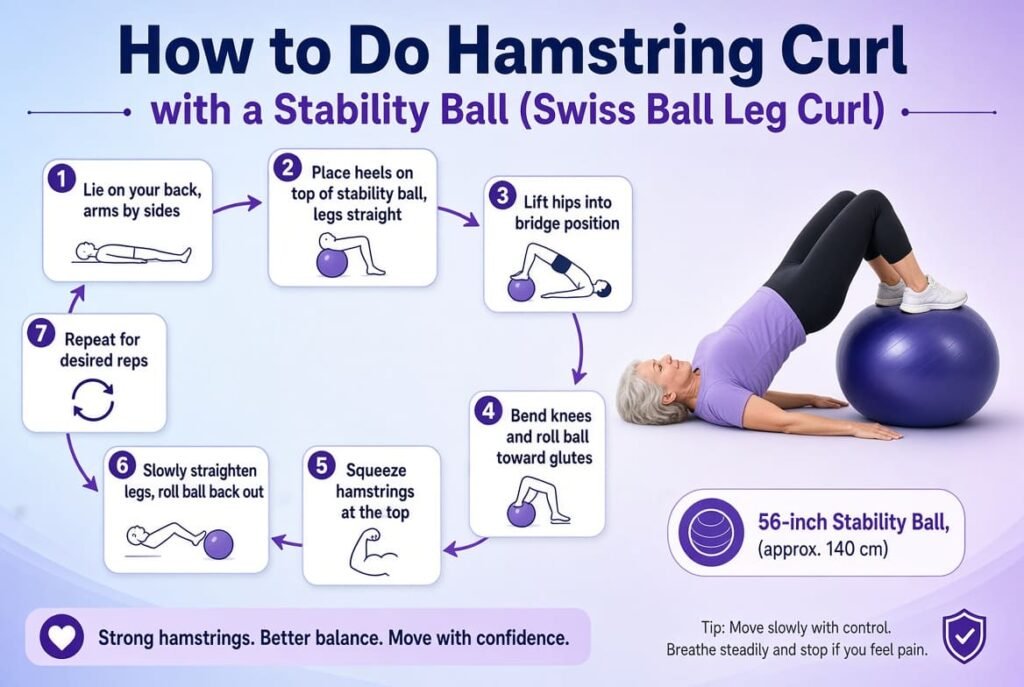
This is a popular bodyweight variation that also works your core and glutes for better stability.
Step-by-step:
- Lie on your back on the floor with your arms by your sides (palms down for support).
- Place both heels on top of a stability ball, legs straight.
- Engage your core and glutes, then lift your hips off the floor into a bridge position (your body should form a straight line from shoulders to heels).
- Keeping your hips high, bend your knees and roll the ball toward your glutes by curling your heels in.
- Squeeze your hamstrings at the top for a second.
- Slowly straighten your legs again, rolling the ball back out while keeping your hips elevated.
- Repeat for the desired number of reps.” and also give me this into a downloadable jpg image format.
Final Thoughts
A stability ball can be a versatile piece of equipment for a home exercise space. For older adults, the biggest priority should be control, stability, and appropriate exercise selection, rather than trying to perform difficult movements.
Start with simple exercises such as seated marching, pelvic tilts, supported squats, and gentle stretching. As your confidence and control improve, you can explore more challenging movements.
If you’re shopping for a ball, pay attention to size, weight capacity, anti-burst construction, surface grip, and included accessories rather than choosing purely on price or review count.
And if you’re building a complete home fitness setup, you can also consider related equipment such as a stability ball chair or stability ball holder to make storage and everyday use more convenient.
👉 👉👉Check current stability balls and related exercise equipment on Amazon

ProBody Pilates Yoga Ball - Gym Grade Exercise Ball
Sizes 45/55/65/75/85 cm, 880 lb Load, CA 10P Cert, PT & Prenatal Use, Recommended by OBs, Pump.Brand- ProBody Pilates; Material -PVC; Color-Blue; Age Range (Description)-Adult; Item Weight-2.2 pounds.45 cm for kids and shorter PT users / 55 cm for 5'0"-5'5" / 65 cm for 5'6"-6'0" (most popular) / 75 cm for 6'1"-6'5" / 85 cm for 6'6"+. The workout ball is intentionally unstable, so your deep core, lower back, and pelvic floor work continuously to keep you upright — turning a desk sit.The box includes the swiss ball, a dual-action pump, two ball plugs, a stopper remover, and a printed exercise guide. Inflate to 80-90% the first time, let the ball settle 24 hours, then top it up.
As an Amazon Associate, I earn from qualifying purchases. This means that if you click an Amazon link on this website and make a qualifying purchase, I may earn a small commission at no additional cost to you.
I only recommend products that are relevant to the topic of the article. Product prices, availability, ratings, and other details may change, so please check the current information on Amazon before making a purchase.
See the stability ball holder chair and related equipment available on Amazon →
See the stability ball holder and wall mount available on Amazon →