
Hip Mobility Exercises for Older Adults: 7 Gentle Moves to Try at Home
Does your hip feel stiff when you get out of bed, stand up from a chair, or take your first few steps in the morning? These everyday movements can become less comfortable when your hips lose some of their flexibility and range of motion.
Fortunately, hip mobility exercises for older adults can help you work on comfortable movement, maintain flexibility, and support the strength needed for daily activities. You do not need an expensive gym membership or complicated workout equipment to get started. A sturdy chair, a little space, and a few minutes of gentle movement may be enough for a simple home routine.
However, hip mobility is about more than stretching tight muscles. It also involves controlling how your hips move when you walk, climb stairs, get dressed, or rise from a seated position.
In this guide, you will discover seven beginner-friendly hip mobility exercises, learn how to perform each movement safely, and find out how to build a practical daily routine.
Whether you are looking for gentle hip mobility stretches or ways to improve your movement as you age, start slowly and choose exercises that feel comfortable for your body.
What Is Hip Mobility, and Why Does It Matter as You Age?
Hip mobility refers to your ability to move your hip joints through a comfortable range of motion. This includes bending your hips, moving your legs outward, rotating your thighs, and extending your hips when you stand or walk.
As you get older, you may notice changes in flexibility, muscle strength, activity levels, or joint comfort. Osteoarthritis and other health conditions can also affect how freely your hips move.
Consequently, maintaining hip mobility can be an important part of an active lifestyle.
Regular, appropriate movement may help you:
Maintain comfortable hip movement during everyday activities.
Work on flexibility in the muscles around your hips and thighs.
Support balance and coordination when combined with suitable strength exercises.
Make movements such as standing, walking, and getting into a car easier to practise.
Reduce stiffness associated with prolonged sitting in some people.
Nevertheless, hip mobility exercises cannot reverse every cause of stiffness or guarantee pain relief. If arthritis, an injury, or another medical condition limits your movement, you may need an exercise plan tailored to your needs.
How to Start Hip Mobility Exercises for Older Adults Safely
Before beginning, prepare a comfortable space where you can move without obstacles. Place a sturdy, non-wheeled chair against a wall if you need support.
Keep these tips in mind:
Start with a small range of motion. You do not need to stretch as far as possible to benefit from gentle movement.
Move slowly and smoothly. Avoid bouncing, forcing your hip into a position, or making sudden turns.
Breathe normally. Exhale naturally during the more effortful part of a movement instead of holding your breath.
Use support when needed. A chair or countertop can help you feel more stable during standing exercises.
Stop if pain increases. Mild muscular stretching may be normal, but sharp pain, pinching, or worsening joint pain is a reason to stop.
If you have recently undergone hip replacement surgery, have a recent hip fracture, or have been given specific movement restrictions, follow your clinician’s instructions before trying these exercises.
Older adults with recurring hip pain, significant stiffness, or unexplained difficulty walking should consider consulting a healthcare professional or physical therapist before starting a new routine.
7 Hip Mobility Exercises for Older Adults
These seven movements cover several aspects of hip mobility, from gentle seated movements to supported standing exercises. Start with the easiest options and gradually add others as your comfort and confidence improve.
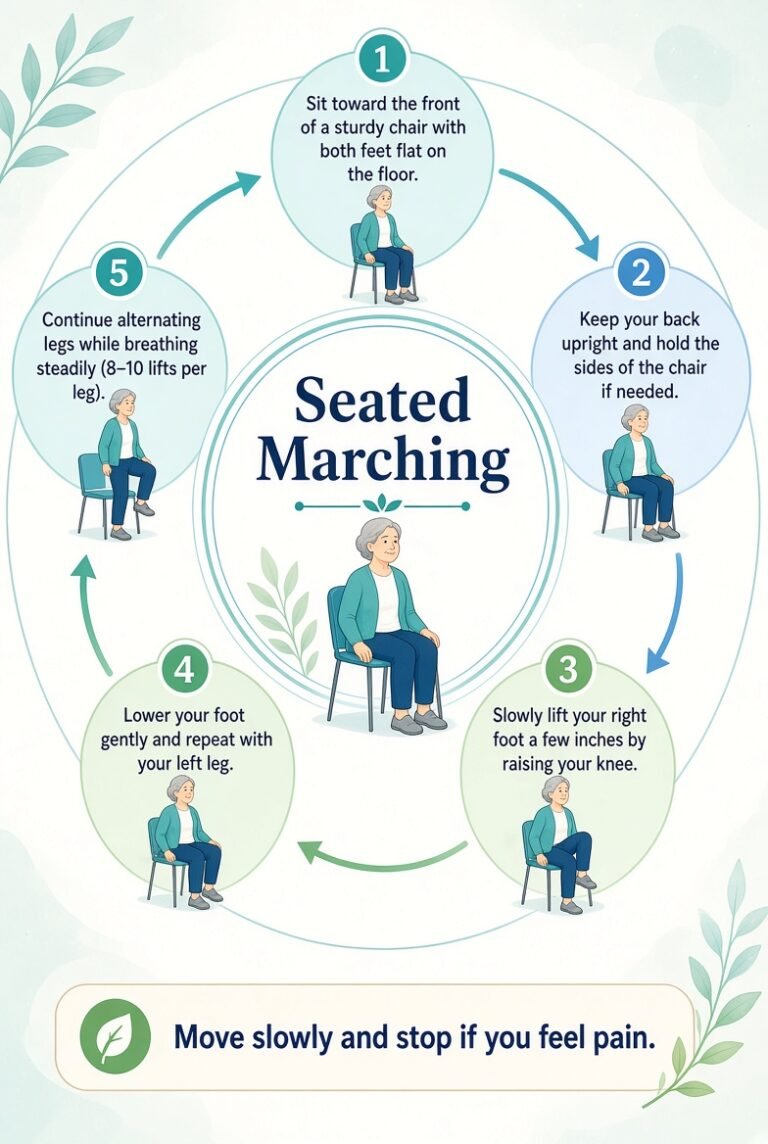
1. Seated Marching
Best for: Beginners, morning stiffness, and gentle hip movement.
Seated marching is a practical starting point if standing exercises feel difficult or you want a movement you can perform at home with minimal equipment.
It involves lifting one knee at a time, gently moving the hip through a comfortable range without requiring you to balance on one leg.
How to do it:
Sit toward the front of a sturdy chair with both feet flat on the floor.
Keep your back comfortably upright and hold the sides of the chair if needed.
Slowly lift your right foot a few inches from the floor by raising your knee.
Lower your foot gently and repeat with your left leg.
Continue alternating legs while maintaining steady breathing.
Repetitions: 8–10 lifts per leg.
Helpful tip: Lift only as high as feels comfortable. If raising your knee causes pinching in the front of your hip, reduce the height or stop the movement.
2. Seated Hip External Rotation
Best for: Gentle hip rotation and flexibility around the outer hip.
Your hips need to rotate during many everyday movements, including changing direction while walking and positioning your legs when sitting.
This exercise introduces controlled outward rotation without requiring you to stand.
How to do it:
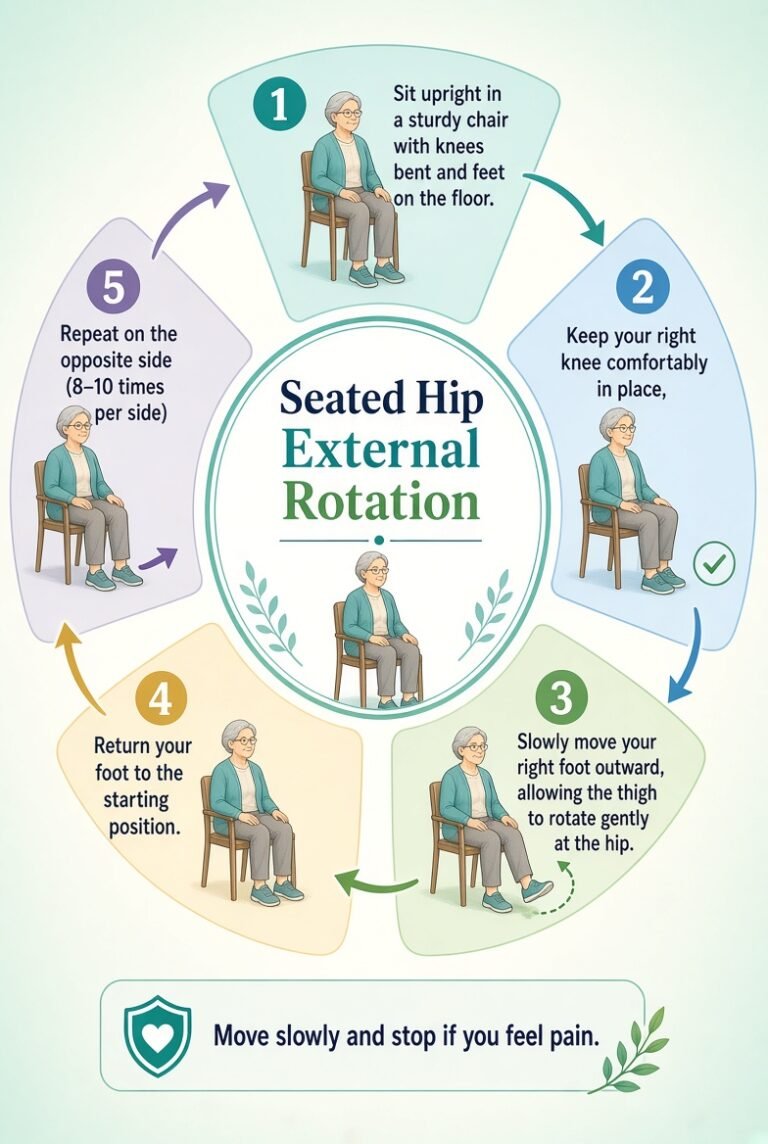
Sit upright in a sturdy chair with your knees bent and feet resting on the floor.
Keep your right knee comfortably in place.
Slowly move your right foot outward, allowing your thigh to rotate gently at the hip.
Return your foot to its starting position.
Repeat on the opposite side.
Repetitions: 8–10 times per side.
Helpful tip: Keep the movement small and controlled. Do not force your knee or twist your lower back to increase the range.
3. Standing Hip Circles With Chair Support
Best for: Gentle multidirectional hip movement and coordination.
Standing hip circles allow you to explore small, controlled movements around the hip joint. Using a stable support makes this exercise easier to manage if your balance is limited.
How to do it:
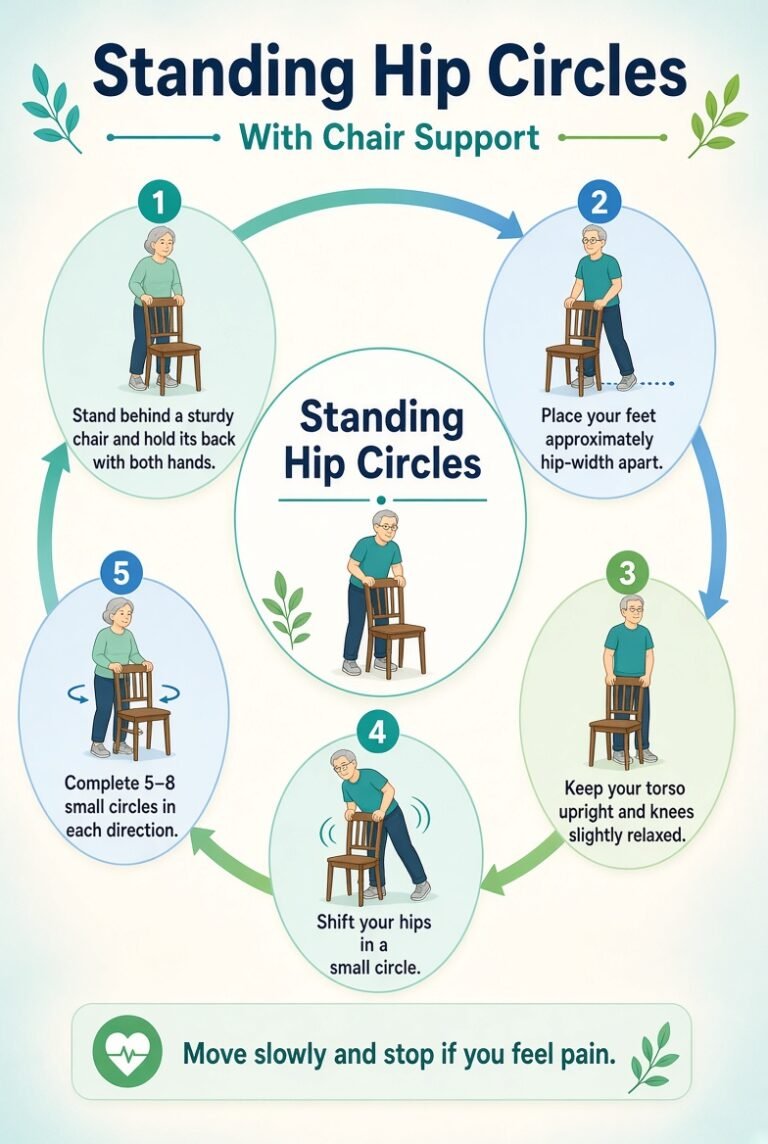
Stand behind a sturdy chair and hold its back with both hands.
Place your feet approximately hip-width apart.
Keep your torso upright and your knees slightly relaxed.
Shift your hips gently in a small circle.
Complete several circles in one direction, then reverse the direction.
Repetitions: 5–8 small circles in each direction.
Helpful tip: Keep your feet planted and avoid making large circles. The goal is controlled movement, not stretching as far as possible.
4. Supported Standing Hip Abduction
Best for: Hip mobility, lateral leg movement, and hip muscle activation.
Hip abduction means moving your leg away from the centre of your body. Practising this movement can help you work on the side-to-side control used during walking and other everyday activities.
Unlike a passive stretch, this exercise also engages the muscles around your hip.
How to do it:
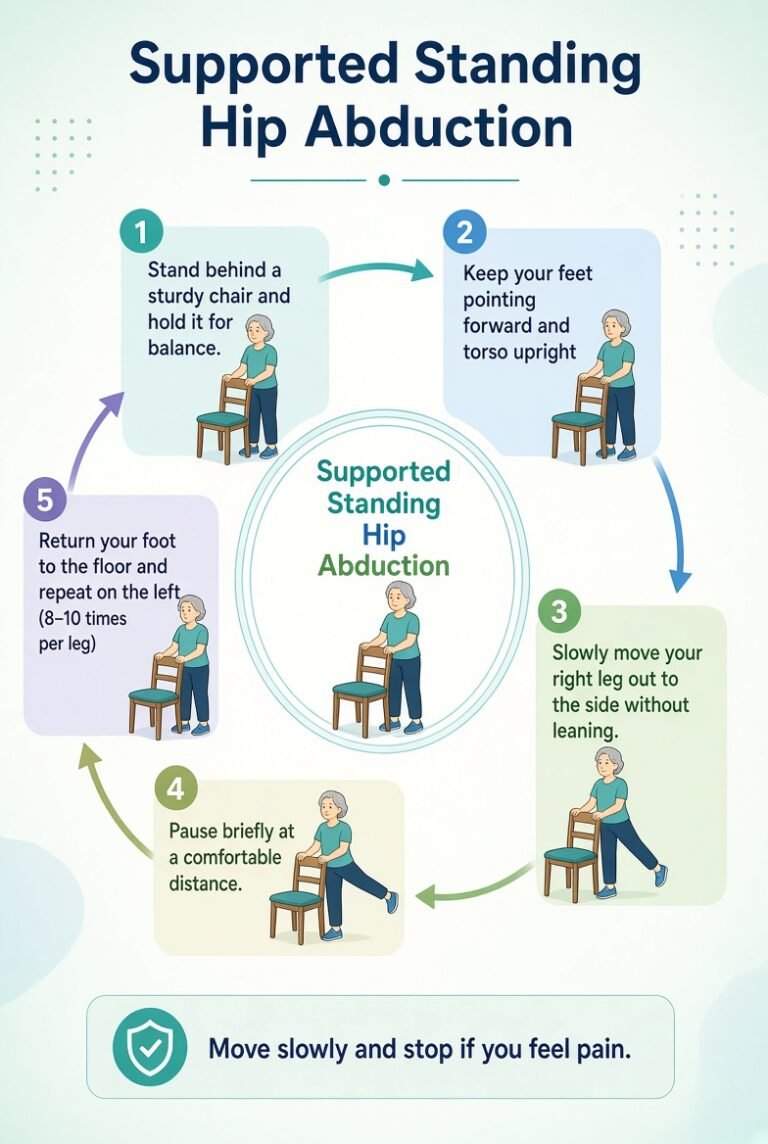
Stand behind a sturdy chair and hold it for balance.
Keep your feet pointing forward and your torso upright.
Slowly move your right leg out to the side without leaning your body.
Pause briefly at a comfortable distance.
Return your foot to the floor and repeat on the left.
Repetitions: 8–10 times per leg.
Helpful tip: Move your leg only a short distance. Avoid turning your toes outward or lifting your leg so high that your body leans to the opposite side.
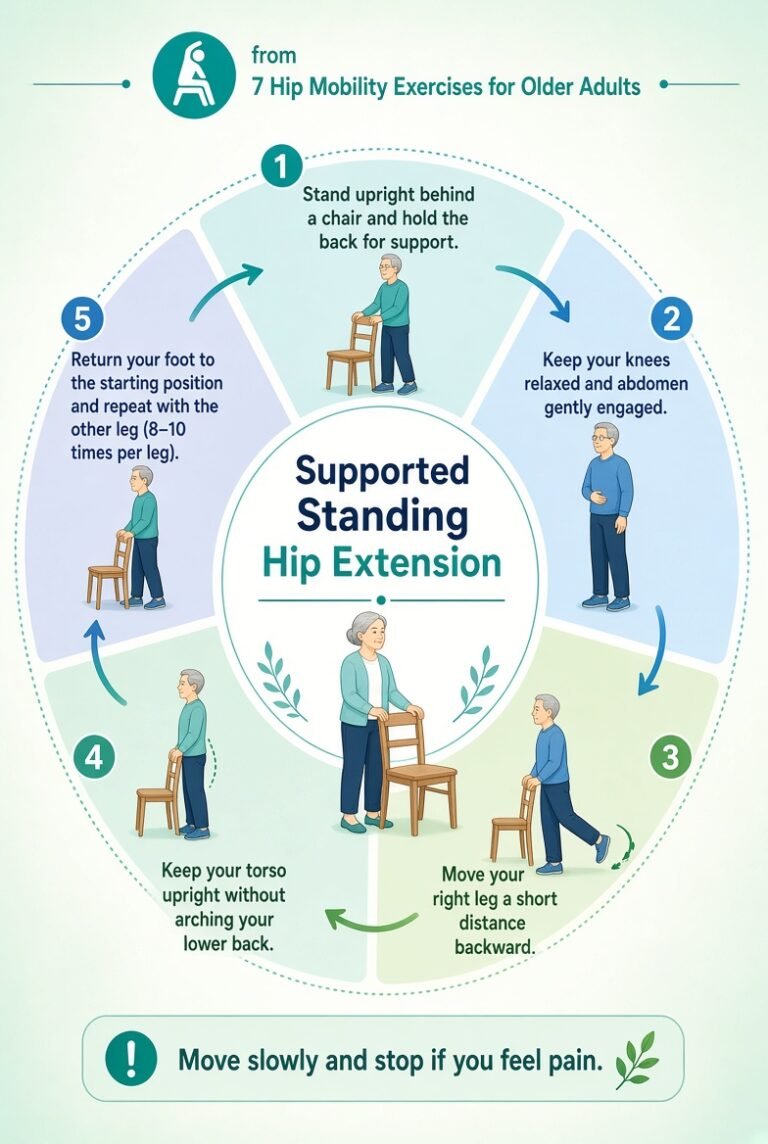
5. Supported Standing Hip Extension
Best for: Practising backward hip movement and activating the gluteal muscles.
Hip extension occurs when your thigh moves backward relative to your pelvis. This movement is important during walking, particularly as your body moves forward over your supporting leg.
How to do it:
Stand upright behind a chair and hold the back for support.
Keep your knees relaxed and your abdomen gently engaged.
Move your right leg a short distance backward.
Keep your torso upright without arching your lower back.
Return your foot to the starting position and repeat with the other leg.
Repetitions: 8–10 times per leg.
Helpful tip: Think about moving from your hip rather than bending your back. A small movement is sufficient.
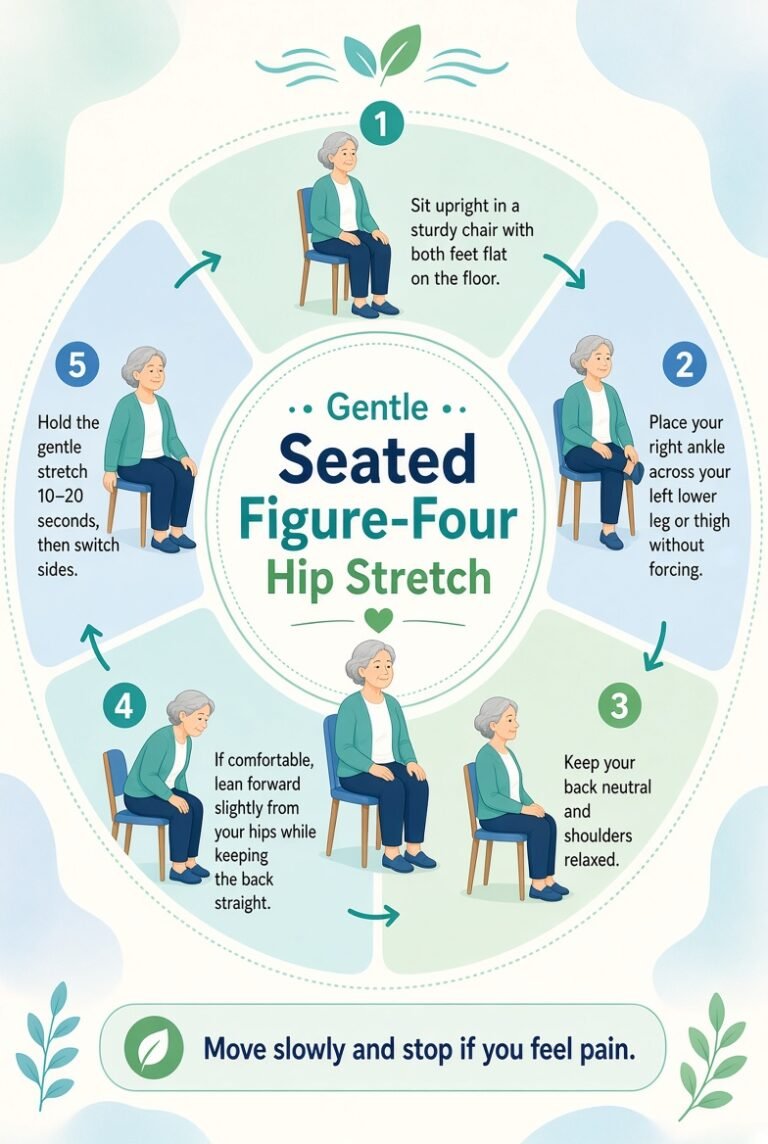
6. Gentle Seated Figure-Four Hip Stretch
Best for: Gentle stretching around the outer hip and buttock.
Prolonged sitting can make some people feel tight around the hips and buttocks. A modified seated figure-four stretch may help you work on flexibility in this area.
However, this stretch is not suitable for everyone, especially people with significant hip joint pain or movement restrictions.
How to do it:
Sit upright in a sturdy chair with both feet flat on the floor.
If comfortable, place your right ankle across your left lower leg or thigh, without forcing the position.
Keep your back neutral and your shoulders relaxed.
If the position feels comfortable, lean forward slightly from your hips while keeping your back relatively straight.
Hold the gentle stretch, then return upright and switch sides.
Duration: Hold for 10–20 seconds per side, if comfortable.
Helpful tip: Do not press down on your knee to deepen the stretch. If crossing your legs causes pain, pinching, or difficulty maintaining balance, skip this exercise.
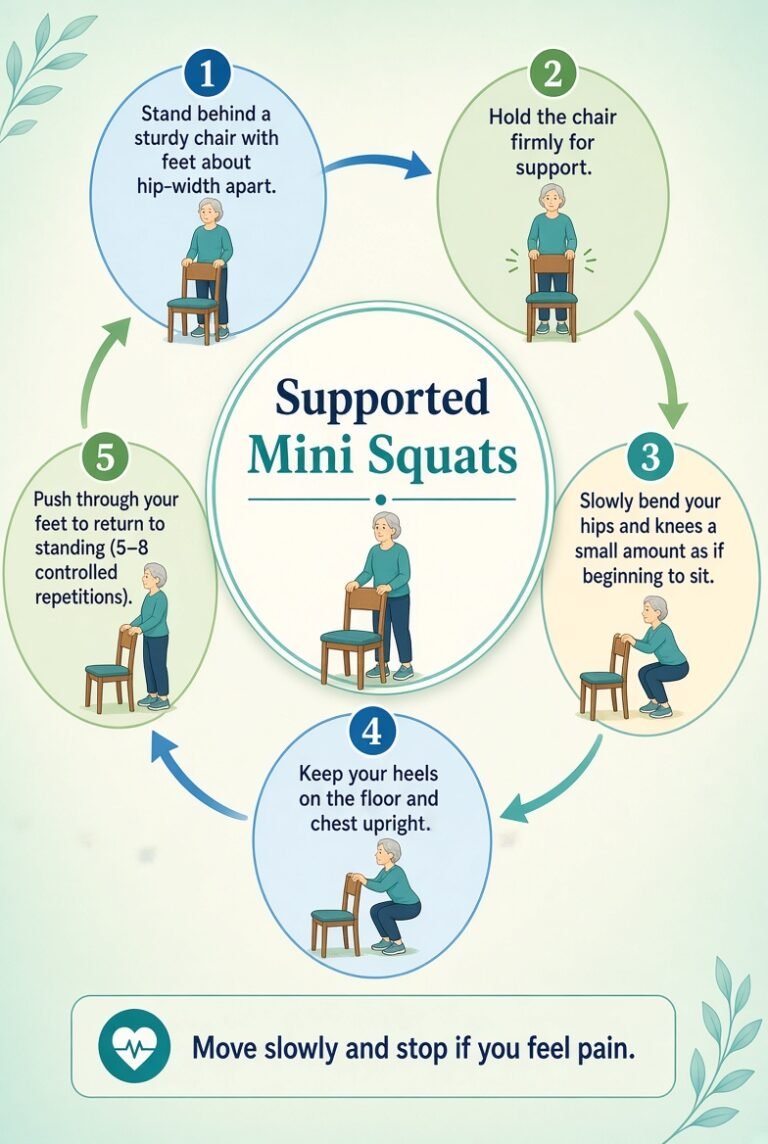
7. Supported Mini Squats
Best for: Combining hip movement with functional leg strength.
Mobility alone does not provide all the support your hips need for daily life. Your hip, thigh, and buttock muscles also help you stand up, sit down, and manage stairs.
Supported mini squats let you practise a small amount of hip and knee bending while holding a stable surface.
How to do it:
Stand behind a sturdy chair with your feet about hip-width apart.
Hold the chair firmly for support.
Slowly bend your hips and knees a small amount, as if beginning to sit down.
Keep your heels on the floor and your chest comfortably upright.
Push through your feet to return to standing.
Repetitions: 5–8 controlled repetitions.
Helpful tip: Keep the movement shallow and comfortable. Do not squat deeply or continue if your hip or knee pain increases.
A Simple 10-Minute Daily Hip Mobility Routine
You do not need to perform all seven exercises every day. Instead, begin with a short routine that includes comfortable movement, gentle stretching, and a little muscle activation.
Here is one way to organise the exercises.
| Exercise | Suggested amount |
|---|---|
| Seated marching | 1 minute |
| Seated hip external rotation | 1 minute |
| Standing hip circles | 1 minute |
| Supported hip abduction | 2 minutes |
| Supported hip extension | 2 minutes |
| Seated figure-four stretch, if comfortable | 1 minute |
| Supported mini squats | 1–2 minutes |
Move at your own pace, resting whenever necessary. The time estimates are flexible rather than strict targets, and you can shorten the routine if you become tired.
For your first few sessions, you might choose just three exercises: seated marching, seated hip rotation, and supported hip abduction. Once those movements feel comfortable, gradually introduce other options.
Best Daily Hip Mobility Exercises: Morning vs Evening
The best time to practise hip mobility depends on your daily schedule and how your body feels.
Morning hip mobility
If your hips feel stiff after sleeping, begin with gentle seated marching and controlled hip rotation. These movements allow you to start slowly before moving into more demanding activities.
Avoid forcing a deep stretch immediately after getting out of bed. Instead, use a comfortable range and increase movement gradually.
Evening hip mobility
Gentle movement in the evening may be useful if you have been sitting or standing for much of the day. Choose relaxed movements and avoid stretches that aggravate your symptoms.
If hip pain repeatedly wakes you at night, becomes worse when lying on one side, or persists despite changing positions, seek medical advice rather than relying solely on stretching.
Hip Mobility Exercises for Lower Back Pain: What Should You Know?
Hip movement and lower-back movement are related because your pelvis and spine work together during walking, bending, and standing.
For some people, limited hip movement may contribute to uncomfortable movement patterns. However, lower-back pain can have many causes, and hip stiffness is not necessarily the underlying problem.
If you experience lower-back discomfort alongside hip stiffness, consider beginning with gentle seated marching and small, supported hip movements.
During each exercise:
Keep your spine in a comfortable, neutral position.
Avoid forcing your pelvis forward or arching your lower back.
Reduce the movement range if discomfort develops.
Stop if pain spreads down your leg or symptoms become worse.
Exercises should be selected according to the cause and nature of your symptoms. If your back pain is persistent, severe, or accompanied by new leg weakness, numbness around the groin, or changes in bladder or bowel control, seek urgent medical assessment.
For related guidance, read our [Knee and Hip Pain Relief Exercises] pillar page.
Best Knee and Hip Mobility Exercises for Everyday Movement
Your hips and knees work together when you walk, climb stairs, stand from a chair, and bend to pick something up.
For that reason, a balanced routine can include comfortable hip movements alongside appropriate knee exercises.
For example:
Seated marching: Gently moves the hips while you remain seated.
Supported hip abduction: Practises moving your leg sideways and activates the muscles around your hip.
Supported mini squats: Combines hip and knee bending with functional leg strength.
Choose movements that suit your current ability rather than assuming every exercise is appropriate for every joint condition.
If knee pain is also affecting your daily activities, explore our related guide to knee arthritis exercises for seniors
Similarly, readers who want to explore gentle movements for hip discomfort can continue to Hip Pain Exercises for Seniors
Do You Need Equipment for Hip Mobility Exercises?
Most of the exercises in this guide require little or no equipment. A stable chair is usually enough to get started.
Nevertheless, a few basic items may be helpful if you want to create a more comfortable home exercise space.
1. A sturdy chair
A chair without wheels and with a stable back can provide support during seated and standing movements.
Choose a chair that allows you to sit down and stand up safely. Avoid lightweight folding chairs or unstable furniture for balance support.
2. A non-slip exercise mat
A non-slip mat may provide a comfortable surface for certain floor-based exercises. However, standing exercises should be performed on a firm, stable surface where you can maintain balance.
Do not use a thick or loose mat that shifts beneath your feet.
3. A foam roller
Foam rollers are sometimes used for self-massage around the thigh and buttock muscles. They are not necessary for the exercises in this guide, and rolling directly over a painful hip joint will not improve joint mobility.
Amazon Affiliate Disclosure: As an Amazon Associate, I earn from qualifying purchases. This means that if you click on an Amazon link on this page and make a purchase, I may earn a commission at no additional cost to you.
How Often Should Older Adults Do Hip Mobility Exercises?
There is no single frequency that works for everyone. A short routine performed regularly may be a practical starting point, provided the movements are appropriate for your health and ability.
For example, you could begin with five to ten minutes of gentle movement on several days each week. If you tolerate it well, you may gradually practise comfortable mobility exercises more frequently.
Strength-focused exercises may require a different schedule depending on their intensity, your recovery, and any existing joint conditions.
Pay attention to how you feel during the session and later that day. If discomfort consistently increases after exercise, reduce the intensity or stop the aggravating movement and consult a healthcare professional.
Over time, you can adjust your routine based on your mobility, balance, strength, and everyday goals
Frequently Asked Questions About Hip Mobility Exercises for Older Adults
1. What are the best hip mobility exercises for older adults?
Seated marching, seated hip rotation, supported hip abduction, gentle standing hip circles, and supported hip extension are useful starting options for many older adults. The best exercises depend on your balance, joint comfort, mobility, and medical history.
2. Can seniors do hip mobility exercises every day?
Some gentle mobility movements may be suitable for daily practice if they are comfortable and appropriate for your condition. Start with a manageable amount, allow recovery when needed, and avoid movements that increase pain.
3. What are the best beginner hip mobility exercises?
Seated marching and gentle seated hip rotation are accessible options because they can be performed without standing on one leg. Once you feel comfortable, you may add supported standing movements using a sturdy chair.
4. Do hip mobility exercises help with hip pain?
They may help some people maintain movement and improve their ability to perform daily activities. However, results depend on the cause of the pain. Exercises do not cure every hip condition, and persistent or worsening symptoms need professional assessment.
5. Can hip mobility exercises help lower-back pain?
Some people with lower-back discomfort may benefit from appropriate hip movement and strengthening. However, lower-back pain has multiple possible causes, so exercises should be selected according to your symptoms and physical needs.
Maintaining comfortable hip movement can help you stay engaged in the everyday activities that matter to you. The key is to choose exercises that match your current ability and perform them with control rather than trying to achieve a deep stretch or a large range of motion.
Start with seated marching and gentle hip rotation. As your confidence improves, you can gradually introduce supported standing exercises and suitable strength movements.
Most importantly, listen to your body. Hip mobility exercises for older adults should support comfortable movement, not force you through pain.
For more guidance, visit our Knee and Hip Pain Relief Exercises pillar page and explore our related Hip Pain Exercises for Seniors article for additional information about movement and managing hip discomfort.
Disclaimer: This article is for educational purposes only and is not a substitute for individual medical advice, diagnosis, or treatment. Consult a qualified healthcare professional before starting a new exercise programme if you have significant pain, a recent injury or surgery, or a medical condition that affects your mobility.