
Knee pain can make everyday activities feel more difficult than they used to. Getting out of bed, climbing stairs, standing up from a chair, or taking a short walk may become uncomfortable, especially when your knees feel stiff after sitting for a long time.
However, avoiding all movement is not always the answer. For many older adults, gentle movement and appropriate strengthening exercises can help maintain mobility, support the muscles around the knee, and make daily activities easier.
That is where chair yoga for knee pain may help. By using a sturdy chair for support, you can practice gentle stretches and controlled movements without having to kneel, get down on the floor, or maintain challenging standing poses.
In this guide, you will learn eight gentle chair yoga poses, how to perform them safely at home, which movements to avoid when your knees hurt, and how to choose a supportive chair for your routine.
Whether you are dealing with age-related stiffness, knee osteoarthritis, or discomfort after prolonged sitting, the goal is to help you move with greater confidence while respecting your body’s limits.
Important: Chair yoga is not a treatment for every cause of knee pain. If your knee is swollen, recently injured, unstable, or painful during ordinary movement, seek advice from a healthcare professional before starting a new exercise routine.
Explore our Gentle Living Picks for comfort and care
Affiliate disclosure: As an Amazon Associate, we may earn from qualifying purchases at no additional cost to you.
What Is Chair Yoga for Knee Pain?
Chair yoga is a modified form of yoga that uses a chair to provide support during gentle stretches, mobility exercises, breathing practices, and selected strengthening movements.
Unlike traditional yoga, chair-based exercises do not require you to kneel, squat deeply, or balance on one leg. As a result, they may be more accessible to seniors and people who find floor exercises uncomfortable.
When adapted appropriately, chair yoga for knee pain can focus on three important goals:
Improving mobility: Gentle knee movements help you practice bending and straightening your legs within a comfortable range.
Supporting leg strength: Controlled movements can activate the quadriceps, hamstrings, and other muscles that help support the knee joint.
Maintaining flexibility: Comfortable stretching can help reduce the feeling of stiffness associated with prolonged sitting.
Nevertheless, not every yoga pose is suitable for painful knees. Deep knee bends, forced stretches, and positions that place excessive pressure on the joint may aggravate symptoms.
Is Chair Yoga Good for Bad Knees?
Yes, chair yoga may be helpful for some people with painful or stiff knees, particularly when it includes gentle mobility exercises and appropriate muscle strengthening.
For example, seated knee extensions allow you to straighten one leg without supporting your full body weight on that knee. Gentle heel slides and hamstring stretches can also help maintain comfortable movement.
However, the benefits depend on the underlying cause of your pain. Someone with mild osteoarthritis may tolerate gentle movement well, while a person with an acute ligament injury, a severely swollen knee, or a recent knee replacement may need a different exercise plan.
If you have knee arthritis, regular low-impact activity and strengthening are commonly recommended as part of conservative management. Chair yoga can be one way to begin moving, although it should not replace a personalized rehabilitation program when one is needed.
A useful rule: Exercise should feel controlled and manageable, not sharp, forceful, or increasingly painful. Stop if your symptoms worsen.
8 Chair Yoga Poses for Knee Pain
You do not need special yoga equipment to begin. A sturdy chair, comfortable clothing, and a little space around you are enough.
Before starting, choose a chair without wheels and place it on a level, nonslip surface. Sit upright with your feet supported, and avoid pushing your knees into painful positions.
1. Seated Knee Extensions
Best for: Gentle knee mobility and quadriceps activation.
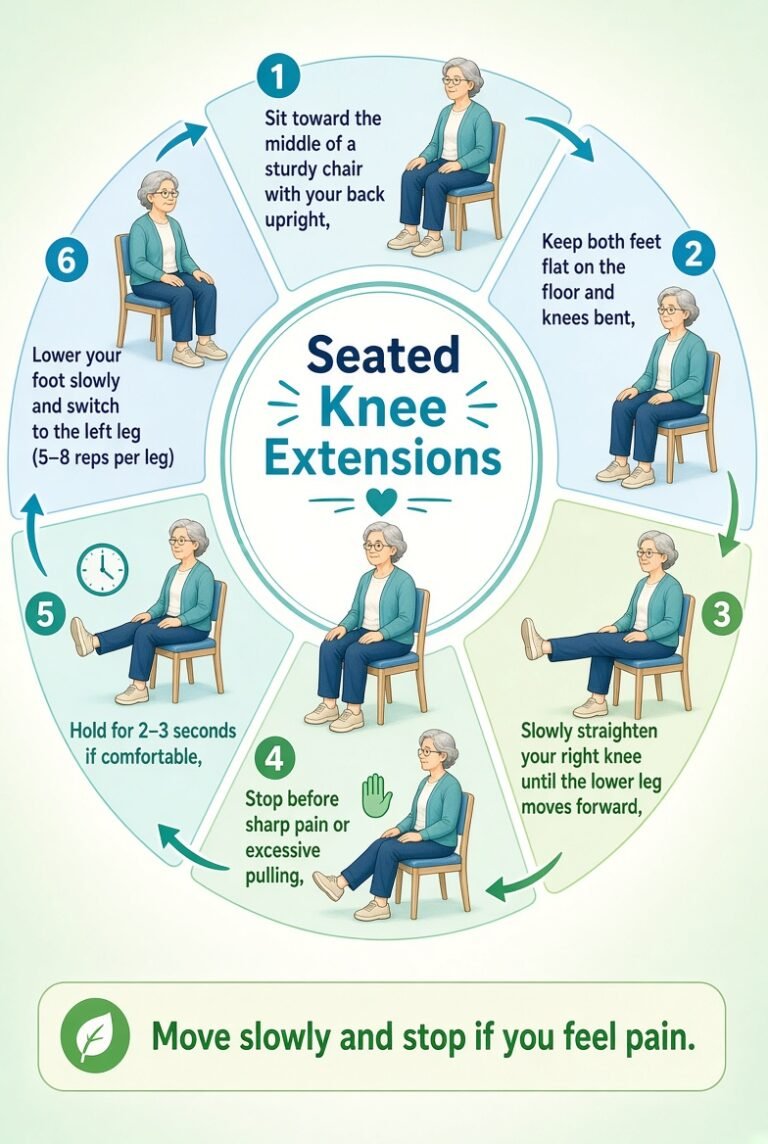
Seated knee extensions are a practical starting point because they allow you to practice straightening your knee while keeping your body supported.
How to do it:
Sit toward the middle of a sturdy chair with your back comfortably upright.
Keep both feet flat on the floor and your knees bent.
Slowly straighten your right knee until your lower leg moves forward.
Stop before you feel sharp pain or excessive pulling.
Hold for two to three seconds if comfortable.
Lower your foot slowly and repeat with the left leg.
Suggested starting amount: 5–8 repetitions per leg.
2. Seated Heel Slides
Best for: Practicing comfortable knee bending and straightening.
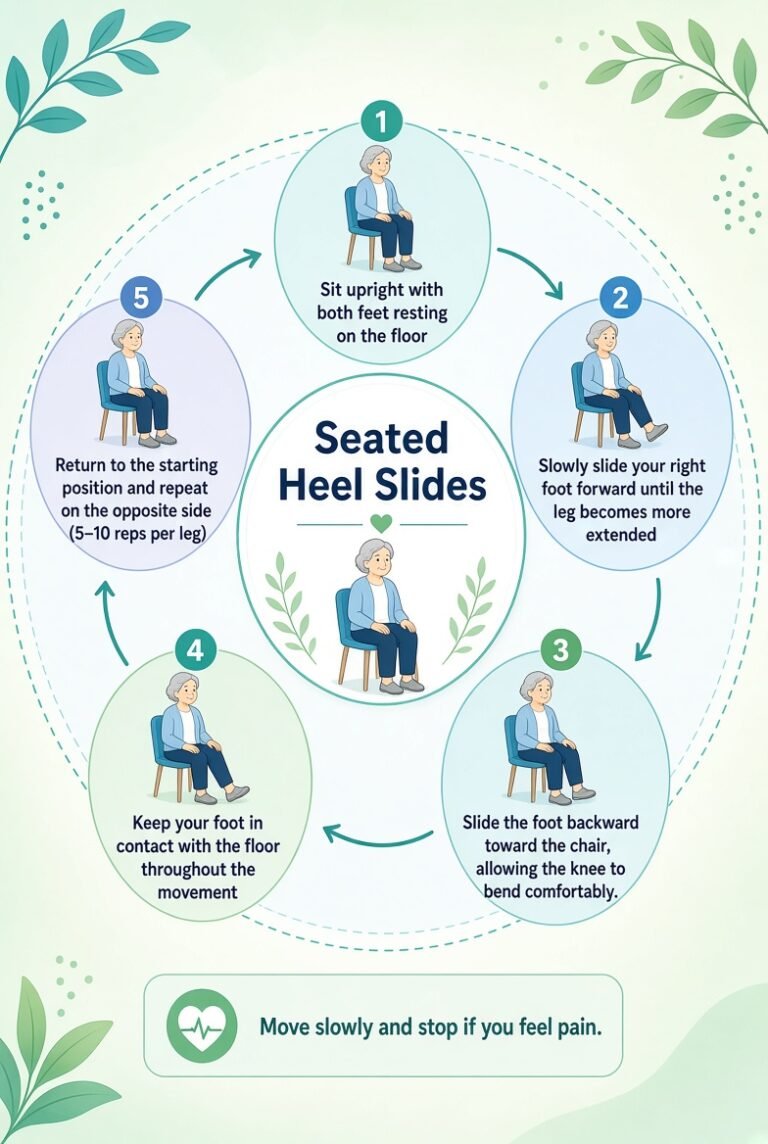
Heel slides are commonly used in rehabilitation because they allow controlled movement without requiring you to stand.
How to do it:
Sit upright with both feet resting on the floor.
Slowly slide your right foot forward until the leg becomes more extended.
Then slide the foot backward toward the chair, allowing your knee to bend comfortably.
Keep your foot in contact with the floor throughout the movement.
Return to the starting position and repeat on the opposite side.
Suggested starting amount: 5–10 repetitions per leg.
Why it may help: This movement allows you to practice knee flexion and extension in a supported position.
3. Seated Hamstring Stretch
Best for: Gentle stretching of the muscles at the back of the thigh.
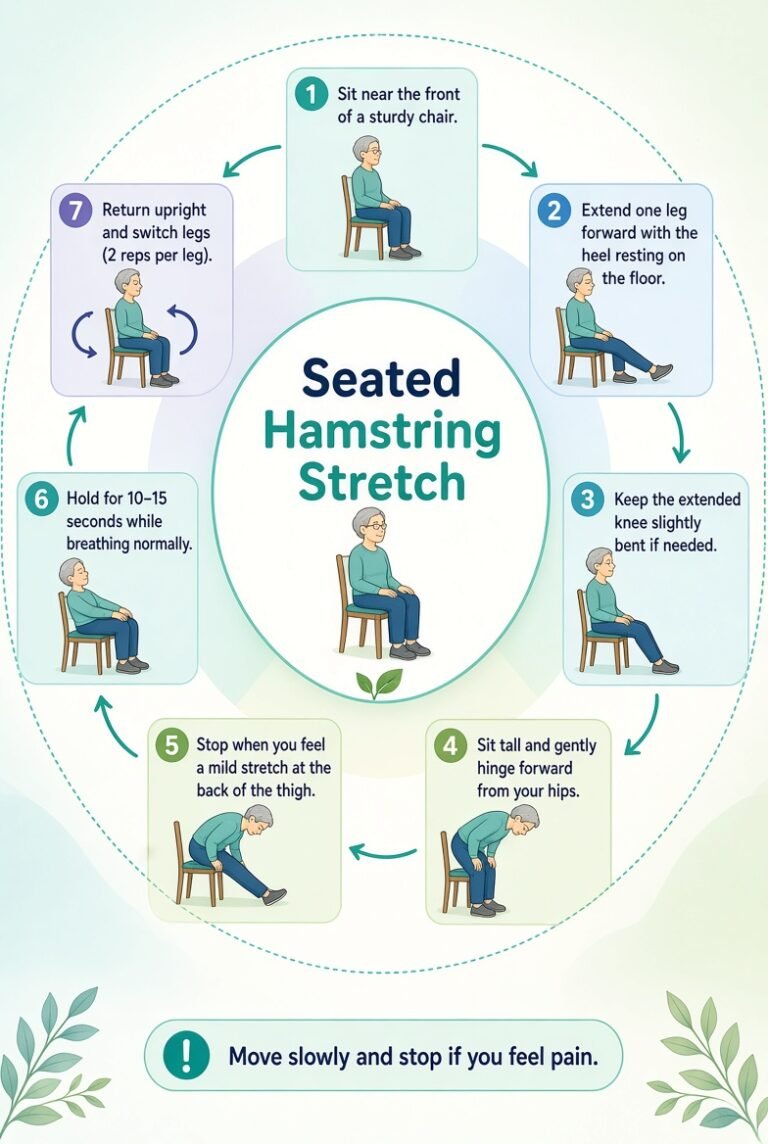
Tight hamstrings can make certain leg movements feel restricted. A comfortable stretch may help maintain flexibility without placing you in a deep squat or standing yoga pose.
How to do it:
Sit near the front of a sturdy chair.
Extend one leg forward with the heel resting on the floor.
Keep the extended knee slightly bent if fully straightening it feels uncomfortable.
Sit tall and gently hinge forward from your hips.
Stop when you feel a mild stretch at the back of your thigh.
Hold for 10–15 seconds while breathing normally.
Return upright and switch legs.
Suggested starting amount: 2 repetitions per leg.
Why it may help: Maintaining comfortable hamstring flexibility can support everyday movement and complement a broader knee exercise routine.
4. Seated Heel Raises
Best for: Activating the calf muscles and practicing controlled ankle movement.
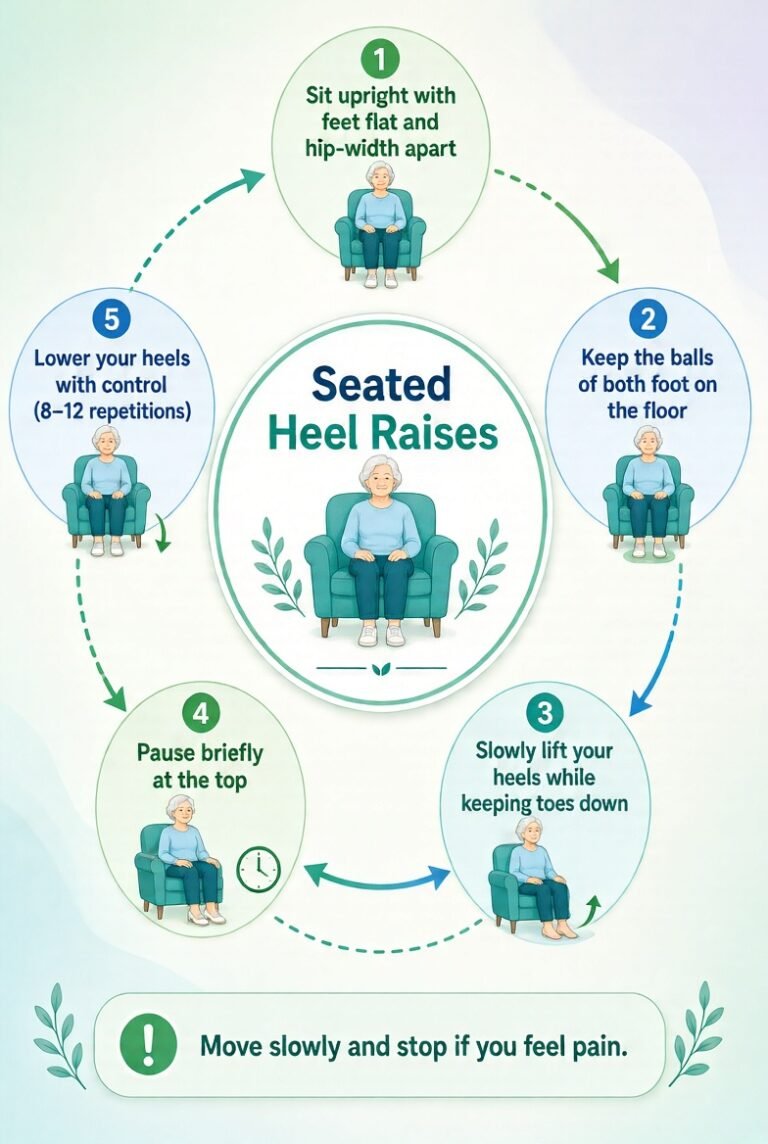
Although heel raises do not directly strengthen every muscle around the knee, calf function contributes to lower-leg movement during walking and other daily activities.
How to do it:
Sit upright with your feet flat and approximately hip-width apart.
Keep the balls of both feet on the floor.
Slowly lift your heels while keeping your toes down.
Pause briefly at the top.
Lower your heels with control.
Suggested starting amount: 8–12 repetitions.
Why it may help: The exercise activates the calf muscles and encourages comfortable ankle movement while you remain seated.
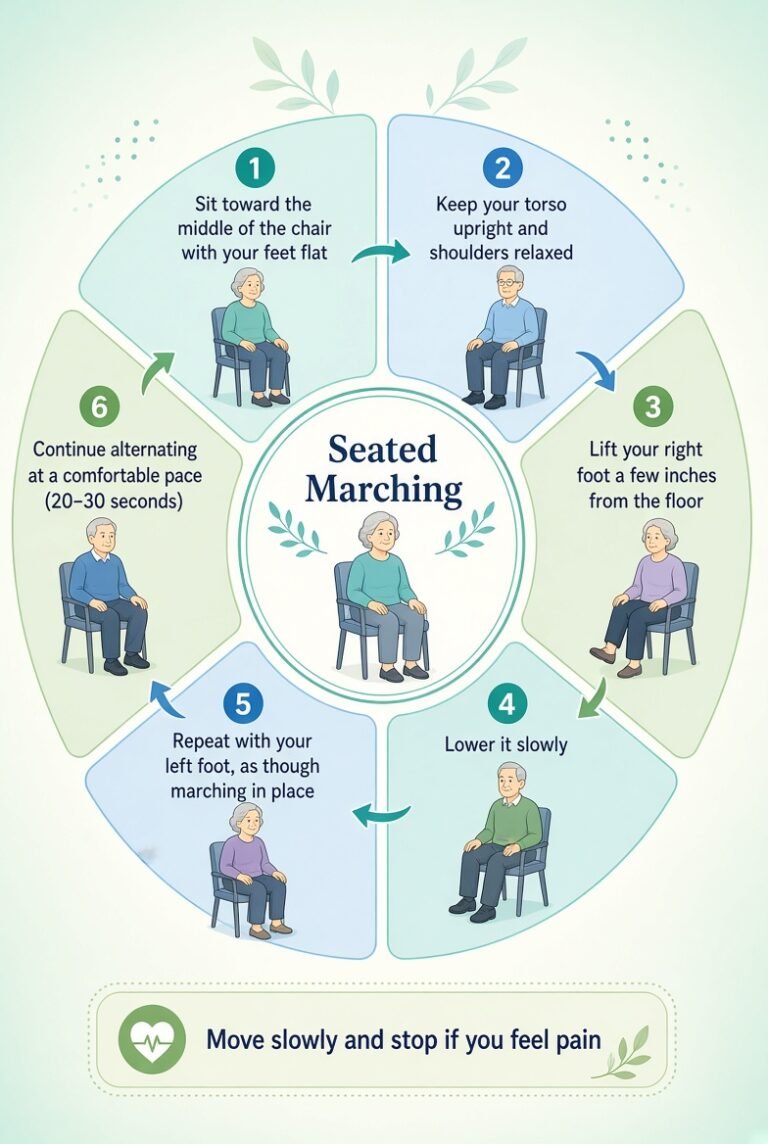
5. Seated Marching
Best for: Gentle hip movement and low-impact activity.
Seated marching is a simple option for people who want to move their legs without standing or placing their full body weight through their knees.
How to do it:
Sit toward the middle of the chair with your feet flat.
Keep your torso upright and your shoulders relaxed.
Lift your right foot a few inches from the floor.
Lower it slowly.
Repeat with your left foot, as though marching in place.
Continue alternating at a comfortable pace.
Suggested starting amount: 20–30 seconds.
Why it may help: Seated marching encourages hip movement and provides a gentle way to remain active.
6. Seated Quadriceps Tightening
Best for: Activating the muscles at the front of the thigh.
If bending your knee is uncomfortable, a gentle isometric exercise may be easier than a movement involving repeated bending.
How to do it:
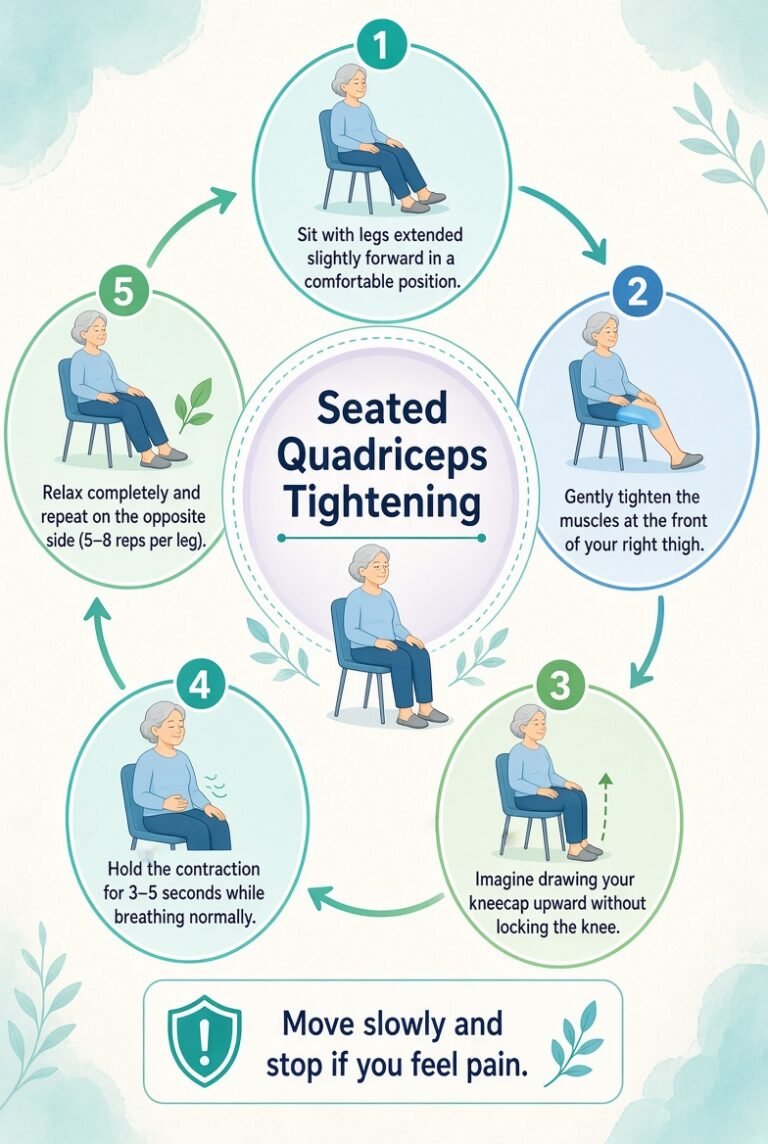
Sit with your legs extended slightly forward, or use a comfortable supported position.
Gently tighten the muscles at the front of your right thigh.
Imagine drawing your kneecap upward without forcing your knee into a locked position.
Hold the contraction for three to five seconds while breathing normally.
Relax completely and repeat on the opposite side.
Suggested starting amount: 5–8 repetitions per leg.
Why it may help: Quadriceps activation is an important component of many knee rehabilitation programs.
7. Seated Hamstring Curls
Best for: Practicing gentle movement of the muscles at the back of the thigh.
This exercise is a seated variation of a hamstring curl. It uses controlled foot movement rather than a standing position.
How to do it:
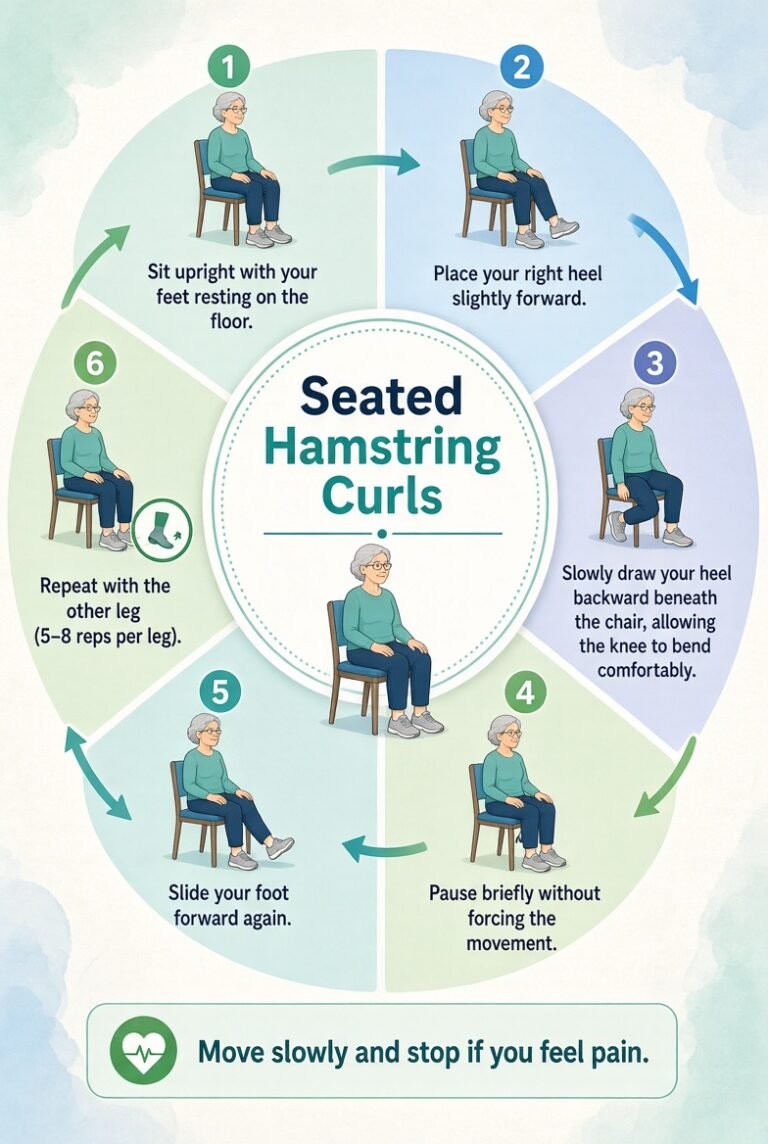
Sit upright with your feet resting on the floor.
Place your right heel slightly forward.
Slowly draw your heel backward beneath the chair, allowing your knee to bend within a comfortable range.
Pause briefly without forcing the movement.
Slide your foot forward again.
Repeat with the other leg.
Suggested starting amount: 5–8 repetitions per leg.
8. Seated Ankle Pumps
Best for: Gentle lower-leg movement and ankle mobility.
Ankle pumps are particularly convenient if you spend a lot of time sitting. They do not require repeated knee bending, making them a useful addition to a gentle movement routine.
How to do it:
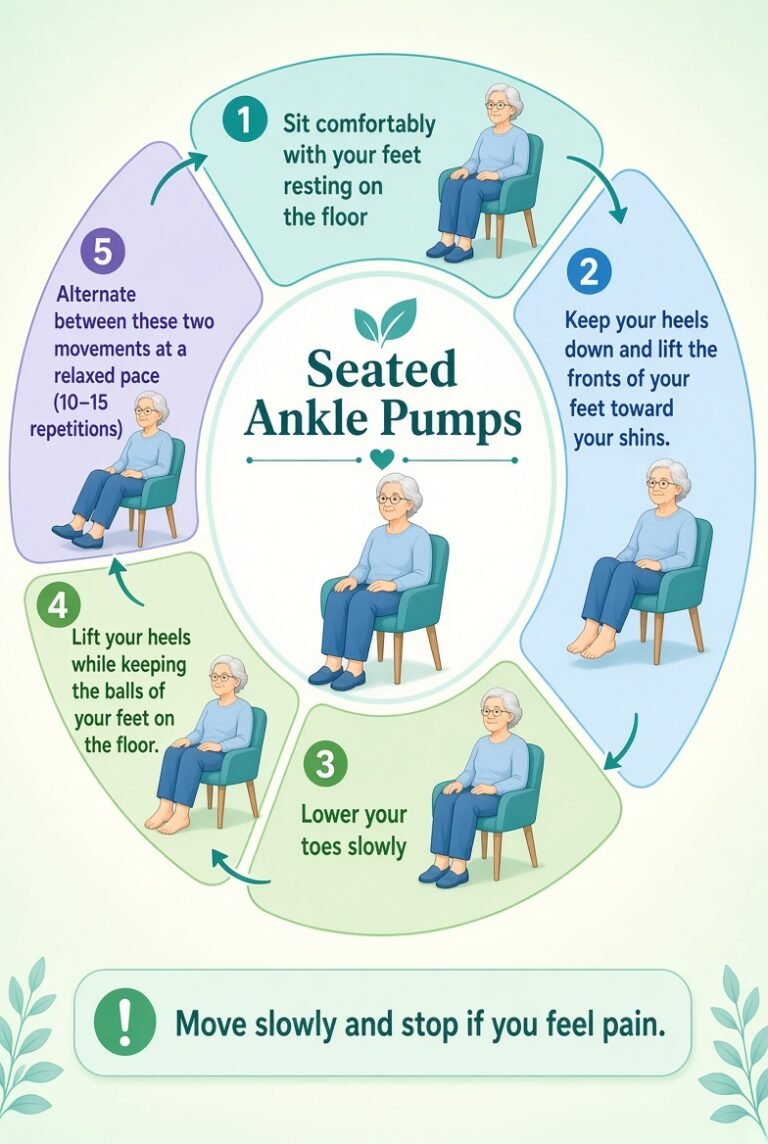
Sit comfortably with your feet resting on the floor.
Keep your heels down and lift the fronts of your feet toward your shins.
Lower your toes slowly.
Next, lift your heels while keeping the balls of your feet on the floor.
Alternate between these two movements at a relaxed pace.
Suggested starting amount: 10–15 repetitions.
Why it may help: Ankle pumps encourage ankle movement and activate the lower-leg muscles.
A Simple 10-Minute Chair Yoga Routine for Knee Pain
You do not have to perform every exercise in one session. Instead, begin with a short routine and adjust it according to your symptoms and ability.
| Time | Exercise | Main purpose |
|---|---|---|
| 1 minute | Relaxed breathing and comfortable sitting | Prepare for movement |
| 1 minute | Ankle pumps | Ankle mobility |
| 2 minutes | Seated knee extensions | Knee movement and quadriceps activation |
| 1 minute | Seated heel slides | Controlled knee bending |
| 1 minute | Seated marching | Gentle hip movement |
| 1 minute | Seated heel raises | Calf activation |
| 2 minutes | Gentle hamstring stretch | Thigh flexibility |
| 1 minute | Relaxed breathing and symptom check | Cool down |
You can take breaks between exercises whenever necessary. In addition, there is no requirement to finish the entire routine if your knees become uncomfortable.
Chair Yoga for Knee Pain for Seniors: How to Exercise Safely
Older adults may have different levels of strength, balance, flexibility, and joint mobility. Therefore, the safest routine is one that matches your current ability rather than one that follows a fixed number of repetitions.
Keep these precautions in mind:
Choose a stable chair. Avoid chairs with wheels, folding chairs that feel unstable, or seats that move when you lean forward.
Start with a comfortable range. You do not need to straighten or bend your knee completely to benefit from controlled movement.
Move slowly. Sudden movements can make it harder to control your joints.
Avoid forcing stretches. Mild tension may be acceptable, but sharp pain is a reason to stop.
Breathe normally. Avoid holding your breath while tightening your muscles.
Monitor your symptoms. Pay attention to new swelling, increased stiffness, or pain that continues after exercising.
Use support when necessary. If you have balance problems, remain seated rather than attempting standing yoga poses without appropriate supervision.
If you have osteoporosis, significant balance difficulties, a recent operation, or a diagnosed knee injury, ask your healthcare professional which movements are appropriate for you.
Chair Yoga for Knee Arthritis: Which Exercises May Help?
Knee osteoarthritis can cause pain, stiffness, and difficulty with activities such as walking, standing up, and climbing stairs. Appropriate exercise is often part of its management, but the type and intensity should reflect the person’s symptoms and physical function.
For some people with knee arthritis, gentle seated knee extensions, heel slides, quadriceps tightening, and ankle pumps are useful starting points.
However, a comfortable movement for one person may aggravate another person’s symptoms. Joint inflammation, the degree of stiffness, other health conditions, and previous injuries can all affect exercise tolerance.
Consider these general guidelines:
Choose gentle movement when your knee feels stiff after sitting.
Avoid repeatedly forcing a painful knee into deep flexion.
Reduce the range or repetitions if discomfort increases.
Ask a physiotherapist about progressive strengthening if weakness limits walking or standing.
Follow your clinician’s advice during an arthritis flare or after a change in symptoms.
Chair yoga can complement a broader exercise plan, but it is not a replacement for medical care or individualized rehabilitation.
For more targeted guidance, read our related article on knee pain relief with gentle exercises for seniors.
Chair Yoga for a Knee Injury: What Should You Know?
Chair-based exercises may be appropriate during some stages of knee rehabilitation. Nevertheless, the correct movements depend on the injured structure, the severity of the injury, and the stage of recovery.
For instance, a person recovering from a mild injury may eventually be able to perform controlled knee extensions. Someone with a suspected meniscus tear, ligament injury, fracture, or recent surgical repair may have restrictions on bending, straightening, or loading the joint.
Therefore, do not assume that every seated exercise is safe simply because it avoids standing.
If your knee injury is recent, seek medical advice before beginning a routine. Follow any restrictions provided by your clinician or physiotherapist, particularly regarding weight-bearing, knee flexion, and resistance.
Avoid exercising through significant pain, and do not use chair yoga to test whether an injured knee is ready to resume normal activity.
Chair Yoga for Knee Pain at Home vs. at the Gym
You can practice suitable chair-based exercises in either setting. The better choice depends on your comfort, access to equipment, and need for supervision.
At home: A stable chair and a small amount of space may be all you need. Home practice can make it easier to establish a consistent routine and take breaks when necessary.
At the gym: A qualified instructor or physiotherapist may help you modify movements, check your technique, and progress exercises appropriately. However, not every general yoga class is designed for people with knee pain.
If you attend a class, tell the instructor about your symptoms before beginning. Ask for seated alternatives to kneeling, deep squats, lunges, and other movements that place uncomfortable pressure on your knees.
Chair Yoga Poses for Knee Pain: Movements to Avoid or Modify
Not all yoga poses place the same demands on your knees. Some positions involve deeper bending, greater body-weight loading, or twisting that may be uncomfortable for someone with an irritated joint.
Depending on your condition, consider avoiding or modifying the following:
Deep chair pose: The traditional yoga chair pose involves bending the knees and lowering the hips, which can place substantial demand on the knee joints. It may be unsuitable during a painful flare or when deep bending aggravates symptoms.
Deep squats: These require substantial knee flexion and can be difficult for people with painful or stiff knees.
Kneeling poses: Floor-based positions may place direct pressure on the knee and can be difficult to enter or leave safely.
Deep lunges: These can place considerable demand on the front knee, particularly when the movement is deep or poorly controlled.
Twisting on a planted foot: Pivoting while the foot remains fixed can create unwanted rotational stress at the knee.
Forceful knee stretches: Pushing your knee beyond a comfortable range does not guarantee better flexibility and may aggravate symptoms.
Importantly, these movements are not universally harmful. Some people can perform modified versions safely. Your symptoms, diagnosis, and rehabilitation guidance should determine which exercises you use.
Is Chair Pose Good for Knees?
The traditional yoga chair pose is not the same as seated chair yoga. In the traditional pose, you bend your knees and lower your hips as though sitting on an imaginary chair.
For people with healthy knees and adequate strength, a properly performed chair pose may form part of a suitable exercise practice. However, it can be uncomfortable for people with knee osteoarthritis, an active injury, or pain during deep bending.
If you have bad knees, do not force yourself into the traditional pose. A seated knee extension or another comfortable chair-based exercise may be a more appropriate starting point.
If you are unsure whether the pose is suitable, ask a qualified physiotherapist or yoga instructor experienced in adapting exercises for joint conditions.
Explore our Gentle Living Picks for comfort and care
Affiliate disclosure: As an Amazon Associate, we may earn from qualifying purchases at no additional cost to you.
Other Exercises That May Complement Chair Yoga
Chair yoga can be a useful starting point, but some people need a broader program to address weakness, reduced walking tolerance, or difficulty with everyday activities.
Depending on your condition, a healthcare professional may recommend additional low-impact exercises or progressive strengthening.
You can explore these related resources on Senior Gentle Fitness:
Knee pain relief with gentle exercises for seniors — learn about gentle movement options for sore knees.
Frequently Asked Questions
1. Is chair yoga good for bad knees?
Chair yoga may help some people with bad knees by encouraging gentle movement, maintaining flexibility, and activating muscles that support the knee joint. Seated knee extensions, heel slides, and quadriceps tightening are possible starting options.
However, the suitability of these exercises depends on the cause and severity of your pain. If you have a recent injury, significant swelling, or worsening symptoms, seek medical advice before exercising.
2. Is chair pose good for knees?
Traditional yoga chair pose involves bending the knees while lowering the hips, so it may place more demand on the knee joints than seated chair yoga. People with painful arthritis, an acute injury, or discomfort during deep bending may need to avoid or modify it.
A supported seated exercise can be a more comfortable starting point. If you want to include the traditional pose, ask a qualified professional whether it is appropriate for your condition.
3. What are the best chair exercises for knee pain?
Suitable exercises vary from person to person, but gentle seated knee extensions, heel slides, quadriceps tightening, and ankle pumps are common options to discuss with a healthcare professional.
Start with a small range of motion and a manageable number of repetitions. Stop if the movement causes sharp pain or your symptoms worsen.
Final Thoughts: Start Gently and Build Consistency
Chair yoga for knee pain offers a practical way to explore gentle movement without immediately attempting demanding standing poses or floor exercises. For some seniors, simple movements such as seated knee extensions, heel slides, and quadriceps tightening can provide a manageable starting point.
Even so, the aim is not to push through pain or complete every exercise in one session. Choose movements that suit your current ability, progress gradually, and pay attention to how your knees respond.
If your symptoms persist, interfere with everyday activities, or become worse, consult a healthcare professional to identify the cause and develop an appropriate plan.
With the right modifications and realistic expectations, chair-based movement can become one useful part of a broader approach to maintaining mobility, strength, and independence as you age.
Disclaimer: This article is for general educational purposes and is not a substitute for individualized medical advice, diagnosis, or treatment. Consult a qualified healthcare professional before starting an exercise program if you have a knee injury, significant arthritis symptoms, recent surgery, or another condition that affects movement.