
Best Low Impact Strength Exercises for Seniors at Home
Staying strong after 60 does not require jumping, heavy barbells, or gym memberships. The best low impact strength exercises help seniors protect joints while building the muscle needed for everyday independence—standing from a chair, carrying groceries, or climbing stairs with confidence.
Age-related muscle loss (sarcopenia) starts earlier than many realize and accelerates after 60. Low impact strength training for seniors counters this gently. These moves improve balance, support bone density, ease joint stiffness, and boost energy without the pounding of high-impact workouts. Whether you are new to exercise or returning after a break, low impact strength exercises for seniors deliver real results right in your living room.
This guide focuses on practical, joint-friendly options you can start today. You will find clear exercise instructions, progression tips, recommended Amazon gear for low impact strength training at home, a sample routine, and answers to common questions. Internal links point to our pillar page on low impact exercises and related posts for deeper reading.
Affiliate Disclosure: SeniorGentleFitness may earn a commission from qualifying purchases made through links to Amazon, at no additional cost to you.
What Is Low Impact Strength Training?
Low impact strength training uses controlled resistance exercises without the repeated jumping, landing, or pounding associated with high-impact workouts.
The resistance can come from:
- Your body weight
- Resistance bands
- Light dumbbells
- Ankle weights
- Household objects
- Exercise machines
The goal is to challenge your muscles while keeping movements controlled.
Importantly, low impact does not mean that an exercise cannot be challenging. You can gradually increase repetitions, resistance, range of motion, or exercise duration as your strength improves.
Best Low Impact Strength Exercises You Can Do at Home
The best low impact strength exercises are movements that are simple to learn, easy to modify, and useful for everyday activities.
Here are several exercises you can incorporate into a home routine.
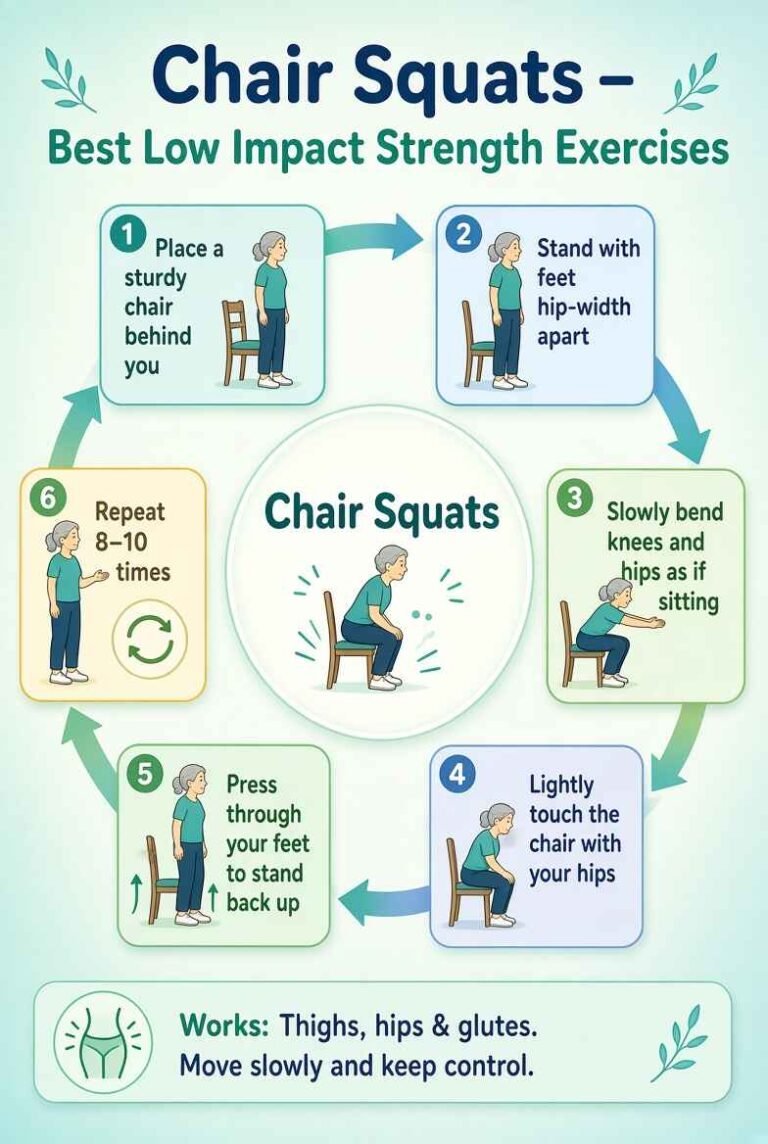
1. Chair Squats
Chair squats are a practical lower-body exercise for beginners and seniors.
Place a sturdy chair behind you and stand with your feet about hip-width apart.
Slowly bend your knees and hips as if you were going to sit down. Lightly touch the chair with your hips, then press through your feet to return to standing.
Start with: 8–10 repetitions.
Works: Thighs, hips, and glutes.
Beginner modification: Use your hands on a stable surface for additional support if needed.
2. Wall Push-Ups
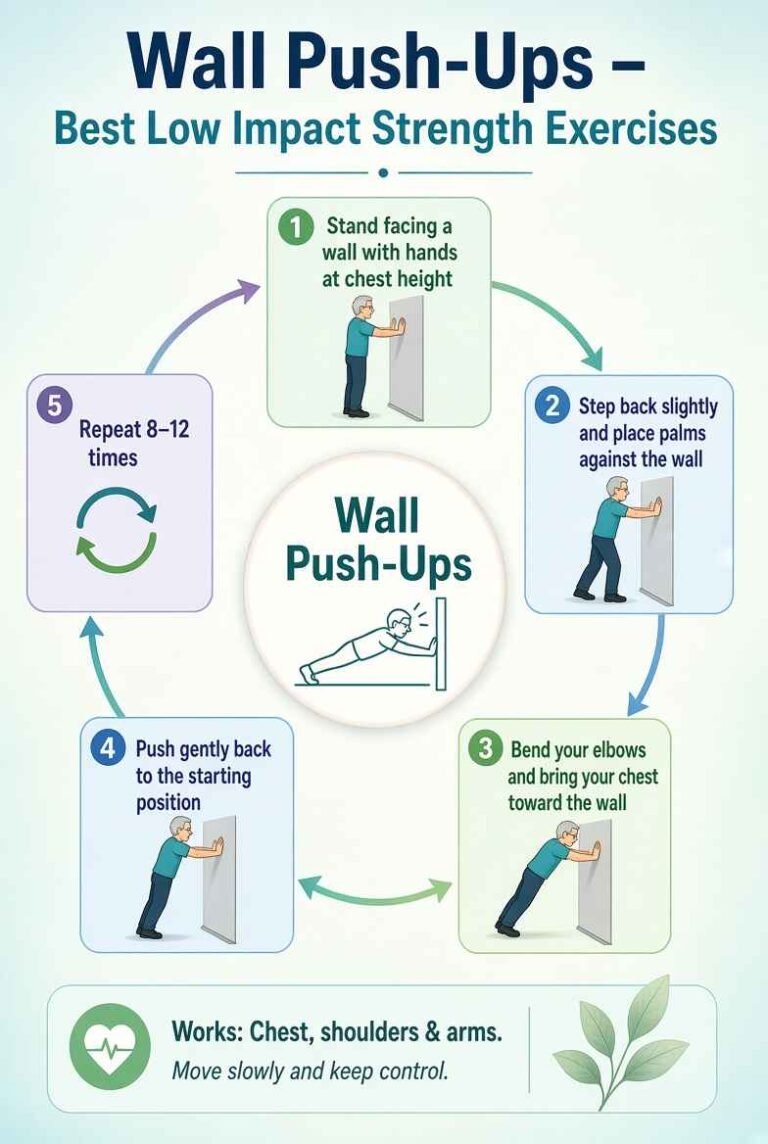
Wall push-ups are an easier alternative to traditional floor push-ups.
Stand facing a wall with your hands around chest height. Step back slightly and place your palms against the wall.
Bend your elbows and bring your chest toward the wall. Then push gently back to your starting position.
Start with: 8–12 repetitions.
Works: Chest, shoulders, and arms.
As you become stronger, you can move your feet farther from the wall to increase the challenge.
3. Seated Leg Extensions
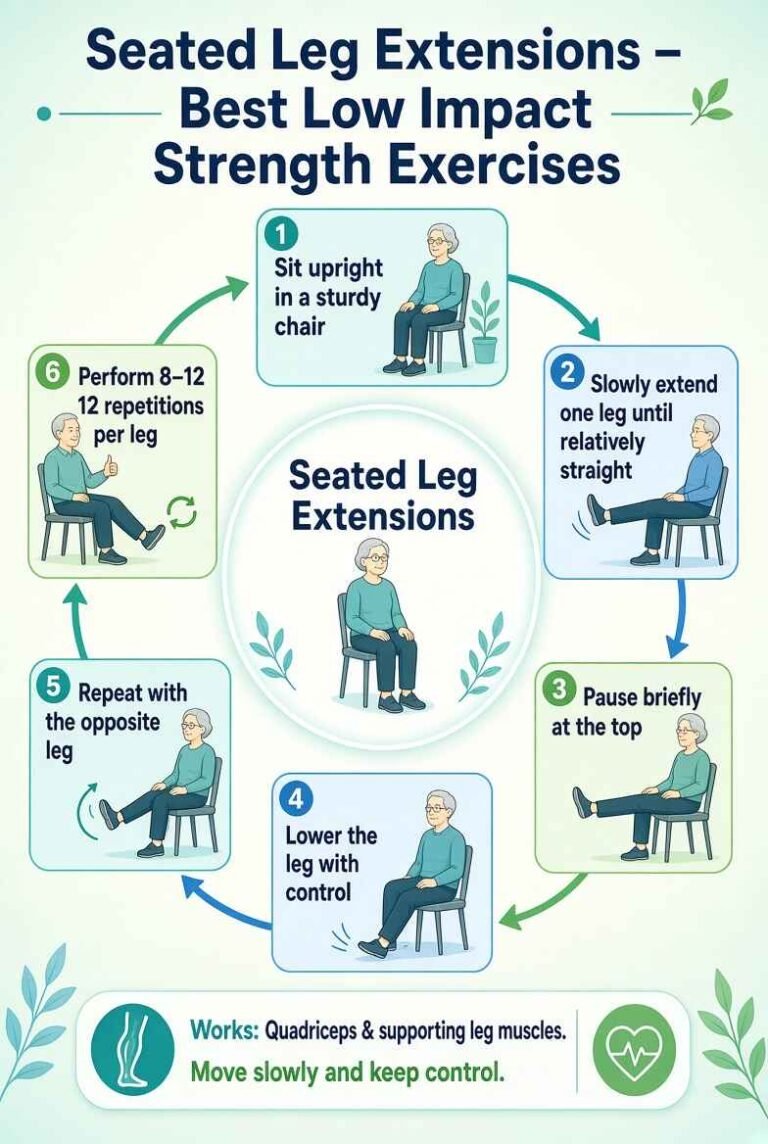
Seated leg extensions are a simple way to work the muscles at the front of your thighs.
Sit upright in a sturdy chair. Slowly extend one leg until it is relatively straight, pause briefly, and then lower it with control.
Repeat with the opposite leg.
Start with: 8–12 repetitions per leg.
Works: Quadriceps and supporting leg muscles.
4. Glute Bridges
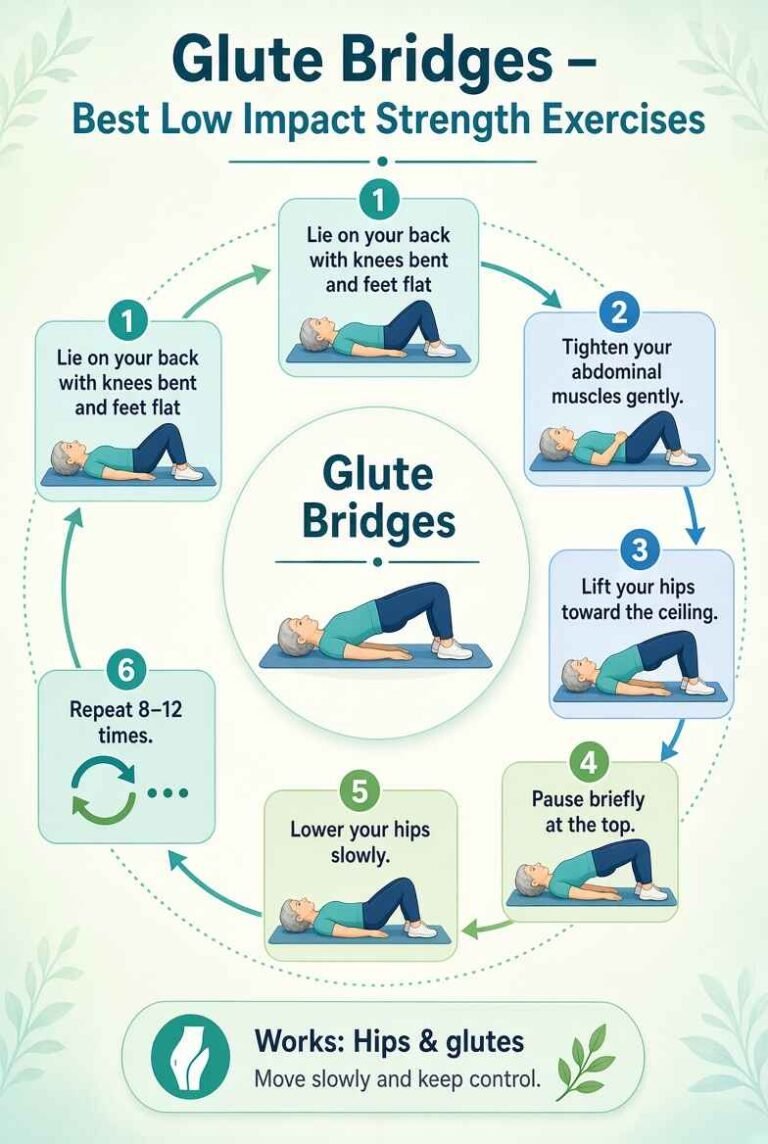
Glute bridges are performed on the floor and primarily target the hips and glutes.
Lie on your back with your knees bent and feet flat on the floor. Tighten your abdominal muscles gently and lift your hips toward the ceiling.
Pause briefly, then lower your hips slowly.
Start with: 8–12 repetitions.
If getting down to or up from the floor is difficult, choose standing or seated strengthening exercises instead.
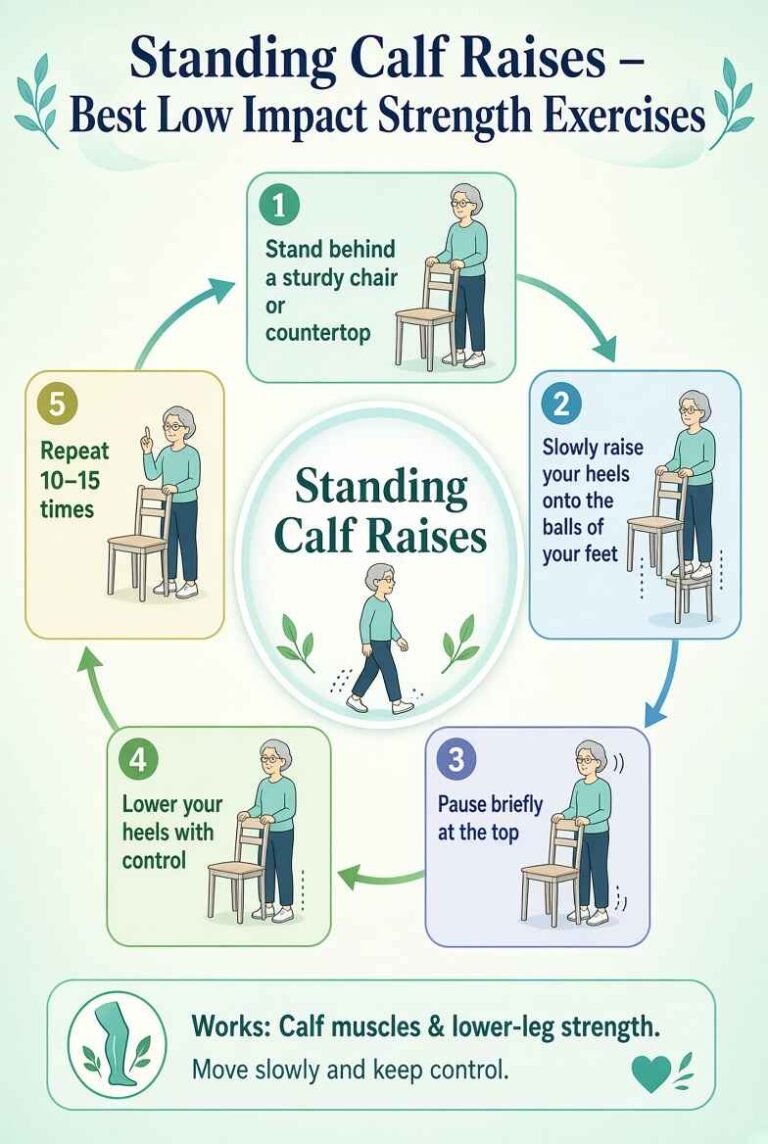
5. Standing Calf Raises
Calf raises require very little equipment and can be performed almost anywhere.
Stand behind a sturdy chair or near a stable countertop. Slowly raise your heels until you are standing on the balls of your feet.
Pause, then lower your heels.
Start with: 10–15 repetitions.
Works: Calf muscles and lower-leg strength.
6. Seated Biceps Curls
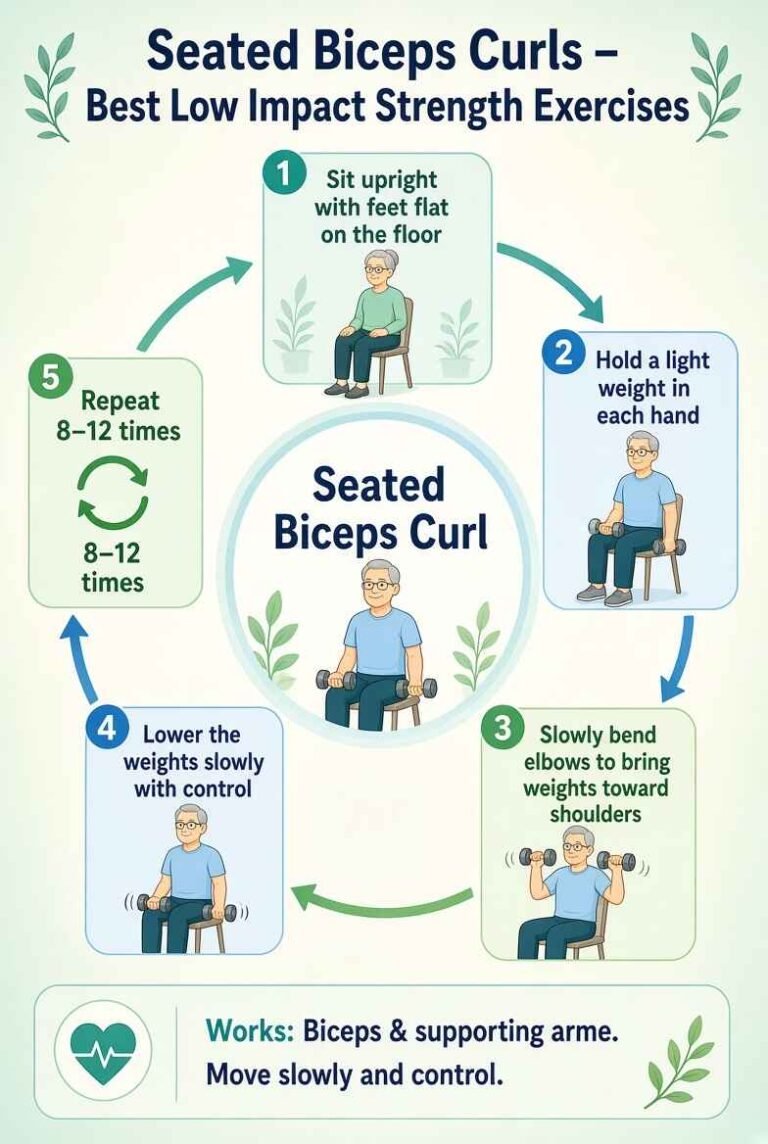
If you have light dumbbells, seated biceps curls are an easy way to add upper-body resistance.
Sit upright with your feet comfortably positioned on the floor. Hold a light weight in each hand and slowly bend your elbows to bring the weights toward your shoulders.
Lower them slowly rather than allowing gravity to do the work.
Start with: 8–12 repetitions.
Works: Biceps and supporting arm muscles.
7. Standing Hip Abduction
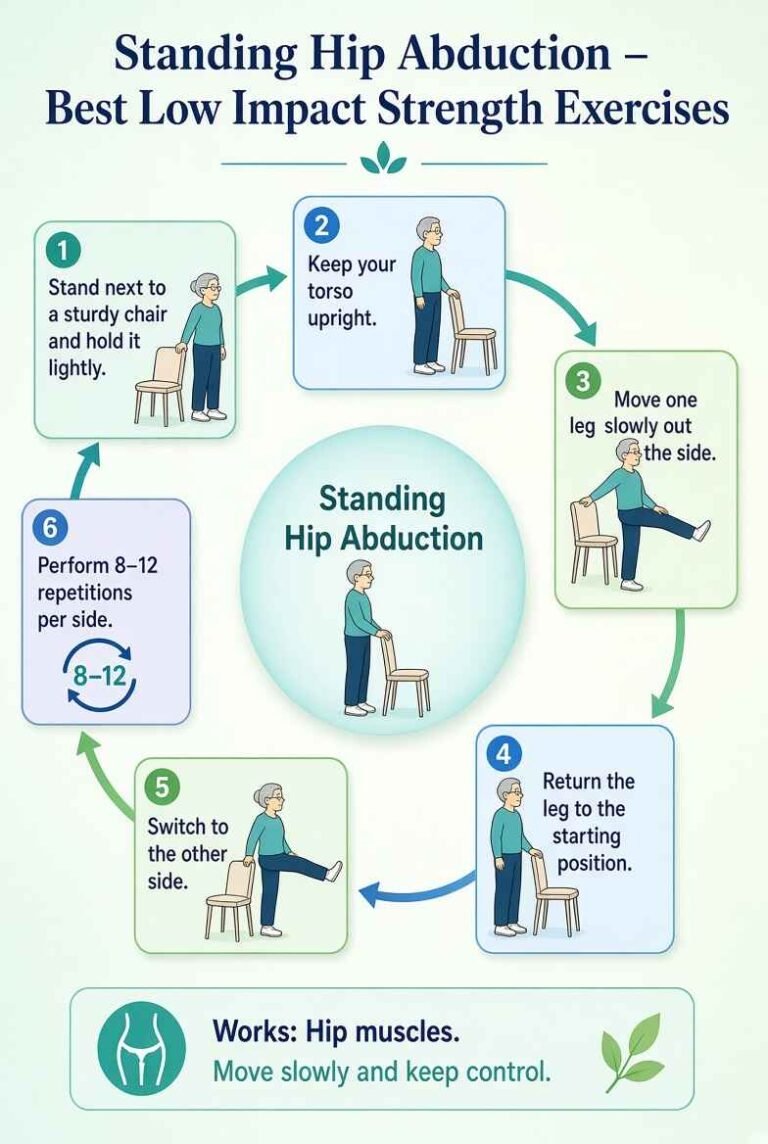
This movement targets the muscles around the hips.
Stand next to a sturdy chair and hold it lightly for balance. Keeping your torso upright, move one leg slowly out to the side.
Return it to the starting position and repeat on the other side.
Start with: 8–12 repetitions per side.
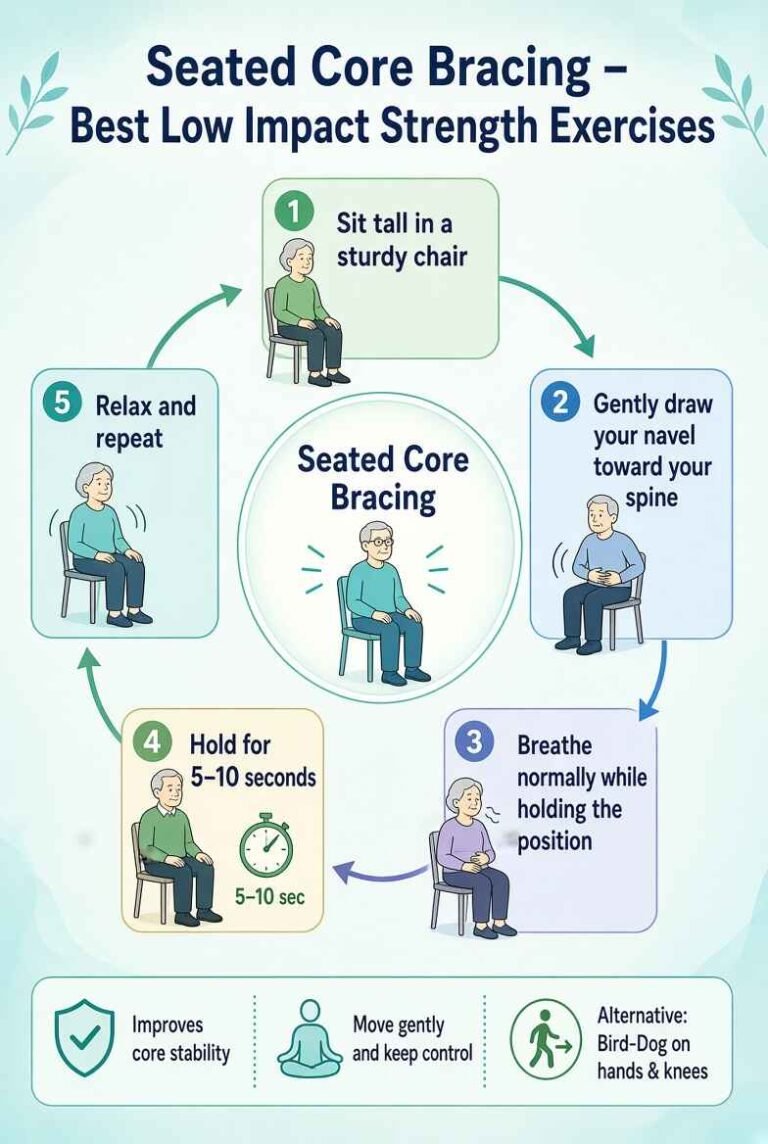
8.Seated Core Bracing or Bird-Dog (Modified)
Sit tall and gently draw your navel toward the spine while breathing normally; hold 5–10 seconds. Or, on hands and knees (or seated), extend opposite arm and leg briefly while keeping the back stable.
These low impact core strength exercises improve stability without strain.
Vary the order and combine upper- and lower-body moves for a balanced low impact strength workout at home. For more variety, explore our full guide to low impact exercises.
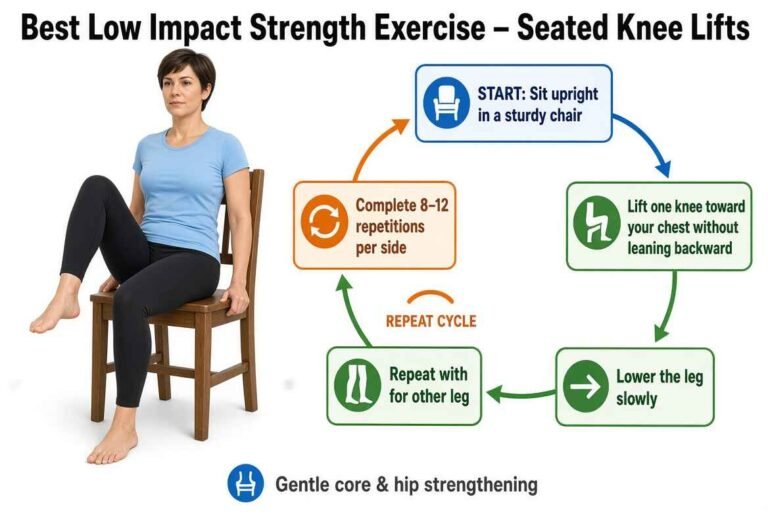
9. Seated Knee Lifts
Seated knee lifts provide a gentle way to strengthen the core and hip muscles.
Sit upright in a sturdy chair. Lift one knee toward your chest without leaning backward.
Lower it slowly and repeat with the other leg.
Start with: 8–12 repetitions per side.
Low Impact Strength Training for Seniors
For seniors, the goal is not to lift the heaviest possible weight. Instead, focus on controlled movement, appropriate resistance, good technique, and gradual progression.
Useful exercises include:
- Chair squats
- Wall push-ups
- Seated leg extensions
- Calf raises
- resistance band
- Seated knee lifts
- Light biceps curls
- Standing hip exercises
A chair can also be useful for balance support during standing exercises.
If you are new to strength training, begin with fewer repetitions and lighter resistance. As the exercises become easier, gradually increase the challenge.
Low Impact Strength Training for Beginners
Beginners should resist the temptation to do too much too soon.
A simple starting routine could include five exercises:
Beginner Low Impact Strength Workout
Chair squats: 8 repetitions
Wall push-ups: 8 repetitions
Seated leg extensions: 8 per leg
Standing calf raises: 10 repetitions
Seated biceps curls: 8 repetitions
Rest between exercises whenever necessary.
After several sessions, you can gradually increase repetitions or add another set if the routine feels comfortable.
Low Impact Strength Workout at Home
You can create a complete home workout without a gym.
20-Minute Low Impact Strength Routine
Warm-up — 3–5 minutes
Start with gentle walking, marching, or arm movements.
Strength circuit
Perform:
- Chair squats — 8–12 reps
- Wall push-ups — 8–12 reps
- Resistance band rows — 8–12 reps
- Seated leg extensions — 8–12 per leg
- Calf raises — 10–15 reps
- Seated biceps curls — 8–12 reps
Rest as needed between movements.
Repeat the circuit once more if your fitness level allows.
Finish with a few minutes of gentle movement.
Low Impact Core Strength Exercises
Your core includes more than just the abdominal muscles. It also includes muscles around the back, pelvis, and trunk that help support movement and stability.
Some low impact core strength exercises include:
- Seated knee lifts
- Bird dog
- Glute bridges
- Seated abdominal bracing
- Standing knee-to-elbow movements
- Wall-supported exercises
The important thing is to avoid rushing through core movements. Slow, controlled repetitions can make an exercise more challenging without requiring heavy resistance.
Low Impact Strength Building Exercises Without Weights
You don’t need equipment to start building strength.
Try:
- Chair squats
- Wall push-ups
- Calf raises
- Standing hip abductions
- Glute bridges
- Seated leg extensions
- Seated knee lifts
Once these exercises become easier, you can progress by increasing repetitions, adding another set, slowing the movement, or introducing resistance equipment.
Low Impact Strength Training With Resistance Bands
Resistance bands are one of the most versatile pieces of equipment for a home strength routine.
They are lightweight, easy to store, and available in different resistance levels.
Common band exercises include:
- Rows
- Chest presses
- Biceps curls
- Triceps extensions
- Leg extensions
- Hip abductions
- Glute exercises
You don’t necessarily need the strongest band available. A set with several resistance levels can be more useful because it allows you to progress gradually. Check resistance band sets on Amazon
Low Impact Strength Training With Dumbbell
Light dumbbells can provide additional resistance for exercises such as:
- Biceps curls
- Shoulder raises
- Chest presses
- Seated rows
- Squats
- Lunges or supported leg exercises
For beginners, lighter weights are generally easier to control.
Rather than choosing a heavy dumbbell immediately, select a weight that allows you to maintain good technique throughout your repetitions.
Ankle Weights for Low Impact Strength Exercises
Ankle weights can add resistance to exercises such as:
- Seated leg extensions
- Standing leg lifts
- Hip abductions
- Controlled leg raises
However, more resistance isn’t always better.
Start with a light amount of resistance and pay attention to how your joints and muscles respond. If an exercise becomes difficult to control, reduce the resistance.
Using a Weight Bench at Home
A compact weight bench can expand the range of strength exercises you can perform at home.
Depending on the design, a bench may support exercises such as:
- Seated dumbbell curls
- Seated shoulder exercises
- Supported rows
- Dumbbell chest exercises
- Seated leg exercises
For a senior-friendly home setup, look for a bench with a stable frame, appropriate weight capacity, comfortable padding, and a size that fits your available space.
Low Impact Strength Training for Women
Women can use the same basic principles of low impact strength training as anyone else.
Exercises such as squats, rows, push-ups, hip exercises, and core strengthening movements can help develop functional strength.
Women who are new to resistance training can start with body-weight exercises or light resistance and gradually progress.
The appropriate resistance level depends on individual strength and training experience, not simply gender.
Low Impact Strength vs. Low Impact Cardio
Strength training and cardio complement each other but have different primary purposes.
Low impact strength training focuses on muscular strength and resistance.
Low impact cardio focuses primarily on cardiovascular endurance and sustained aerobic activity.
For example:
- Resistance bands → strength
- Dumbbells → strength
- Chair squats → strength
- Recumbent bike → cardio
- Walking pad → cardio
- Under-desk elliptical → cardio
Combining both types of exercise can create a more balanced home fitness routine.
For cardio ideas, read our related guide:
Low Impact Cardio Exercises for Seniors at Home
You can also start with our main pillar:
Low Impact Exercises for Seniors at Home
For balance and mobility, see:
Balance Exercises for Older Adults: Best Mobility Exercises to Improve Stability and Prevent Falls
And if you prefer chair-based movement:
Safety Tips for Successful Low Impact Strength Training
Clear the floor of rugs and obstacles. Use a stable chair or counter for support. Move slowly and control both the lifting and lowering phases. Stop if you feel sharp pain (muscle fatigue is normal; joint pain is not). Stay hydrated and wear supportive shoes. Consistency matters more than intensity—two solid sessions weekly produce noticeable gains in strength and daily ease within weeks.
Frequently Asked Questions
What are the best low impact strength exercises for seniors?
Chair sit-to-stands, wall push-ups, glute bridges, band rows, leg extensions, and calf raises rank among the most effective and accessible. They build functional strength with minimal joint stress.
How often should seniors do low impact strength training?
Two to three non-consecutive days per week is ideal, following general guidelines from health organizations. Pair with daily walking or other low impact activity.
Do I need equipment for low impact strength exercises at home?
No—bodyweight and a chair work well to start. Resistance bands and light dumbbells accelerate progress and keep workouts interesting. The Amazon options listed above are beginner-friendly and affordable.
Are resistance bands safe for seniors and beginners?
Yes. They offer smooth, adjustable resistance that is often gentler on joints than free weights and carry no drop risk. Start with the lightest level.