
Strong knees can make everyday activities such as walking, standing from a chair, climbing stairs, and getting in and out of a car feel more manageable. However, as we get older, maintaining strength around the knees becomes increasingly important.
The good news is that you do not need an intense workout to strengthen your knees. Gentle, controlled movements performed consistently can help improve the muscles that support the knee joint while also encouraging better mobility and stability.
In this guide, we will look at some of the best knee strengthening exercises for seniors, including simple exercises you can do at home, resistance-band movements, and options that may be suitable for people with bad or arthritic knees.
Safety note: If you have significant knee pain, swelling, a recent injury, instability, or have had knee surgery, speak with your doctor or physical therapist before beginning a new exercise program. Stop an exercise if it causes sharp or worsening pain.
Why Knee Strength Matters as You Age
The knee does not work by itself. Several muscles around the hips and legs help control and support the joint during movement.
The quadriceps at the front of the thigh are particularly important for activities such as standing up, walking, and climbing stairs. The hamstrings, glutes, and calf muscles also contribute to lower-body stability.
Therefore, strengthening these supporting muscles can be an important part of maintaining functional movement.
Regular strengthening exercises may help you:
- Support the muscles surrounding the knee
- Improve lower-body strength
- Make standing and sitting easier
- Support balance and stability
- Improve confidence during everyday movement
- Maintain mobility as you age
- Make activities such as walking and climbing stairs more manageable
If your main concern is ongoing knee discomfort, you can also read our guide to knee pain relief naturally with gentle exercises for seniors.
For a broader collection of exercises addressing both areas, visit our [Knee & Hip Pain Relief Exercises] pillar page.
Best Knee Strengthening Exercises for Seniors
The following exercises are designed to be relatively gentle and adaptable. If you are a beginner, use a sturdy chair, countertop, or other stable support whenever necessary.
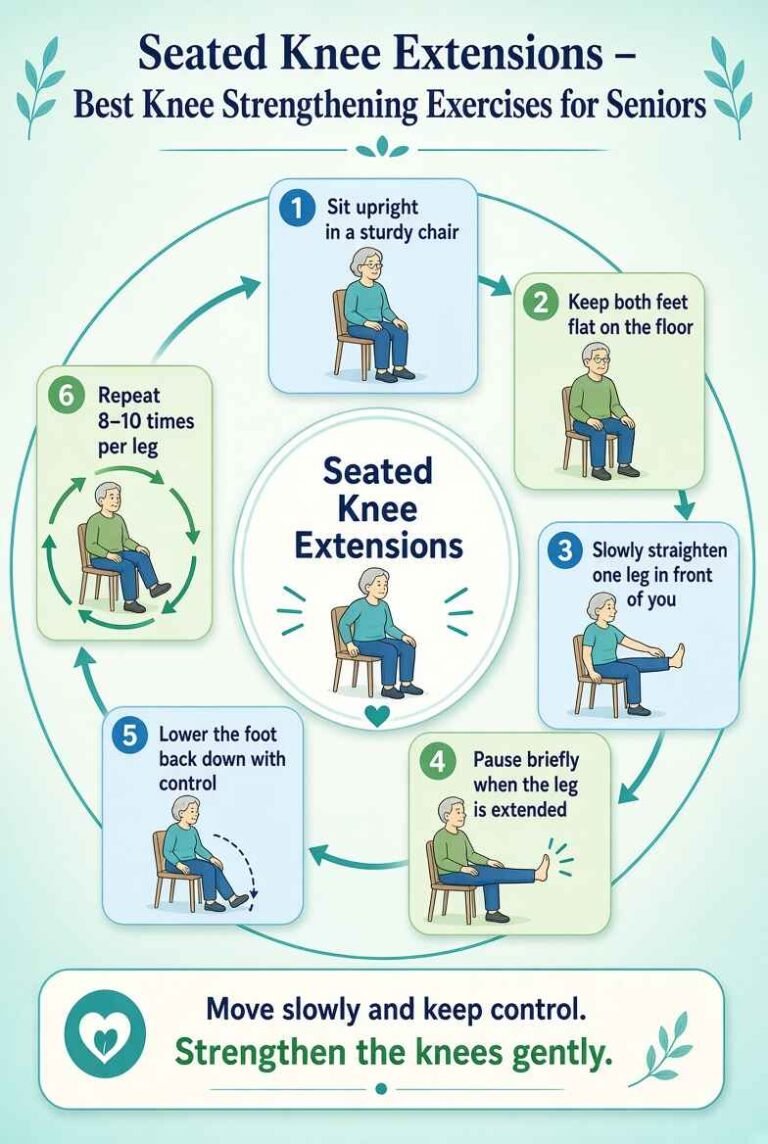
1. Seated Knee Extensions
Seated knee extensions are one of the simplest ways to work the quadriceps without placing as much demand on the body as some standing exercises.
How to do it:
- Sit upright in a sturdy chair.
- Keep both feet flat on the floor.
- Slowly straighten one leg in front of you.
- Pause briefly when the leg is comfortably extended.
- Lower the foot back down with control.
- Repeat with the other leg.
Start with 8–10 repetitions per leg.
Avoid swinging the leg or locking the knee forcefully at the top.
2. Sit-to-Stand
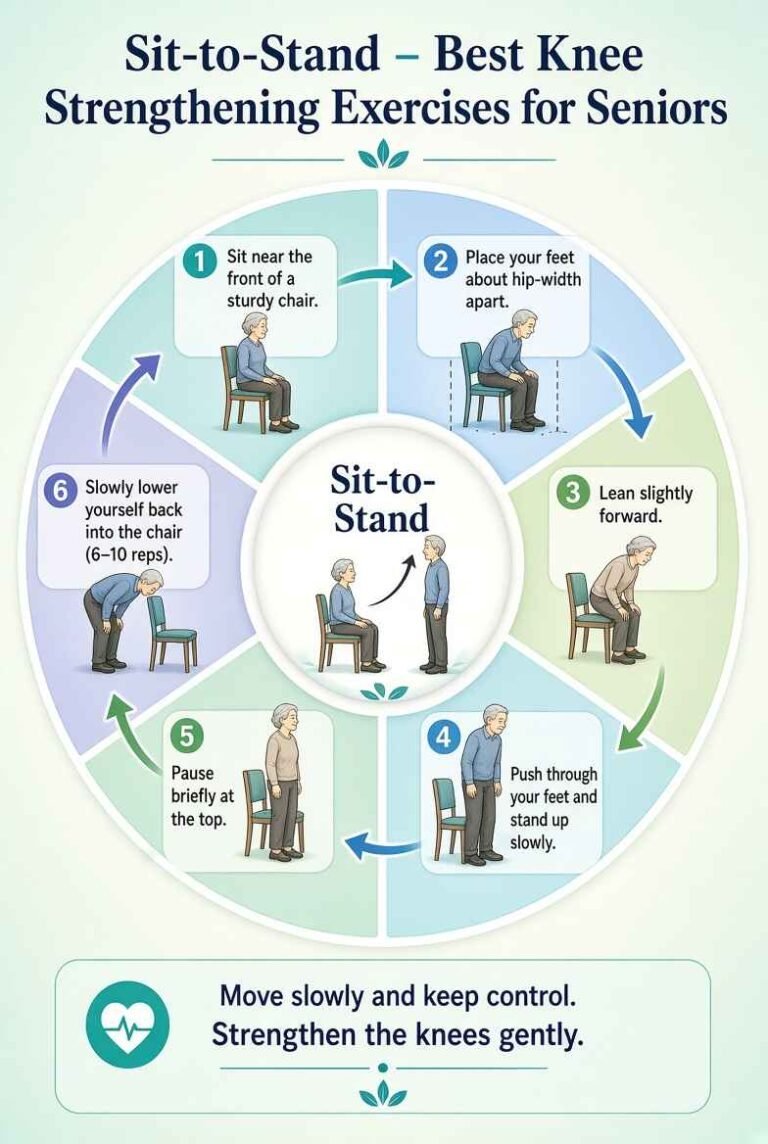
The sit-to-stand exercise works several lower-body muscles while closely matching an everyday movement.
How to do it:
- Sit near the front of a sturdy chair.
- Place your feet about hip-width apart.
- Lean slightly forward.
- Push through your feet and stand up slowly.
- Pause briefly.
- Slowly lower yourself back into the chair.
Try 6–10 repetitions to begin.
3. Supported Mini Squats
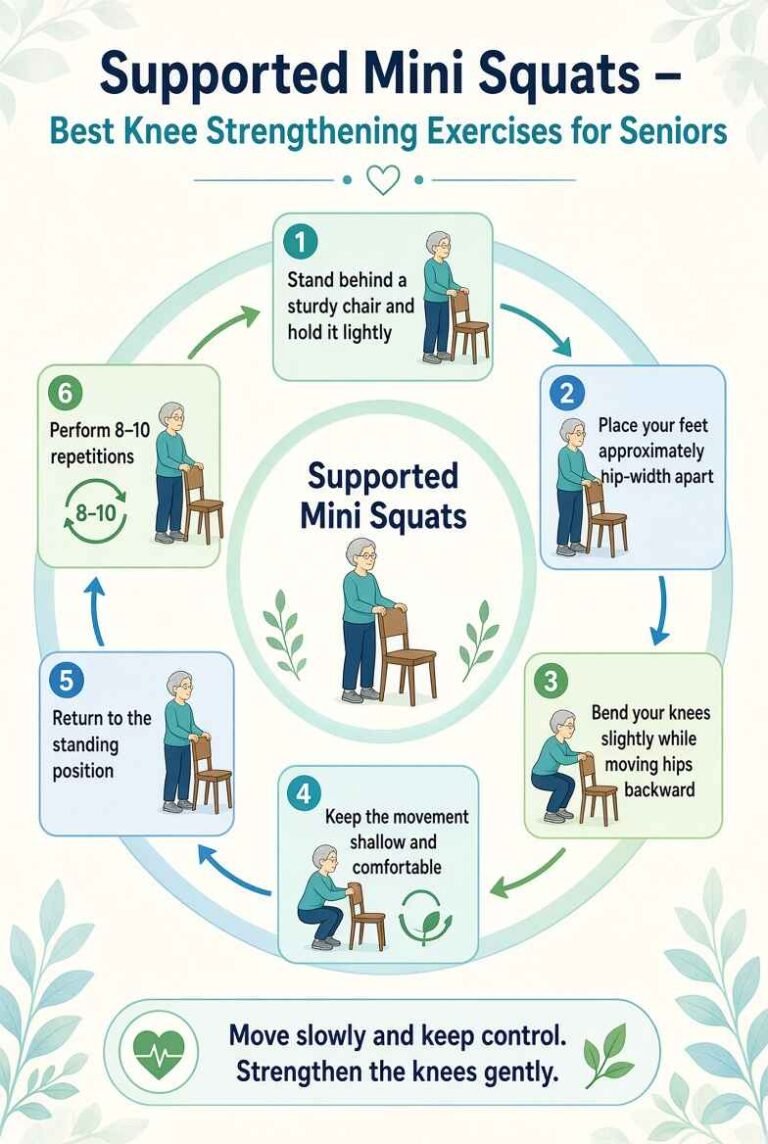
Mini squats can strengthen the thighs and hips without requiring a deep squat.
How to do it:
- Stand behind a sturdy chair and hold it lightly.
- Place your feet approximately hip-width apart.
- Bend your knees slightly while moving your hips backward.
- Keep the movement shallow and comfortable.
- Return to the standing position.
Perform 8–10 repetitions.
4. Straight Leg Raises
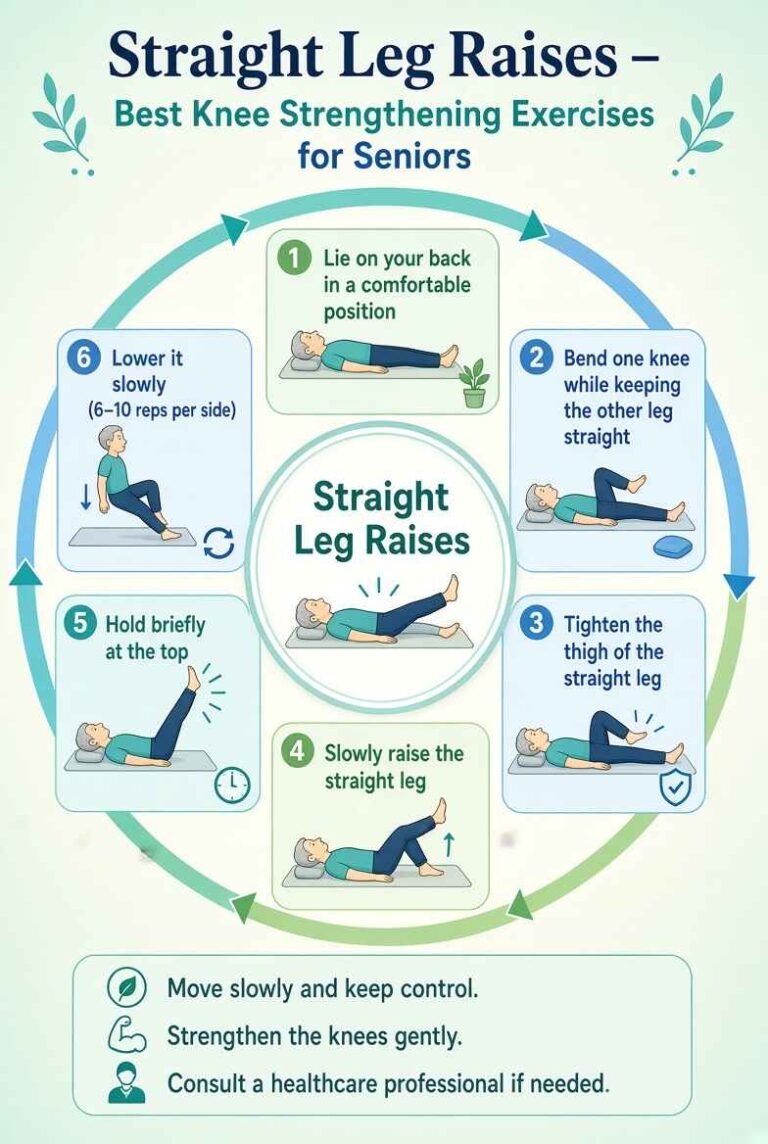
Straight leg raises target the quadriceps while keeping the knee relatively straight.
How to do it:
- Lie on your back or use another comfortable position recommended by your healthcare professional.
- Bend one knee while keeping the other leg straight.
- Tighten the thigh of the straight leg.
- Slowly raise the straight leg.
- Hold briefly.
- Lower it slowly.
Begin with 6–10 repetitions per side.
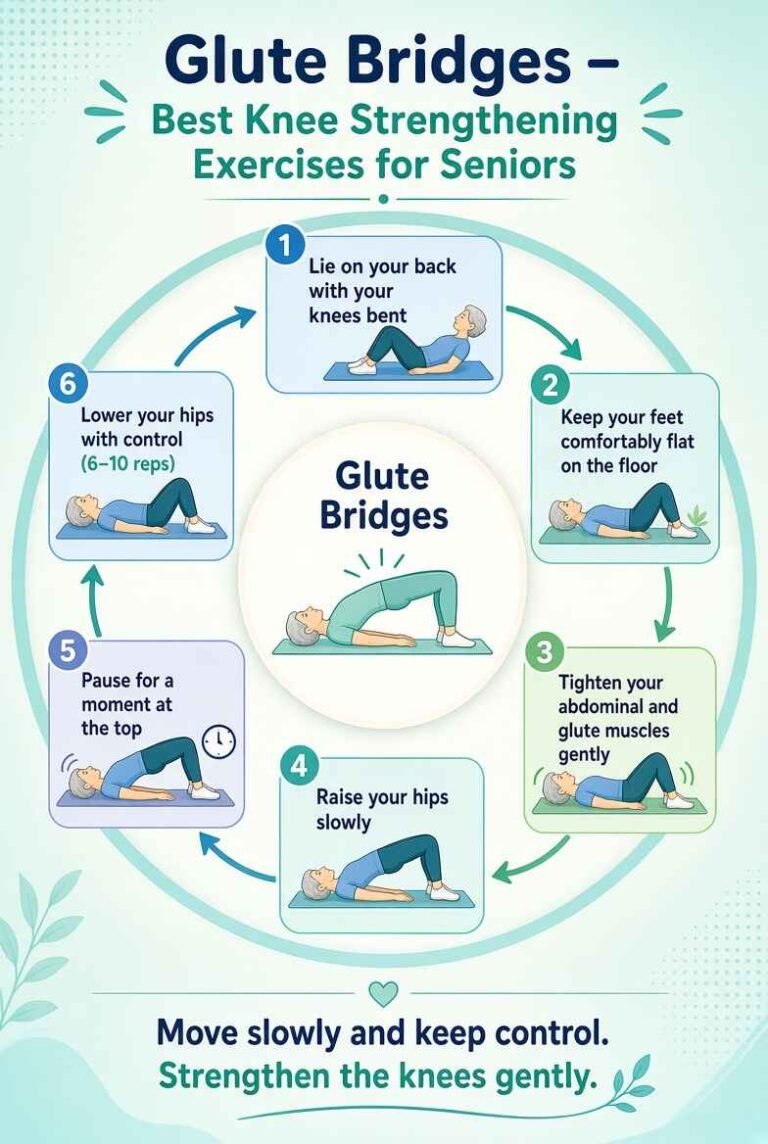
5. Glute Bridges
Although this exercise primarily works the glutes and hips, stronger hip muscles can contribute to better lower-body control.
How to do it:
- Lie on your back with your knees bent.
- Keep your feet comfortably flat on the floor.
- Tighten your abdominal and glute muscles gently.
- Raise your hips slowly.
- Pause for a moment.
- Lower your hips with control.
Start with 6–10 repetitions.
Anyone who finds floor exercises difficult can skip this movement and focus on standing or seated exercises.
6. Standing Hamstring Curls
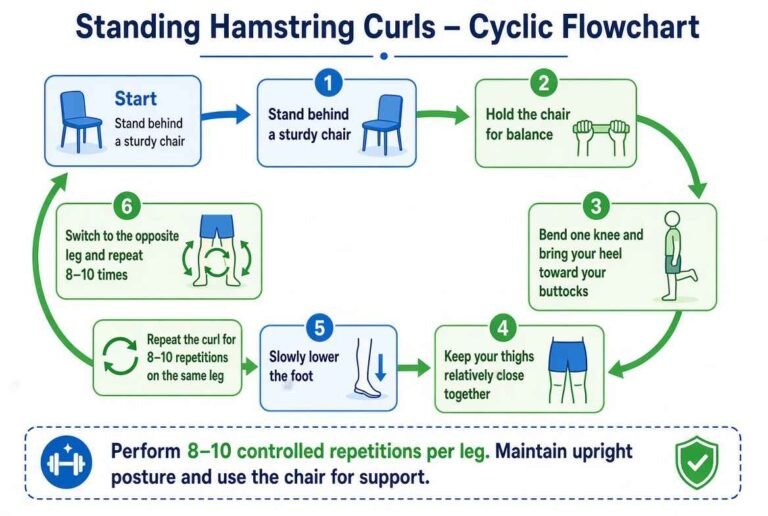
Hamstring curls strengthen the muscles at the back of the thigh.
How to do it:
- Stand behind a sturdy chair.
- Hold the chair for balance.
- Bend one knee and bring your heel toward your buttocks.
- Keep your thighs relatively close together.
- Slowly lower the foot.
- Repeat on the opposite side.
Try 8–10 repetitions per leg.
Keep your upper body upright rather than leaning forward.
7. Calf Raises
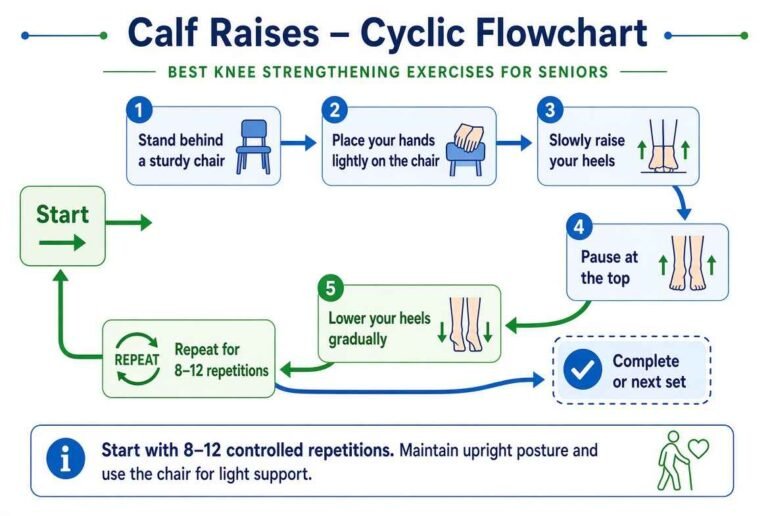
Strong calves can contribute to better ankle and lower-leg control, which is useful for overall lower-body stability.
How to do it:
- Stand behind a sturdy chair.
- Place your hands lightly on the chair.
- Slowly raise your heels.
- Pause at the top.
- Lower your heels gradually.
Start with 8–12 repetitions.
As your balance improves, you may be able to perform the movement with less support.
Knee Strengthening Exercises at Home for Seniors
One major advantage of knee strengthening exercises is that many require little or no equipment.
A simple home routine could include:
- Seated knee extensions
- Sit-to-stands
- Supported mini squats
- Standing hamstring curls
- Calf raises
You can complete these movements in a small space and adjust the number of repetitions according to your fitness level.
For seniors who are new to strength training, beginning with two or three exercises may be more practical than attempting a long workout.
Over time, you can gradually increase repetitions or add resistance.
Knee Strengthening Exercises With Resistance Band
Once basic bodyweight exercises become comfortable, a resistance band can provide an additional challenge.
Resistance bands are lightweight, inexpensive, and convenient for home workouts. They can also make it easier to gradually increase exercise difficulty.
Resistance Band Knee Extensions
Sit on a sturdy chair and attach a resistance band securely according to the manufacturer’s instructions.
Then:
- Sit upright.
- Secure the band around the lower leg as appropriate.
- Slowly straighten the knee.
- Pause briefly.
- Return to the starting position with control.
Start with light resistance.
Resistance Band Leg Curls
A resistance band can also be used to challenge the hamstrings.
Stand behind a sturdy chair and secure the band appropriately. Bend your knee against the resistance, then slowly return your foot to its starting position.
Perform the movement slowly rather than trying to create maximum resistance.
Resistance Band Side Steps
Side steps primarily target the muscles around the hips, which play an important role in lower-body stability.
Place a light resistance band around the thighs or legs according to the manufacturer’s instructions.
Then take small controlled steps sideways while maintaining good posture.
Keep the movements slow and avoid allowing your knees to collapse inward.
Knee Strengthening for Bad Knees
If you have what you consider “bad knees,” strengthening exercises may still be possible, but the exercise selection and intensity matter.
Instead of immediately performing deep squats, jumping exercises, or high-impact movements, start with gentler options such as:
- Seated knee extensions
- Sit-to-stands
- Straight leg raises
- Supported mini squats
- Gentle hamstring curls
- Calf raises
A comfortable range of motion is generally preferable to forcing a joint into a position that causes significant discomfort.
If your knee becomes increasingly painful, swollen, unstable, or difficult to use, stop the exercise and seek professional medical advice.
Knee Strengthening Exercises for Knee Pain
Knee pain can have many different causes, including osteoarthritis, previous injuries, overuse, and other joint or muscle problems.
Consequently, there is no single exercise routine that is appropriate for everyone with knee pain.
For some people, strengthening the muscles around the knee may be part of a broader approach to managing symptoms and maintaining function. However, the correct exercises depend on the underlying problem and individual limitations.
If your goal is specifically to learn gentle movements for managing knee discomfort, see our detailed guide on knee pain relief naturally with gentle exercises for seniors.
Knee Strengthening Exercises for Arthritic Knees
People with knee osteoarthritis often need to balance movement with symptom management.
Low-impact strengthening can be useful because it allows you to work the supporting muscles without relying on jumping or other high-impact activities.
Good starting options may include:
- Seated knee extensions
- Sit-to-stands
- Straight leg raises
- Supported mini squats
- Calf raises
- Light resistance-band exercises
However, arthritis symptoms vary considerably. If an exercise causes significant or persistent pain, discuss your routine with a qualified healthcare professional.
A Simple Beginner Knee-Strengthening Routine
If you are just starting, you can keep your routine short.
Beginner routine
| Exercise | Starting amount |
|---|---|
| Seated knee extensions | 8–10 per leg |
| Sit-to-stand | 6–10 |
| Supported mini squats | 8–10 |
| Standing hamstring curls | 8–10 per leg |
| Calf raises | 8–12 |
Rest between exercises whenever necessary.
Rather than trying to complete a long workout immediately, focus on controlled movement and consistency.
As the exercises become easier, you can gradually increase repetitions or introduce light resistance.
How Often Should Seniors Do Knee Strengthening Exercises?
A reasonable starting point is two to three strengthening sessions per week, allowing recovery between sessions.
You do not need to train your knees every day to make progress.
On other days, gentle walking, mobility exercises, balance work, or other low-impact activities can complement your strengthening routine.
Most importantly, pay attention to how your body responds. If your knees remain unusually painful after exercise, reduce the intensity or speak with a healthcare professional.
Simple Equipment That Can Help
You can perform many knee exercises without equipment. However, a few basic items may make home training more convenient.
Useful options include:
- A sturdy chair
- Resistance bands
- A comfortable exercise mat
- Supportive footwear
- Light weights, when appropriate
If you decide to purchase resistance bands or other exercise equipment through Amazon, choose products that match your current ability and follow the manufacturer’s safety instructions.
Amazon Affiliate Disclosure: Some links on Senior Gentle Fitness may be affiliate links. If you purchase through these links, we may earn a small commission at no additional cost to you.
When Should You Talk to a Healthcare Professional?
Exercise is not appropriate as a substitute for medical evaluation when a significant knee problem may be present.
Speak with a doctor or physical therapist if you experience:
- Severe or persistent knee pain
- Significant swelling
- A knee that repeatedly gives way
- A recent knee injury
- Inability to put weight on the leg
- Significant loss of movement
- Pain that consistently worsens with exercise
A healthcare professional can help identify the underlying problem and recommend exercises appropriate for your condition.
Frequently Asked Questions
What is the best exercise to strengthen knees?
There is not one best exercise for everyone. For many seniors, practical starting exercises include sit-to-stands, seated knee extensions, supported mini squats, hamstring curls, and calf raises. The best choice depends on your current strength, mobility, knee condition, and exercise tolerance.
What are some good exercises to strengthen knees?
Good options include seated knee extensions, sit-to-stands, supported mini squats, straight leg raises, hamstring curls, calf raises, and suitable resistance-band exercises. Start with movements you can perform comfortably and with good control.
Which exercises are good for strengthening knees?
Exercises that strengthen the quadriceps, hamstrings, glutes, and calf muscles can support overall knee function. Bodyweight exercises, controlled chair exercises, and light resistance-band movements are useful options for many beginners.
How long does it take to strengthen a weak knee?
The timeline varies from person to person. With consistent training, some people may notice improvements in strength and everyday movement within several weeks, while greater improvements may require several months.
Final Thoughts
Knee strengthening exercises can be a valuable part of an active lifestyle for seniors. You do not need complicated equipment or intense workouts to begin. Simple movements such as sit-to-stands, seated knee extensions, supported mini squats, and calf raises can provide a practical starting point.
The key is to begin at an appropriate level, use controlled movements, and progress gradually.
If knee pain is your primary concern, explore our guide to knee pain relief naturally with gentle exercises for seniors. You can also visit our broader Knee & Hip Pain Relief Exercises pillar page for additional exercises and related resources.
Strong, supported legs can help you stay active, confident, and independent as you get older.