
Chair Yoga for Knee Pain: 8 Gentle Exercises for Seniors
Knee pain can make everyday movement feel difficult. Simple activities such as walking, standing from a chair, climbing stairs, or exercising may become uncomfortable, especially as we get older.
But having sore or stiff knees does not always mean you have to stop moving.
Chair yoga for knee pain is a gentle way to introduce stretching, controlled movement, breathing, and mobility exercises while remaining seated or using a chair for support. For seniors who find floor-based yoga uncomfortable, chair yoga can provide a more accessible starting point.
In this guide, you will learn several gentle chair yoga exercises for knee pain, how to modify them for bad knees, and what precautions to take if you have arthritis or persistent knee discomfort.
Important: Chair yoga may be useful as part of an overall exercise routine, but it is not a treatment or cure for an underlying knee condition. If you have significant pain, swelling, an injury, or difficulty putting weight on your knee, speak with a qualified healthcare professional before exercising.
What Is Chair Yoga for Knee Pain?
Chair yoga for knee pain is a modified form of yoga that uses a sturdy chair for sitting, balance, or support.
Instead of getting down onto the floor or performing deep knee bends, many movements can be performed while seated. This makes chair yoga particularly useful for older adults, beginners, or people who have difficulty with balance or getting up and down from the floor.
Yoga can help improve flexibility, strength, balance, and physical function for people with arthritis when the exercises are appropriately modified. The Arthritis Foundation also notes that chair-based yoga can be an option for people with more severe arthritis.
If you are completely new to chair yoga, start with our main guide: [Chair Yoga Exercises for Seniors: Gentle and Easy Chair Yoga at Home]
What Kind of Chair Is Best for Chair Yoga?
You don’t need specialized yoga equipment to get started. A sturdy, stable chair without wheels or a slippery base is usually more important than having a dedicated yoga chair.
If you are practicing chair yoga regularly at home, you may want to consider a supportive yoga chair or sturdy exercise chair that provides a comfortable seat and good stability during seated stretches and mobility exercises.
👉 [Check the latest price of a suitable yoga/exercise chair on Amazon]
You can Also buy yoga chair:
👉[Check the latest price of a yoga/exercise chair for adult on Amazon]
As an Amazon Associate, we may earn from qualifying purchases.
Is Chair Yoga Good for Bad Knees?
For many people, gentle chair yoga can be a practical way to stay active without putting the same demands on the knees as deeper squats, kneeling positions, or high-impact exercise.
The important word is gentle.
Chair yoga should not force your knee into a painful position. Movements should be slow and controlled, and you should modify or stop an exercise if it causes pain.
For people with arthritis, appropriate yoga may help improve flexibility, physical function, strength, balance, and stress management. However, different forms of yoga place different demands on the joints, so modifications are important.
8 Gentle Chair Yoga Exercises for Knee Pain
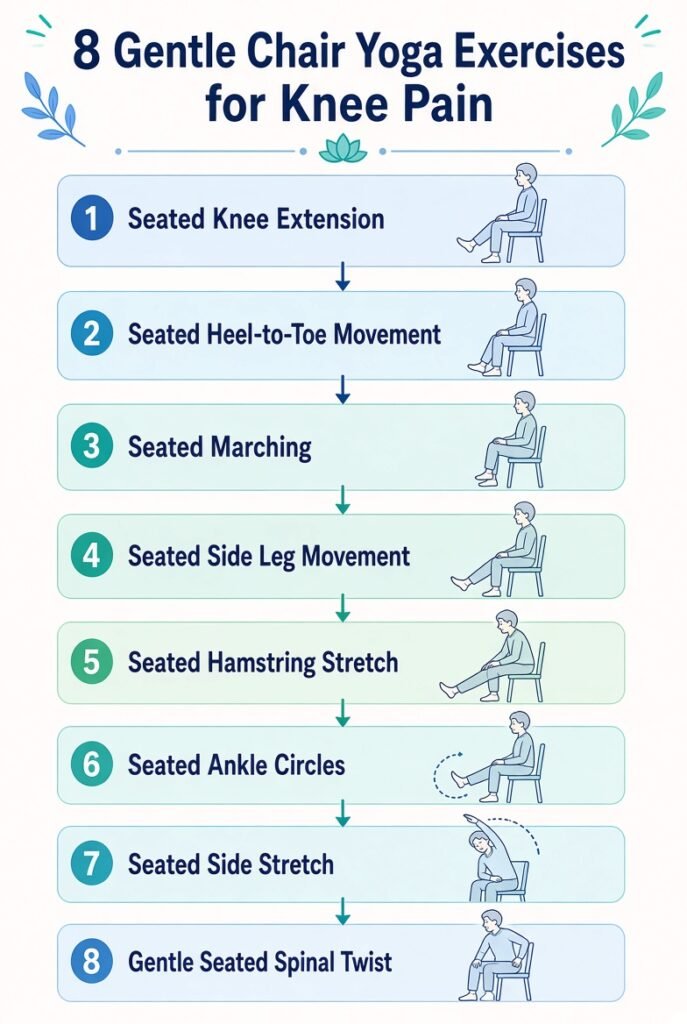
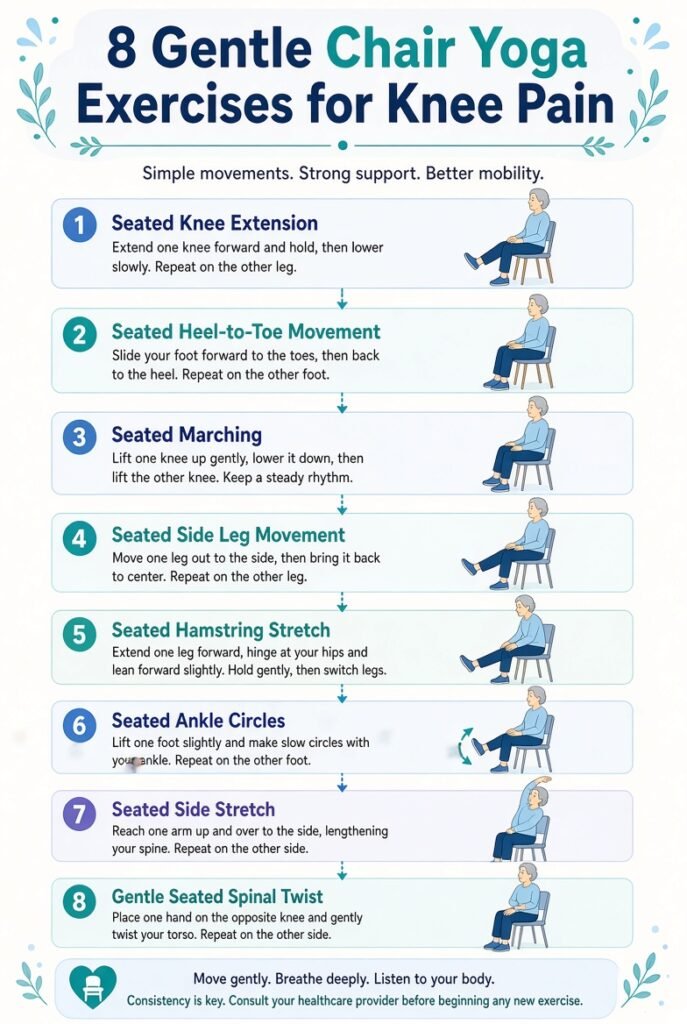
The following movements are designed around comfortable seated or chair-supported positions. They are not intended to diagnose or treat knee problems.
Start with a stable, heavy chair that does not easily slide across the floor.
1. Seated Knee Extension
The seated knee extension is one of the simplest chair exercises for knee pain.
How to do it:
- Sit upright toward the front half of a sturdy chair.
- Keep both feet comfortably on the floor.
- Slowly straighten one leg forward.
- Stop before you feel pain or excessive pulling.
- Hold for a few seconds.
- Slowly lower your foot.
- Repeat with the other leg.
Try several comfortable repetitions on each side.
This movement gently takes the knee through part of its range of motion while also engaging the muscles at the front of the thigh.
The Arthritis Foundation includes leg lifts and other knee exercises among movements intended to strengthen muscles around the knee and improve knee stability and mobility.
2. Seated Heel-to-Toe Movement
This simple movement helps you practice controlled movement around the ankles and lower legs.
How to do it:
- Sit tall with your feet flat on the floor.
- Lift the toes of both feet while keeping your heels down.
- Lower the toes.
- Then lift your heels while keeping your toes on the floor.
- Continue slowly.
You do not need to move quickly.
This can be especially useful as a gentle warm-up before other seated exercises for knee pain.
3. Seated Marching
Seated marching is a beginner-friendly movement that works the hips and thighs while you remain supported by the chair.
How to do it:
- Sit upright with your back comfortable and supported.
- Keep your feet about hip-width apart.
- Slowly lift one foot a small distance from the floor.
- Lower it gently.
- Lift the opposite foot.
- Continue alternating.
If lifting your knee high feels uncomfortable, make the movement smaller.
The goal is controlled movement—not lifting your knees as high as possible.
4. Seated Side Leg Movement
This is another gentle option when you want to include hip movement without standing.
How to do it:
- Sit upright near the edge of your chair.
- Keep one foot firmly on the floor.
- Slowly move the opposite leg slightly outward.
- Return it to the center.
- Repeat on the other side.
Keep the movement small and controlled.
Do not twist your knee while moving the leg.
5. Seated Hamstring Stretch
Tight muscles around the back of the thigh can make lower-body movement feel restricted.
A gentle seated stretch may help improve flexibility.
How to do it:
- Sit toward the front of a sturdy chair.
- Extend one leg forward.
- Keep your heel on the floor.
- Keep the knee slightly soft rather than forcing it completely straight.
- Sit tall and gently lean forward from your hips.
- Stop when you feel a mild stretch behind your thigh.
- Hold comfortably and breathe normally.
- Return to the starting position.
Do not bounce or force the stretch.
Stretching should create gentle tension rather than sharp or increasing pain. The Arthritis Foundation recommends stretching slowly and only to the point of gentle pulling.
6. Seated Ankle Circles
Although this movement focuses on the ankle, it can be a useful addition to a gentle lower-body mobility routine.
How to do it:
- Sit comfortably.
- Lift one foot slightly from the floor.
- Slowly circle your ankle.
- Perform several circles in one direction.
- Reverse the direction.
- Place your foot down and switch sides.
Keep your knee relaxed rather than holding it rigidly.
7. Seated Side Stretch
Chair yoga is not only about the knees. Your whole body can benefit from gentle mobility.
How to do it:
- Sit tall with both feet supported.
- Place one hand beside you or on the chair.
- Slowly raise the opposite arm.
- Gently lean toward the supporting side.
- Keep your movement comfortable.
- Return to the center.
- Repeat on the other side.
Avoid collapsing forward or twisting aggressively.
8. Gentle Seated Spinal Twist
A seated twist can be included as part of a whole-body chair yoga routine.
How to do it:
- Sit upright with both feet supported.
- Place your hands comfortably on your thighs.
- Slowly rotate your upper body to one side.
- Keep the movement gentle.
- Return to the center.
- Repeat on the other side.
Do not force the twist.
The Arthritis Foundation includes seated spinal twists among arthritis-friendly yoga movements and emphasizes modifying poses according to individual limitations.
A Simple 10-Minute Chair Yoga Routine for Knee Pain
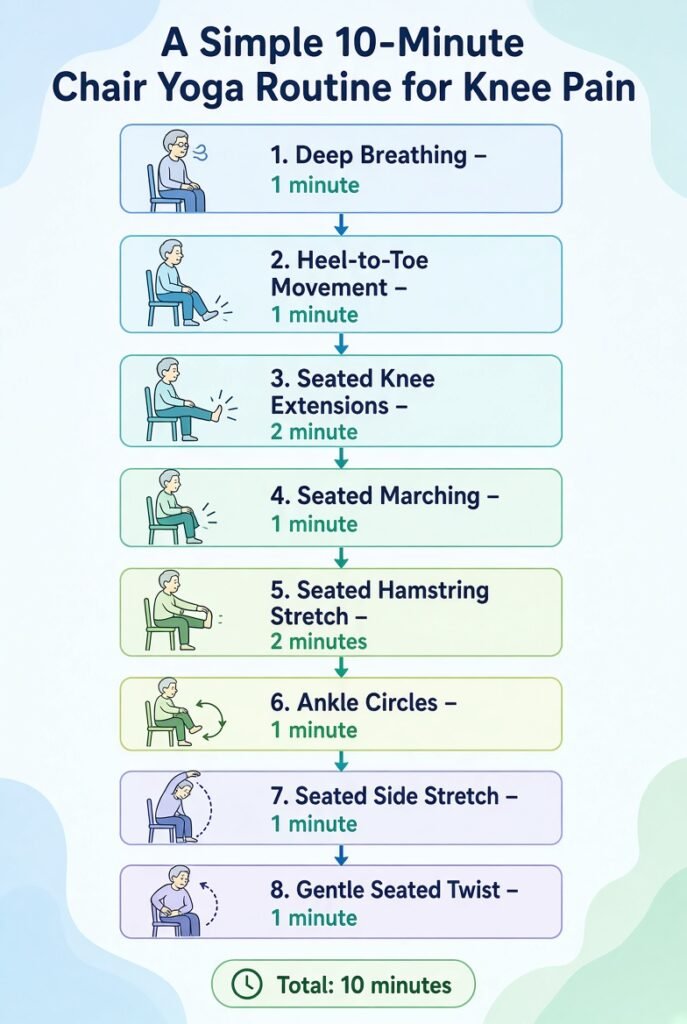
If you are a beginner, you do not need a long workout.
Try this simple sequence:
| Exercise | Suggested time |
|---|---|
| Deep breathing | 1 minute |
| Heel-to-toe movement | 1 minute |
| Seated knee extensions | 2 minutes |
| Seated marching | 1 minute |
| Seated hamstring stretch | 2 minutes |
| Ankle circles | 1 minute |
| Seated side stretch | 1 minute |
| Gentle seated twist | 1 minute |
Move slowly and take breaks whenever necessary.
The goal is to create a comfortable movement habit, not to complete as many repetitions as possible.
Chair Yoga for Arthritis Knee Pain
People with knee arthritis often experience pain, stiffness, and difficulty with certain movements.
Gentle yoga can be one component of an exercise routine for people with arthritis. Research discussed by the Arthritis Foundation indicates that modified yoga may improve pain, stiffness, physical function, flexibility, and stress in people with arthritis.
However, arthritis does not affect everyone in the same way.
For example, a movement that feels comfortable for one person may aggravate another person’s knee.
That is why chair yoga for arthritis knee pain should be individualized.
Consider:
- reducing the range of motion
- performing fewer repetitions
- using a sturdy chair for support
- avoiding deep knee bends
- avoiding movements that cause sharp pain
- taking rest breaks
- working with a physical therapist or qualified instructor when necessary
An instructor experienced with arthritis can help modify movements to reduce unnecessary joint strain.
Chair Yoga for Bad Knees: How to Modify Exercises
If your knees are particularly sensitive, you do not have to perform every movement exactly as demonstrated.
Try these modifications:
Keep the movement smaller
You don’t have to fully straighten or bend the knee. Use the range of motion that feels comfortable.
Slow down
Fast movements can make it harder to control your position. Slow repetitions allow you to pay attention to how your knee feels.
Use a supportive chair
Choose a stable chair without wheels. Avoid chairs that slide easily across the floor.
Avoid deep knee bending
Deep squats or positions that require significant knee flexion may not be appropriate for everyone with knee problems.
Don’t exercise through sharp pain
A mild stretching sensation is different from sharp, increasing, or severe pain.
If an exercise hurts, stop and modify it rather than trying to push through it.
Can Chair Exercises Help With Knee Pain?
Chair exercises can be a useful way to remain physically active when standing exercises are uncomfortable.
They can include:
- seated knee extensions
- seated marching
- ankle movements
- gentle leg movements
- seated stretches
- breathing exercises
- mobility exercises
Regular physical activity can help maintain joint mobility, strengthen supporting muscles, and improve balance. For people with knee arthritis, exercise programs may also include strengthening and cardiovascular activities in addition to flexibility work.
Chair yoga should therefore be viewed as one part of a broader movement routine, rather than the only exercise you ever need.
Knee Pain Relief Exercises at Home: Where Chair Yoga Fits
If you search for knee pain relief exercises at home, you will find many different types of exercises.
Some focus on:
- flexibility
- quadriceps strength
- hamstring flexibility
- hip strength
- balance
- mobility
- low-impact cardiovascular activity
Chair yoga can complement these activities because it gives beginners an accessible way to work on movement and flexibility.
However, the best exercise routine depends on the reason for your knee pain.
Knee pain caused by osteoarthritis is different from pain caused by an acute injury, surgery, ligament problem, or another medical condition.
If you have persistent or unexplained knee pain, professional assessment is more appropriate than trying to diagnose the problem yourself.
Yoga for Knee Pain in Old Age: Is It Safe?
Older adults can benefit from staying active, but age itself is not a reason to force difficult yoga poses.
For seniors, a gentle routine can emphasize:
- comfortable range of motion
- balance
- flexibility
- breathing
- posture
- gradual strengthening
- safe transitions
A chair can also provide additional support.
The Arthritis Foundation recommends choosing appropriate modifications and paying attention to pain or discomfort when practicing yoga with arthritis.
If you are new to exercise, have significant arthritis, recently had surgery, or have another medical condition affecting movement, consider speaking with your doctor or physical therapist before starting.
When Should You Avoid Chair Yoga?
Chair yoga is generally designed to be gentle, but “gentle” does not mean appropriate for every situation.
Stop exercising and seek medical advice if you experience symptoms such as:
- severe or sudden knee pain
- significant swelling
- inability to bear weight
- a new injury
- a knee that becomes unstable
- symptoms that continue or worsen after exercise
If your knee pain is severe or you cannot bend or bear weight on the knee, the Arthritis Foundation recommends seeking medical attention rather than simply continuing exercise.
How Often Should You Do Chair Yoga for Knee Pain?
There is no single schedule that works for everyone.
If you are beginning, start with a short routine and see how your body responds.
For example, you might begin with 5–10 minutes of gentle movement and gradually increase the duration as your comfort and fitness improve.
Consistency is generally more useful than trying to complete a difficult session once in a while.
And remember that chair yoga does not have to replace other forms of physical activity. Walking, cycling, swimming, strengthening exercises, or physical therapy may also be appropriate depending on your condition and fitness level.
Looking for a Chair for Your Home Yoga Routine?
If you plan to practice chair yoga regularly, investing in a stable, comfortable chair can make your home routine more convenient.
Look for features such as:
- sturdy construction
- non-slip feet
- comfortable but supportive seating
- appropriate seat height
- no wheels
- enough space to move your legs comfortably
👉 [See recommended chairs for chair yoga for adult on Amazon]
👉 [See recommended chairs for chair yoga on Amazon]
Check the current price, dimensions, weight capacity, and customer reviews on Amazon before purchasing.
Frequently Asked Questions About Chair Yoga for Knee Pain
Is chair yoga good for bad knees?
Chair yoga can be a gentle exercise option for some people with knee pain or arthritis because many movements can be performed while seated. It allows you to modify the range of motion and avoid positions that are uncomfortable.
However, chair yoga is not appropriate for every knee condition. Stop any movement that causes significant pain and seek professional advice if your symptoms are severe or persistent.
Is chair pose good for knees?
It depends on what you mean by chair pose.
Traditional yoga Chair Pose involves standing and bending the knees into a squat-like position. That is different from chair yoga, where you remain seated or use a chair for support.
If you have painful knees, do not assume that a deeper Chair Pose is appropriate. The Arthritis Foundation recommends modifying yoga poses to accommodate joint limitations.
Should I do yoga if my knee hurts?
You may be able to do gentle, modified yoga if the movement does not aggravate your symptoms. However, knee pain can have many causes.
If the pain is new, severe, worsening, or associated with an injury or swelling, get medical advice before exercising.
Is yoga bad for knees?
Yoga itself is not necessarily bad for the knees. The type of yoga, the pose, the range of motion, technique, and the individual’s condition all matter.
Some poses may need to be modified for people with arthritis or other knee problems. You should not force a painful position simply because it is part of a traditional yoga routine.
Which yoga is best for knee pain?
There is no single style that is best for everyone with knee pain.
A gentle, modified practice—particularly one that allows the use of a chair or other support—may be easier for people with limited mobility or arthritis.
The most appropriate routine depends on the individual’s condition, mobility, fitness level, and symptoms.
Is yoga good for hip and knee pain?
Gentle yoga may help support flexibility, mobility, strength, balance, and relaxation in people with joint problems. The Arthritis Foundation notes that appropriately modified yoga can be part of an exercise program for people with arthritis.
If you have both hip and knee pain, however, it is particularly important to modify poses according to your limitations rather than forcing a standard routine.
Final Thoughts: Start Gentle and Listen to Your Knees
Chair yoga for knee pain can be a practical starting point for seniors and beginners who want to stay active without immediately getting onto the floor or performing demanding yoga poses.
The most important principles are simple:
- Start slowly.
- Use a stable chair.
- Keep movements comfortable.
- Avoid forcing your knees.
- Modify exercises when necessary.
- Stop if you experience significant pain.
- Progress gradually.
If you want to explore more gentle movements beyond knee-focused exercises, continue with our complete guide to Chair Yoga Exercises for Seniors. This pillar guide covers a wider range of chair yoga exercises, including flexibility, mobility, balance, and beginner-friendly movements.
Medical disclaimer: This article provides general educational information and is not medical advice. Chair yoga and other exercises may not be appropriate for every person or every cause of knee pain. If you have a significant injury, severe pain, swelling, recent surgery, or another medical condition, consult a qualified healthcare professional before starting a new exercise program.