
Chair Yoga for Hip Pain: A Gentle Way to Move More Comfortably
Hip pain can make everyday activities such as walking, climbing stairs, getting out of a chair, or even getting dressed more difficult. For older adults, stiffness can sometimes make the problem feel even worse.
However, avoiding movement completely is not always the answer.
Gentle movement can help maintain flexibility, mobility, muscle function, and confidence. This is one reason chair yoga for hip pain can be useful for seniors who find traditional floor-based yoga uncomfortable or difficult.
Chair yoga allows you to perform modified yoga movements while sitting on a sturdy chair. You can also use the chair for additional support during selected movements.
In fact, Harvard Health reports that a small study of older adults with lower-body osteoarthritis, including hip and knee osteoarthritis, found that participants who practiced chair yoga experienced less pain and fatigue than those in a health education group.
That does not mean chair yoga will cure hip pain or arthritis. Instead, it can be one gentle way to keep moving while working on flexibility and mobility.
Important: If you have severe hip pain, a recent hip replacement or other surgery, an acute injury, significant swelling, or unexplained pain, talk with your healthcare professional before beginning a new exercise routine.
Chair yoga allows you to perform modified yoga movements while sitting on a sturdy chair.
If you are practicing chair yoga regularly at home, you may want to consider a supportive yoga chair or sturdy exercise chair that provides a comfortable seat and good stability during seated stretches and mobility exercises.
 [Check the latest price of a suitable yoga/exercise chair on Amazon]
You can Also buy yoga chair:
[Check the latest price of a yoga/exercise chair for adult on Amazon]
As an Amazon Associate, Senior Gentle Fitness earns from qualifying purchases. If you purchase a product through an Amazon link on this website, we may receive a small commission at no extra cost to you.
Why Try Chair Yoga for Hip Pain?
When your hips feel stiff, it can be tempting to sit still for most of the day. Unfortunately, prolonged inactivity can make stiffness feel worse.
Gentle chair yoga provides a way to move without requiring you to get down onto the floor.
Depending on your condition and the exercises you choose, chair yoga may help you:
- Maintain hip mobility
- Gently stretch the muscles around the hips
- Improve flexibility
- Encourage better posture
- Move the lower back and hips more comfortably
- Support leg and core strength
- Reduce stiffness associated with inactivity
- Improve relaxation and body awareness
The Arthritis Foundation notes that yoga can support flexibility, strength, balance, posture, and relaxation for people with arthritis, although movements may need to be modified according to an individual’s condition.
Therefore, the goal is not to push your hip into a deep stretch. Instead, focus on slow, comfortable movements that you can control.
Helpful Home Exercise Equipment
If you also perform standing or floor-based exercises, a non-slip exercise mat can provide a more stable surface and make your home workout area more comfortable.
8 Gentle Chair Yoga Exercises for Hip Pain
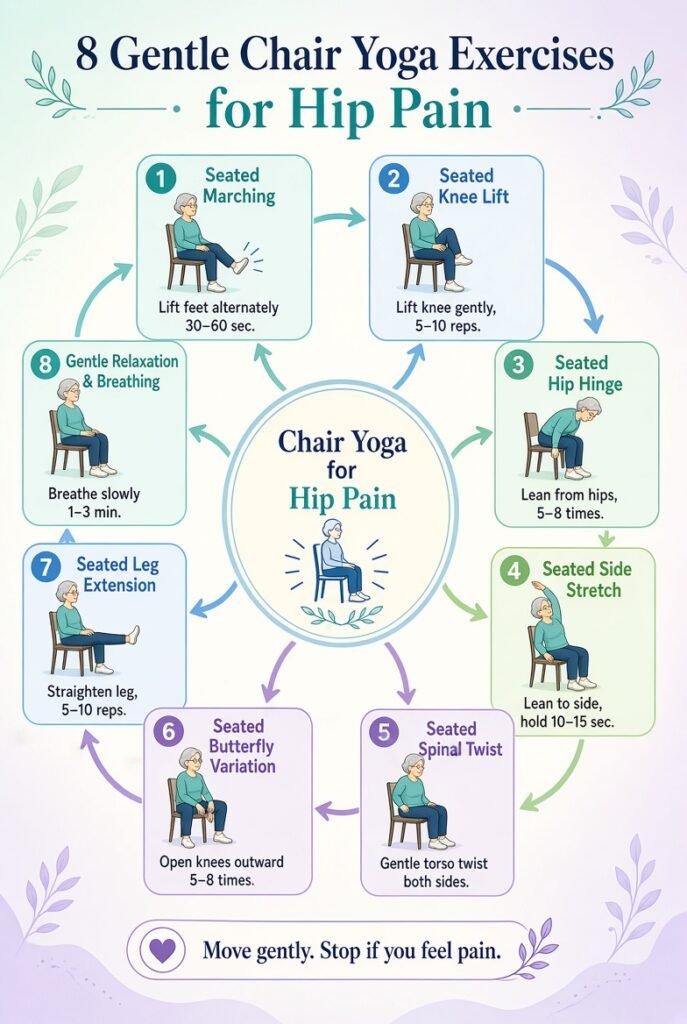
The following chair yoga exercises for hip pain are designed around simple seated movements. They are particularly suitable for beginners and older adults who prefer low-impact exercise.
Use a sturdy, stable chair placed on a non-slip surface. Avoid chairs with wheels.
1. Seated Marching
Seated marching is a simple way to move the hips and legs without standing.
How to do it:
- Sit tall near the middle or front of your chair.
- Keep both feet flat on the floor.
- Hold the sides of the chair if you need additional support.
- Slowly lift your right foot a few inches from the floor.
- Lower it gently.
- Repeat with your left foot.
- Continue alternating for 30–60 seconds.
Try to keep your upper body relaxed while your legs move.
Why it may help:
Seated marching gently moves the hips through a comfortable range of motion. It can also help reduce stiffness after sitting for a long time.
The Arthritis Foundation includes seated marching among gentle movements that can help improve range of motion.
2. Seated Knee Lift
This movement provides a gentle hip-flexion exercise while keeping you seated.
How to do it:
- Sit upright with both feet flat.
- Keep your stomach gently engaged.
- Slowly lift your right knee toward your chest.
- Only lift it as high as feels comfortable.
- Lower your foot slowly.
- Repeat with the other leg.
- Perform 5–10 repetitions on each side.
You do not need to pull your knee toward your chest.
Remember: A smaller movement is perfectly fine if your hip feels stiff.
3. Seated Hip Hinge
This is a gentle movement for the hips and lower back.
How to do it:
- Sit near the front of a sturdy chair.
- Place your feet slightly wider than hip-width apart.
- Keep your spine relatively straight.
- Place your hands on your thighs.
- Slowly lean your upper body forward from your hips.
- Keep your movement comfortable.
- Return to an upright position.
Repeat 5–8 times.
This exercise should feel like a controlled movement from your hips rather than a deep forward bend.
If you have a condition that makes forward bending unsafe or uncomfortable, skip this exercise and ask a healthcare professional about an appropriate modification.
4. Seated Side Stretch
A gentle side stretch can involve the muscles along your waist, back, and hip.
How to do it:
- Sit tall with both feet firmly on the floor.
- Place your left hand on the chair for support.
- Slowly raise your right arm.
- Gently lean your upper body toward the left.
- Keep both hips on the chair.
- Hold for about 10–15 seconds.
- Return slowly to the center.
- Repeat on the opposite side.
Do not force the stretch.
You should feel a mild stretch rather than sharp pain.
5. Seated Spinal Twist
Hip discomfort can sometimes occur together with stiffness in the lower back. A gentle seated twist can help you move your upper body while remaining supported by the chair.
How to do it:
- Sit upright with your feet flat.
- Place your left hand on your right thigh.
- Place your right hand on the side or back of the chair.
- Take a slow breath in.
- As you breathe out, gently rotate your upper body to the right.
- Stop when you feel a comfortable stretch.
- Return to the center.
- Repeat on the other side.
Avoid forcing the rotation.
The Arthritis Foundation includes seated spinal twists among arthritis-friendly yoga movements that can support spinal mobility and posture.
6. Seated Butterfly Variation
A traditional butterfly position can place the feet together and allow the knees to open outward. However, people with hip arthritis or significant hip pain may need a much gentler version.
Try this chair-based variation instead:
- Sit upright.
- Place your feet comfortably apart.
- Turn your toes slightly outward if comfortable.
- Allow your knees to gently move outward.
- Return them to a neutral position.
- Repeat slowly 5–8 times.
Do not push your knees downward.
The Arthritis Foundation describes butterfly stretching as a way to stretch the inner thighs, groin, and hips, while emphasizing slow movement and a gentle stretch.
If this movement causes hip pain, skip it.
7. Seated Leg Extension
Although this movement mainly works the thigh muscles, stronger supporting muscles can help with everyday movements such as standing and walking.
How to do it:
- Sit tall with your back supported.
- Keep your right foot on the floor.
- Slowly straighten your left leg.
- Hold for a few seconds.
- Lower your leg slowly.
- Repeat with the other leg.
- Perform 5–10 repetitions per side.
Keep the movement slow and controlled.
The Arthritis Foundation includes seated leg lifts and related lower-body exercises among movements used to improve strength and mobility.
8. Gentle Seated Relaxation and Breathing
Chair yoga is not only about stretching.
Slow breathing can help you relax your body and finish your routine without rushing.
How to do it:
- Sit comfortably with your back supported.
- Place your hands on your thighs or stomach.
- Relax your shoulders.
- Breathe slowly through your nose.
- Slowly exhale.
- Continue for 1–3 minutes.
Do not force deep breaths. Simply allow your breathing to become slow and comfortable.
Breathing and relaxation techniques are commonly included in arthritis-friendly yoga practices.
A Simple 10-Minute Chair Yoga Routine for Hip Pain
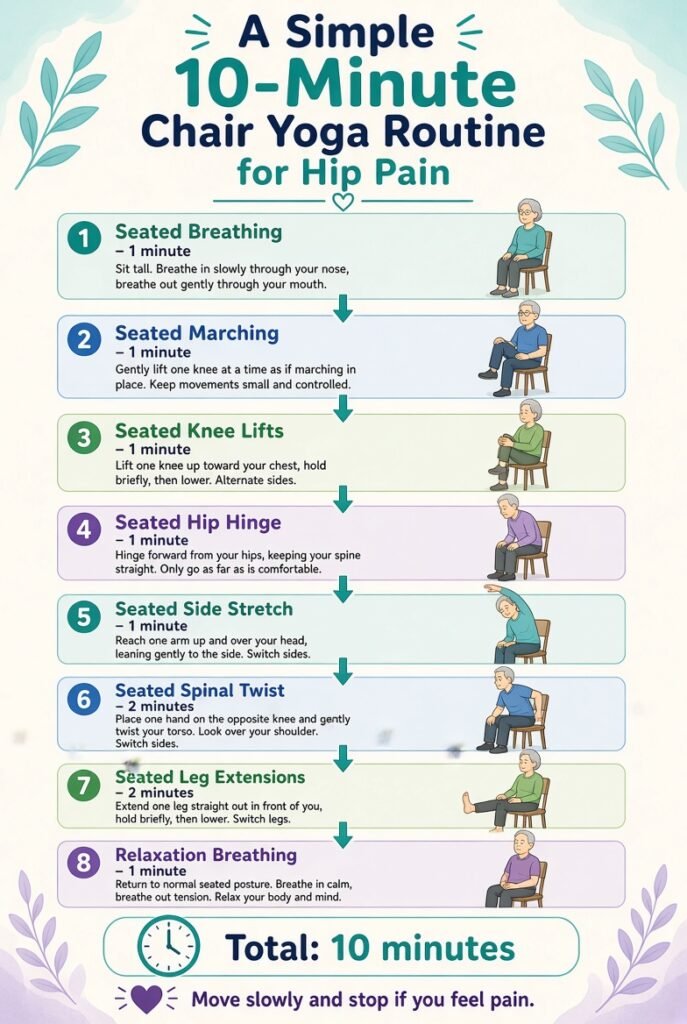
If you are a beginner, you do not need to perform all eight exercises at once.
Instead, try this simple routine:
| Exercise | Suggested Time |
|---|---|
| Seated breathing | 1 minute |
| Seated marching | 1 minute |
| Seated knee lifts | 1 minute |
| Seated hip hinge | 1 minute |
| Seated side stretch | 1 minute |
| Seated spinal twist | 2 minutes |
| Seated leg extensions | 2 minutes |
| Relaxation breathing | 1 minute |
Move slowly between exercises.
Most importantly, comfort is more important than the number of repetitions.
Helpful Yoga Accessory: Yoga Strap
A yoga strap can be useful for people who have limited flexibility and need help maintaining a comfortable position during certain stretches. However, you should never use a strap to force your hip into a deeper stretch.
Chair Yoga for Hip Arthritis
If your hip pain is related to arthritis, you may wonder whether chair yoga is appropriate.
The answer depends on your individual condition.
Yoga can be a useful form of gentle physical activity for many people with arthritis, but some movements may need to be modified. Harvard Health recommends avoiding vigorous practices that aggravate painful joints and adjusting movements when necessary.
The Arthritis Foundation also recommends choosing yoga that is appropriate for your condition and using modifications or props when necessary.
Therefore, chair yoga for hip arthritis should focus on:
- Gentle range of motion
- Comfortable stretching
- Controlled movements
- Good posture
- Breathing and relaxation
- Gradual progression
Do not try to imitate advanced yoga poses simply because someone else can perform them.
Your comfortable range of motion is the correct starting point.
Chair Yoga for Hip and Lower Back Pain
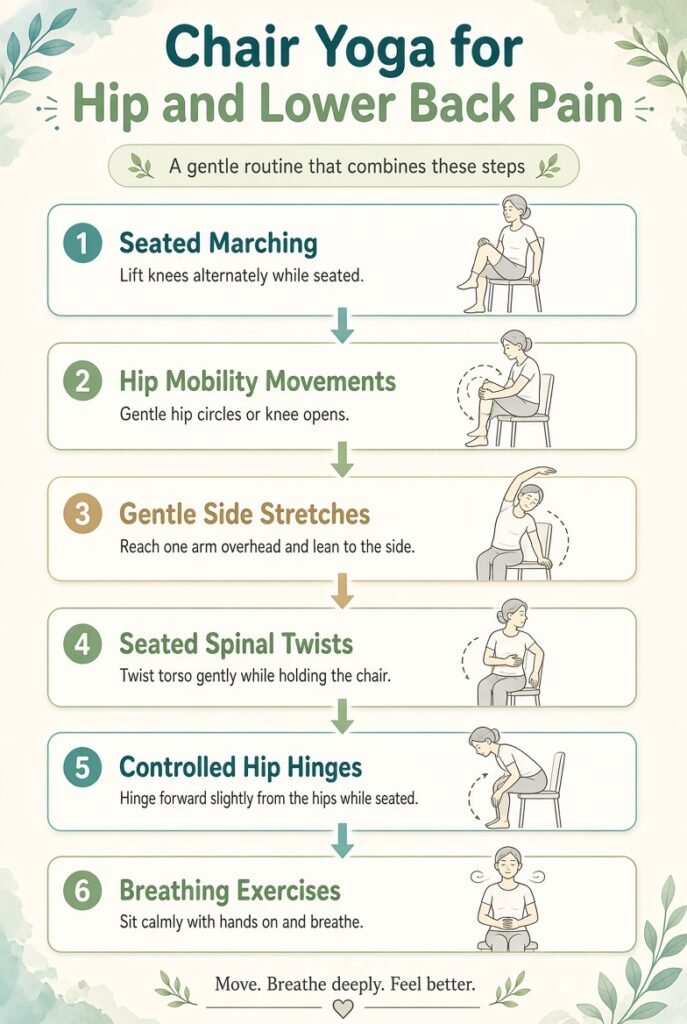
Hip pain and lower-back discomfort can sometimes occur together. Sitting for long periods may also contribute to stiffness around the hips and lower back.
For this reason, a gentle routine can combine:
- Seated marching
- Hip mobility movements
- Gentle side stretches
- Seated spinal twists
- Controlled hip hinges
- Breathing exercises
However, hip pain does not always come from the hip joint itself. Pain can sometimes be related to the lower back, muscles, nerves, or other conditions.
Therefore, persistent or unexplained hip and lower-back pain deserves professional evaluation rather than simply adding more stretching.
Hip Pain Exercises for Seniors With Arthritis
For seniors, the best exercise is often one that can be performed consistently and safely.
Besides chair yoga, other low-impact movements may be useful depending on your condition. The Arthritis Foundation lists exercises such as seated butterfly stretching, knee-to-chest movements, sit-to-stands, side leg raises, and other hip and buttock exercises.
You do not have to perform every exercise.
Instead, start with a few comfortable movements and gradually build your routine.
If an exercise consistently increases your symptoms, stop and ask a qualified professional whether you should modify or replace it.
Helpful Products for a Home Chair Yoga Routine
You don’t need expensive equipment to begin chair yoga. A sturdy chair is usually enough. However, a few simple accessories may make your home routine more comfortable.
1. Supportive Chair
Useful for maintaining stability during seated exercises.
2. Non-Slip Exercise Mat
Useful if you combine chair yoga with standing or floor-based exercises.
3. Resistance Bands
May help with certain gentle stretching movements when used correctly.
4. yoga Chair for adult
Can make longer seated exercise sessions more comfortable.
Explore More Chair Yoga Exercises for Seniors
If you enjoyed these gentle hip-focused movements, you can continue with our complete guide:
10 Best Chair Yoga Exercises for Seniors Over 50 (Safe & Easy at Home)
In that pillar guide, you can explore a broader selection of chair yoga exercises for seniors, including seated stretching, mobility movements, breathing exercises, spinal mobility, and relaxation techniques.
If you are looking for a complete beginner-friendly routine, explore our guide to chair yoga exercises for seniors over 50.
Frequently Asked Questions
Is chair yoga good for hip pain?
Chair yoga may be a useful gentle exercise option for some people with hip pain because it allows you to perform modified movements while remaining seated and supported.
Research summarized by Harvard Health found that, in a small study of older adults with lower-body osteoarthritis involving the hips and knees, chair yoga was associated with less pain and fatigue compared with a health education program.
However, chair yoga is not a treatment for every cause of hip pain. If your pain is severe, persistent, or unexplained, speak with a healthcare professional.
Is yoga good for hip pain?
Gentle yoga may help some people improve flexibility, mobility, strength, posture, and relaxation.
However, evidence specifically for yoga as a treatment for hip osteoarthritis is more limited than the evidence for some other forms of exercise. The American College of Rheumatology/Arthritis Foundation guideline noted insufficient evidence to make a recommendation for yoga specifically for hip osteoarthritis.
Therefore, yoga can be considered one possible form of gentle movement, rather than a guaranteed treatment for hip pain.
What yoga poses should I avoid with hip pain?
Avoid or modify any pose that causes sharp pain, excessive pressure, or uncomfortable hip rotation.
Deep hip-opening poses, extreme stretches, or movements that require you to push beyond your comfortable range may not be appropriate for everyone.
Instead, try a smaller range of motion or use a chair for support.
Can yoga cause hip problems?
Yoga can aggravate an existing hip problem if you force movements, use poor technique, or repeatedly move beyond your current range of motion.
However, gentle and appropriately modified yoga is not automatically harmful.
Listen to your body, avoid painful movements, and consider working with a qualified instructor or physical therapist if you have a significant hip condition.
Can seniors do chair yoga for hip arthritis?
Many seniors can perform modified chair yoga, but the appropriate exercises depend on their individual condition.
If you have significant arthritis, recent surgery, a hip replacement, severe pain, or major mobility limitations, consult your healthcare professional before beginning.
What are the best hip pain exercises to do at home?
There is no single best exercise for everyone with hip pain.
Depending on the cause of the pain and your physical ability, gentle exercises may include seated marching, leg extensions, mobility exercises, gentle stretching, walking, strengthening exercises, or chair yoga.
A physical therapist can help identify exercises appropriate for your specific condition.
How long should I do chair yoga for hip pain?
Beginners can start with around 5–10 minutes and gradually increase the duration if the movements remain comfortable.
You do not need to perform a long routine to benefit from regular movement. Consistency and appropriate exercise selection are more important than forcing yourself through a long session.
Can Yoga Cause Hip Problems?
Yes, yoga can potentially aggravate an existing problem if movements are performed incorrectly, too aggressively, or beyond your current range of motion.
However, that does not mean yoga is inherently harmful to the hips.
The key is how you practice it.
Avoid forcing a stretch just because you think you should feel a strong sensation. Instead, move gradually and stay within a comfortable range.
Harvard Health advises people with arthritis to avoid vigorous practices that aggravate damaged joints, while the Arthritis Foundation emphasizes modifying poses and stopping when movements cause discomfort.
For beginners and older adults, chair-supported or gentle yoga can provide an easier starting point.