
A stiff knee can change the way you move through your entire day.
You may notice it when taking your first steps in the morning, standing after sitting for a long time, walking downstairs, or getting up from your favorite chair. When knee arthritis is involved, it is natural to wonder whether exercise will help or simply make the discomfort worse.
For many older adults, avoiding movement altogether is not the answer. The right type of activity can help maintain strength, flexibility, and everyday mobility. At the same time, some movements may be too demanding when the knee is painful or irritated.
That is why Knee Arthritis exercises should not be about pushing through pain. Instead, they should be about finding comfortable movements, building strength gradually, and keeping your body active.
This guide explains how seniors can approach exercise with knee arthritis, which gentle movements may be useful, which activities may need modification, and how to create a simple routine at home.
Important: This article is for general educational purposes and does not replace medical advice. If you have severe pain, substantial swelling, a recent injury, significant instability, or difficulty putting weight on your leg, consult a qualified healthcare professional before exercising.
When Knee Arthritis Makes Movement Difficult
Knee arthritis can make ordinary movements feel surprisingly challenging.
For example, you might be comfortable while sitting but notice discomfort as soon as you stand. Likewise, walking for several minutes may feel manageable one day but more difficult on another.
Common problems can include:
- Morning stiffness
- Knee discomfort during walking
- Difficulty using stairs
- Trouble standing from a low chair
- Reduced flexibility
- Swelling around the knee
- Reduced confidence when moving
- Less activity because movement feels uncomfortable
Unfortunately, becoming less active can also make the surrounding muscles weaker over time.
That creates a difficult cycle:
Knee discomfort → less movement → reduced strength → more difficulty with everyday movement.
A sensible exercise routine can help break that cycle without requiring an intense workout.
Start With Movement, Not Intensity
If your knees feel stiff, jumping straight into squats or resistance exercises may not be the most comfortable way to begin.
Try gentle movements first.
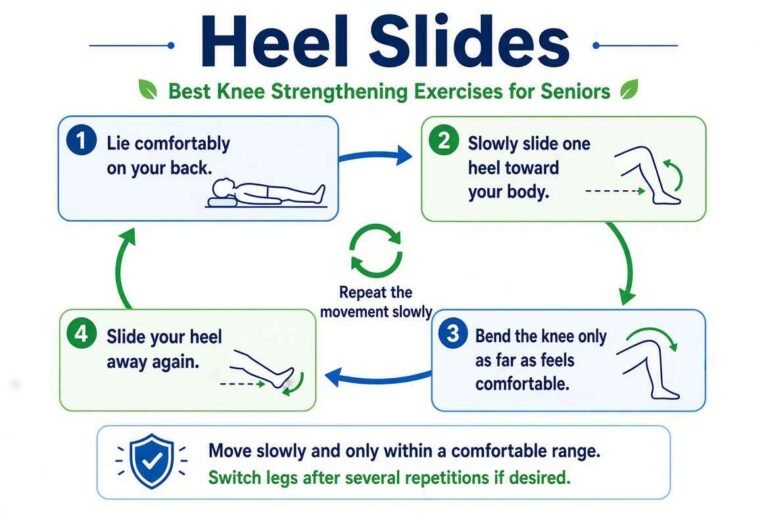
Heel Slides
Heel slides are particularly convenient because they can be performed lying down.
Lie comfortably on your back and slowly slide one heel toward your body. Bend the knee only as far as feels comfortable, then slide your heel away again.
Repeat the movement slowly.
The purpose is simply to move the knee through a comfortable range rather than forcing additional flexibility.
Seated Knee Straightening
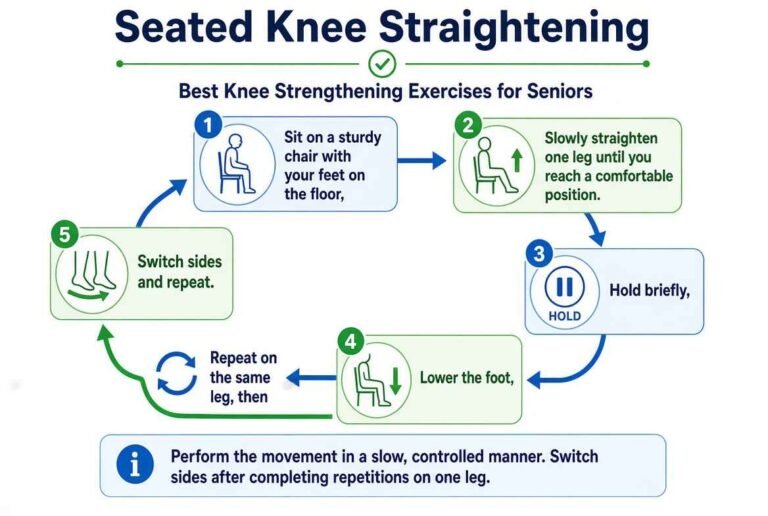
Sit on a sturdy chair with your feet on the floor.
Slowly straighten one leg until you reach a comfortable position. Hold briefly, then lower the foot.
Switch sides and repeat.
This simple movement can be incorporated into your morning routine, especially if your knees feel stiff after sitting.
Ankle Pumps
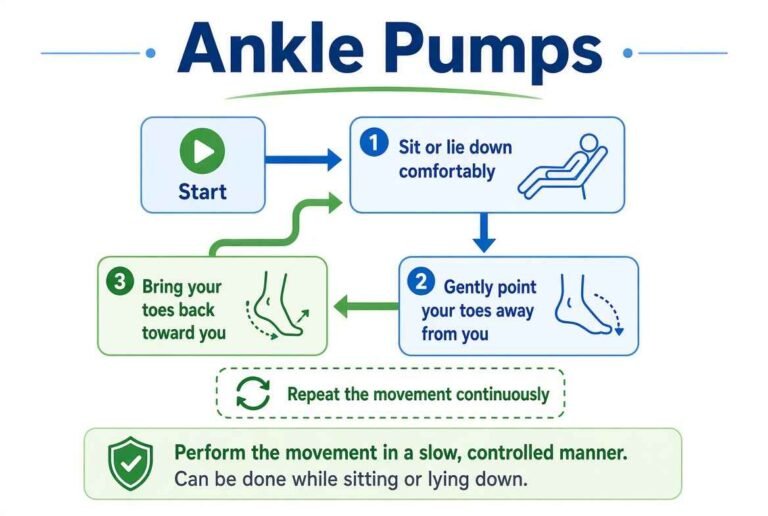
While sitting or lying down, gently point your toes away from you and then bring them back toward you.
Although this is not a knee-strengthening exercise, it provides gentle lower-limb movement and can be an easy addition to a mobility routine.
Once You're Moving, Add Strength
Mobility is only one part of maintaining useful knee function.
The muscles around the knee and hip also help you perform everyday activities. Consequently, gentle strengthening can become an important part of your routine.
Chair Sit-to-Stand
This is one of the most practical exercises because it resembles something you already do every day.
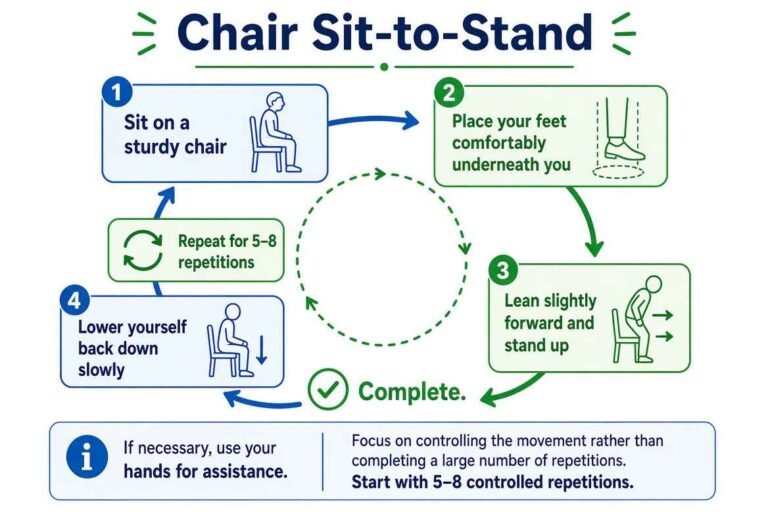
Sit on a sturdy chair.
Place your feet comfortably underneath you, lean slightly forward, and stand up. Then lower yourself back down slowly.
If necessary, use your hands for assistance.The important part is controlling the movement rather than completing a large number of repetitions.
Start with 5–8 repetitions.
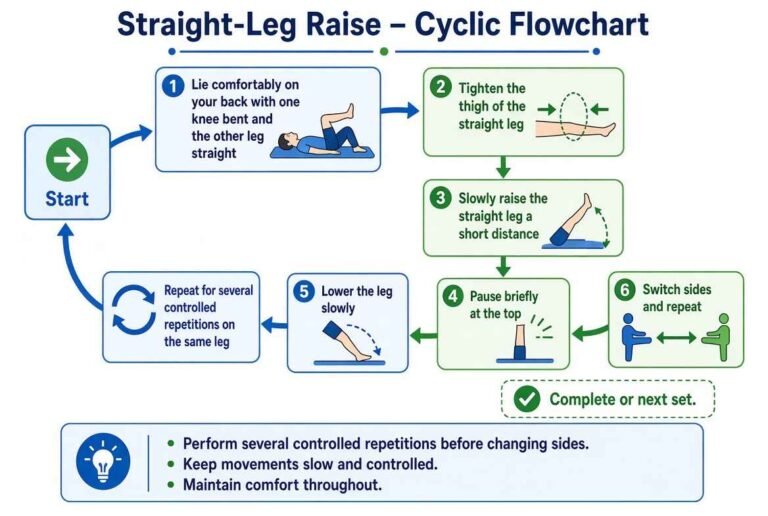
Straight-Leg Raise
Lie comfortably on your back with one knee bent and the other leg straight.
Tighten the thigh of the straight leg and slowly raise it a short distance. Pause briefly, then lower it.
Perform several controlled repetitions before changing sides.
If getting onto the floor is difficult, skip this exercise rather than struggling to get into position.
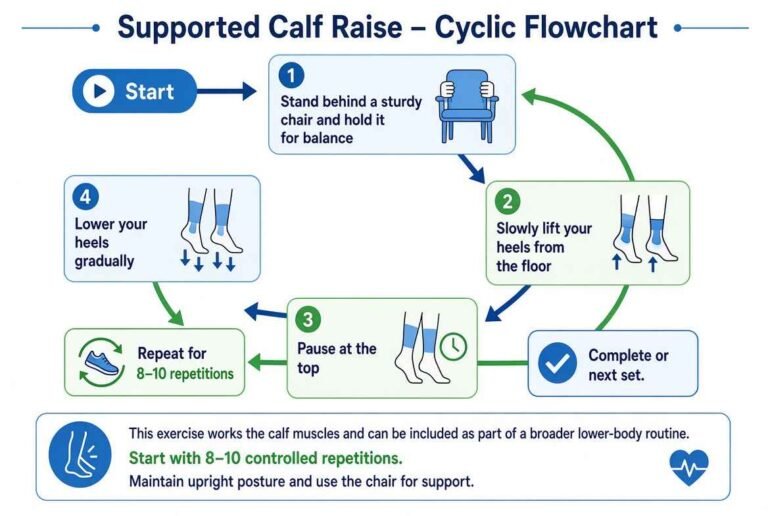
Supported Calf Raise
Stand behind a sturdy chair and hold it for balance.
Slowly lift your heels from the floor, pause, and then lower them.
This exercise works the calf muscles and can be included as part of a broader lower-body routine.
Start with 8–10 repetitions.
What About Knee Arthritis Exercises at Home?
You do not need a home gym to begin.
A sturdy chair can provide support. A comfortable pair of shoes can make standing exercises easier. A small exercise mat can make floor exercises more comfortable.
That is enough for many beginners.
A simple home session could look like this:
First: 2–3 minutes of gentle mobility.
Next: seated knee extensions and sit-to-stands.
Then: calf raises or another comfortable strengthening movement.
Finally: a short, easy walk if walking is appropriate for you.
This approach is often easier to maintain than trying to follow a complicated exercise program.
Exercises to Improve Mobility When Your Knees Feel Stiff
Some days, stiffness may be a bigger problem than weakness.
On those days, focus on movement rather than resistance.
Try:
- Heel slides
- Seated knee extensions
- Gentle walking
- Ankle pumps
- Comfortable leg movements
You can perform these movements for a few minutes and see how your knees respond.
There is no need to force a particular range of motion.
If your knee becomes increasingly painful as you continue, stop rather than assuming that more movement is always better.
Can You Do Knee Arthritis Exercises in Bed?
Yes, some gentle movements can be performed in bed.
This can be especially convenient if your knees feel stiff when you first wake up.
A simple morning sequence
While lying comfortably:
1. Ankle pumps
Move your feet gently forward and backward.
2. Heel slides
Slowly bend one knee and then straighten it.
3. Gentle thigh tightening
Tighten the thigh muscle of one leg for a few seconds and relax.
4. Repeat on the other side.
The entire sequence can take only a few minutes.
The purpose is not to perform a workout before getting out of bed. Instead, it provides a gentle transition from rest to movement.
Knee Osteoarthritis Exercises for Older Adults
For older adults with osteoarthritis, the best exercise program is usually one that can be performed consistently and adjusted to individual ability.
For example, someone who is relatively active may tolerate more challenging strengthening exercises. Another person with significant stiffness may need to begin with seated movements.
Therefore, do not compare your exercise routine with someone else’s.Your starting point might be five minutes of movement.That is still a starting point.
Over time, you can gradually increase your activity as your body allows.
Knee Arthritis Exercises to Avoid: Think Beyond a Simple List
Searches for “Knee Arthritis exercises to avoid” often produce long lists of supposedly bad exercises.
The reality is more nuanced.
An exercise is not automatically unsuitable simply because you have knee arthritis. Your symptoms, technique, fitness level, joint condition, and exercise intensity all matter.
For example, a movement performed comfortably with a small range of motion may be very different from the same movement performed deeply, quickly, or with heavy resistance.
What Exercises Are Bad for Arthritis Knees?
Instead of asking whether a particular exercise is universally “bad,” ask:
Does this movement suit my current knee condition?
An exercise may be inappropriate if it repeatedly causes:
- Sharp pain
- Significant swelling
- Knee instability
- A feeling that the joint is giving way
- Major worsening of symptoms
- Difficulty walking afterward
Your response to exercise matters more than whether an exercise appears on an online “avoid” list.
A Gentle 10-Minute Routine
If you want something simple, try organizing your session like this:
Minutes 1–3: Mobility
- Ankle pumps
- Heel slides
- Seated knee extensions
Minutes 4–7: Strength
- Sit-to-stand
- Supported calf raises
- Straight-leg raises if comfortable
Minutes 8–10: Gentle movement
Walk slowly around your home or perform another comfortable low-impact activity.
You do not need to complete the entire routine every day.The purpose is to give you a simple framework that can be adjusted to your ability.
When Exercise Is Not Enough
Exercise can be useful, but it should not be treated as a complete solution for every knee problem.
Contact a healthcare professional if you experience:
- Severe or persistent pain
- Significant swelling
- A recent injury
- Repeated knee instability
- Inability to put weight on the leg
- Sudden loss of movement
- Symptoms that are getting progressively worse
A physical therapist can also assess how you move and help create an exercise program based on your individual needs.
Frequently Asked Questions
Is exercise good for arthritis in the knees?
For many people with knee osteoarthritis, appropriately selected exercise can support mobility, muscle strength, physical function, and overall activity. The exercise should be adjusted to the person’s symptoms and physical ability.
What exercises should you avoid for knee arthritis?
Exercises that consistently cause significant pain, swelling, instability, or worsening symptoms should be avoided or modified. High-impact activities and deep knee-bending movements may need particular caution for some people.
What exercises are bad for arthritis knees?
There is no universal list of exercises that are bad for every person with arthritis. The important consideration is whether an activity is appropriate for your condition and whether you can perform it without significant symptoms.
What exercise is best for arthritis knees?
There is no single best exercise. Gentle strengthening movements such as sit-to-stands, seated knee extensions, straight-leg raises, and supported calf raises can be useful options for many seniors. Walking and other low-impact activities can also complement strengthening work.
Final Thoughts
And when an exercise consistentlyThe purpose of Knee Arthritis exercises is not to prove how much exercise you can tolerate.
It is to help you keep moving in a way that fits your body.
For some seniors, that may begin with a few heel slides in bed. For others, it may be a short walk followed by sit-to-stands and gentle strengthening exercises.
Start where you are.
Move with control.
Progress gradually. causes significant pain or other concerning symptoms, do not simply push through it.
For more information about exercises related to knee and hip discomfort, visit our Knee & Hip Pain Exercises pillar page. You can also read Knee Pain Relief Naturally With Gentle Exercises for Seniors for another perspective on gentle approaches to managing knee discomfort.
The goal is not a perfect workout. The goal is maintaining movement, strength, and confidence in everyday life.