
Hip pain can make everyday activities feel more difficult as we get older. Getting out of bed, climbing stairs, walking to the grocery store, or even sleeping comfortably on your side may become challenging when your hips feel stiff or sore. Fortunately, the right hip pain exercises for seniors may help improve flexibility, strengthen supporting muscles, and make daily movements more comfortable.
However, not every hip exercise is suitable for every person. Hip discomfort can result from osteoarthritis, muscle weakness, bursitis, tendon problems, or other conditions. Therefore, choosing gentle movements that match your symptoms and physical abilities is essential.
In this guide, you will learn eight gentle hip pain exercises you can try at home, how to modify them for arthritis, which movements to avoid when your hip hurts, and when to seek professional advice. You will also discover practical ways to manage hip discomfort during walking, sleeping, and other everyday activities.
Important: These exercises are general educational guidance, not a substitute for an individualized medical assessment. If your hip pain is new, severe, worsening, or unexplained, consult a healthcare professional before starting an exercise program.
Visit My Amazon Storefront and Explore your hip pain exercise equipment.
Affiliate disclosure: Senior Gentle Fitness may use affiliate links. If you purchase a product through an affiliate link, we may receive a commission at no additional cost to you.
What Causes Hip Pain in Older Adults?
Before choosing the best exercises for hip pain relief, it helps to understand what might be causing your discomfort. The location of your pain, when it occurs, and which movements trigger it can provide useful clues, although they cannot establish a diagnosis on their own.
Common causes of hip pain include:
Hip osteoarthritis: Wear-related changes in the hip joint may cause stiffness, reduced movement, and pain during walking or standing.
Greater trochanteric pain syndrome: Pain around the outer hip can involve irritated tendons and nearby tissues, sometimes making side-sleeping uncomfortable.
Muscle weakness or strain: Weak hip and gluteal muscles or an overstretched muscle may contribute to discomfort during daily activities.
Tendon problems: Irritation of the tendons around the hip may cause pain during walking, climbing stairs, or standing on one leg.
Back-related pain: Problems in the lower back can sometimes produce pain that spreads toward the hip or buttock.
Other medical conditions: Fractures, infections, inflammatory conditions, and other problems can also cause hip pain and may require prompt treatment.
For this reason, the best hip pain exercises depend on the underlying cause, your symptoms, and your current mobility.
Why Does Hip Pain Occur When Walking?
Hip pain when walking may develop because the joint and surrounding muscles experience repeated loading during each step. People with hip osteoarthritis, tendon problems, or muscle weakness may notice discomfort after walking for a certain distance.
If walking aggravates your symptoms, try shorter, more frequent walks on level ground instead of one long session. Use a comfortable pace and supportive footwear. A walking aid may also help some people, but a healthcare professional can advise you about the correct type and fit.
Do not push through sharp, increasing, or unexplained pain simply to complete your walk.
Why Does My Hip Hurt When I Sleep on My Side?
Hip pain from sleeping on your side often occurs when pressure is placed directly on the outer hip. This pattern can be associated with greater trochanteric pain syndrome, although other causes are possible.
To reduce pressure, consider these adjustments:
Sleep on your back with a pillow under your knees if that position feels comfortable.
If you prefer side-sleeping, try lying on the less painful side with a pillow between your knees.
Avoid lying directly on the painful outer hip when that position triggers symptoms.
Choose a sleeping position that keeps your hips comfortable without forcing them into an extreme angle.
8 Gentle Hip Pain Exercises for Seniors
The following hip pain exercises focus on comfortable movement, flexibility, and gradual strengthening. Start with a few repetitions rather than attempting the entire routine at once.
Choose a stable chair without wheels, keep your surroundings clear, and have a sturdy support nearby when needed. Move slowly and breathe normally throughout each exercise.
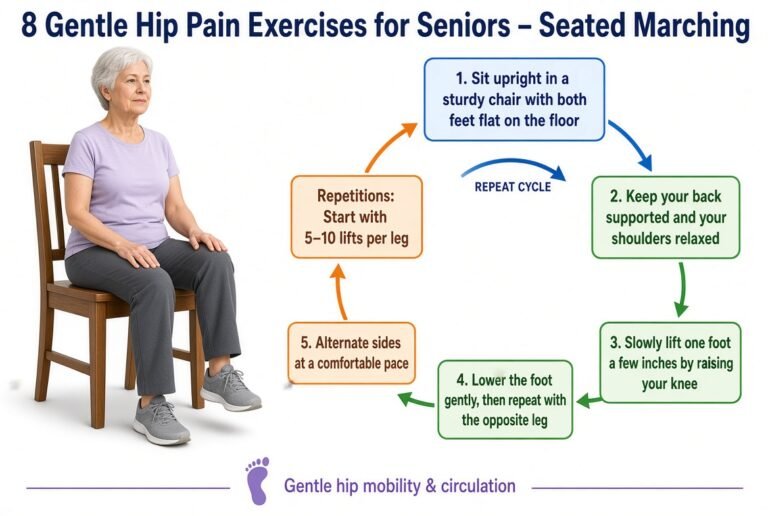
1. Seated Marching
Best for: Gentle hip movement and maintaining mobility.
Seated marching is a useful starting point for older adults who find standing exercises difficult or tiring.
How to do it:
Sit upright in a sturdy chair with both feet flat on the floor.
Keep your back supported and your shoulders relaxed.
Slowly lift one foot a few inches from the floor by raising your knee.
Lower the foot gently, then repeat with the opposite leg.
Alternate sides at a comfortable pace.
Repetitions: Start with 5–10 lifts per leg.
2. Seated Knee Extensions
Best for: Strengthening the thigh muscles that support everyday movement.
Although this exercise primarily targets the quadriceps, maintaining thigh strength can support activities such as standing up from a chair and walking.
How to do it:
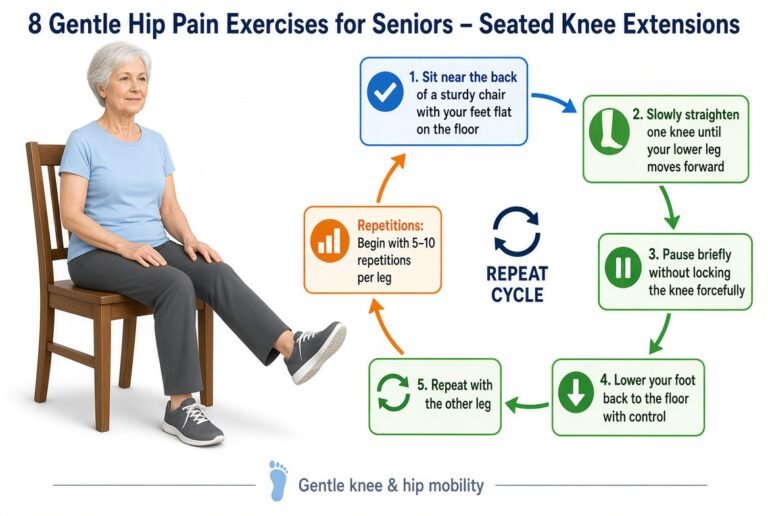
Sit near the back of a sturdy chair with your feet flat on the floor.
Slowly straighten one knee until your lower leg moves forward.
Pause briefly without locking the knee forcefully.
Lower your foot back to the floor with control.
Repeat with the other leg.
Repetitions: Begin with 5–10 repetitions per leg.
3. Standing Hip Abduction
Best for: Gradually strengthening the muscles on the outside of the hip.
The hip abductor muscles help stabilize the pelvis during walking. However, this exercise may not suit everyone with outer hip pain, particularly when the surrounding tendons are irritated.
How to do it:
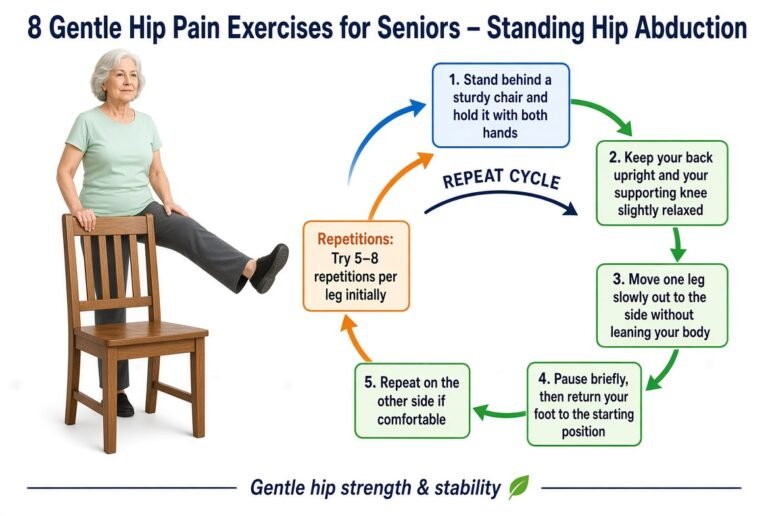
Stand behind a sturdy chair and hold it with both hands.
Keep your back upright and your supporting knee slightly relaxed.
Move one leg slowly out to the side without leaning your body.
Pause briefly, then return your foot to the starting position.
Repeat on the other side if comfortable.
Repetitions: Try 5–8 repetitions per leg initially.
4. Supported Mini Squats
Best for: Building functional strength for standing and sitting.
Mini squats work several muscles around the hips and thighs. Because they place additional load through the lower body, they should be introduced gradually.
How to do it:
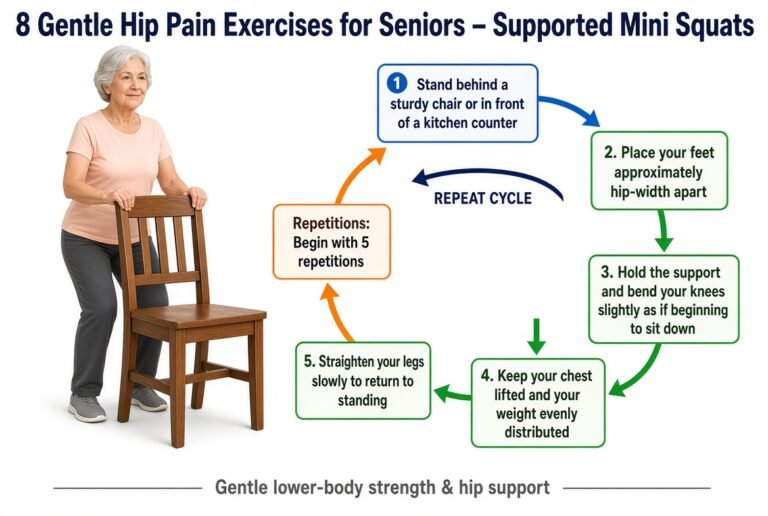
Stand behind a sturdy chair or in front of a kitchen counter.
Place your feet approximately hip-width apart.
Hold the support and bend your knees slightly as if beginning to sit down.
Keep your chest lifted and your weight evenly distributed.
Straighten your legs slowly to return to standing.
Repetitions: Begin with 5 repetitions.
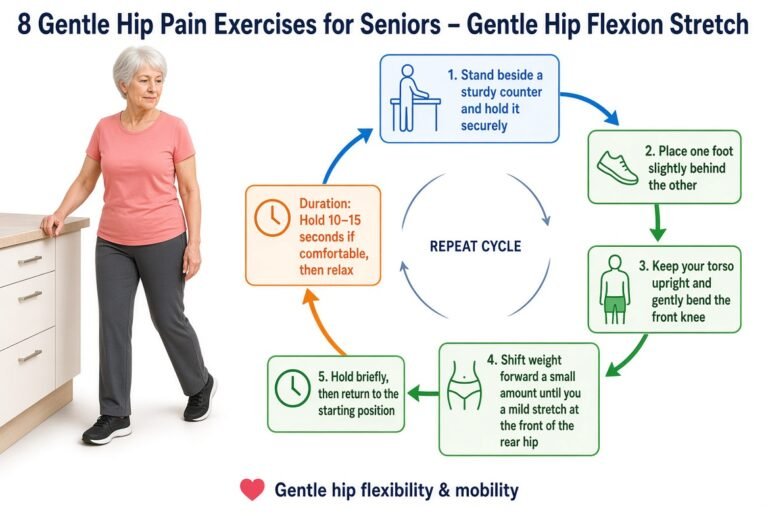
5. Gentle Hip Flexion Stretch
Best for: Maintaining comfortable movement at the front of the hip.
Tightness around the front of the hip may affect some people’s movement. However, stretching is not always appropriate during an acute flare-up or when a particular hip position causes pain.
How to do it:
Stand beside a sturdy counter and hold it securely.
Place one foot slightly behind the other.
Keep your torso upright and gently bend the front knee.
If comfortable, shift your weight forward a small amount until you feel a mild stretch at the front of the rear hip.
Hold briefly, then return to the starting position.
Duration: Hold for approximately 10–15 seconds if comfortable, then relax.
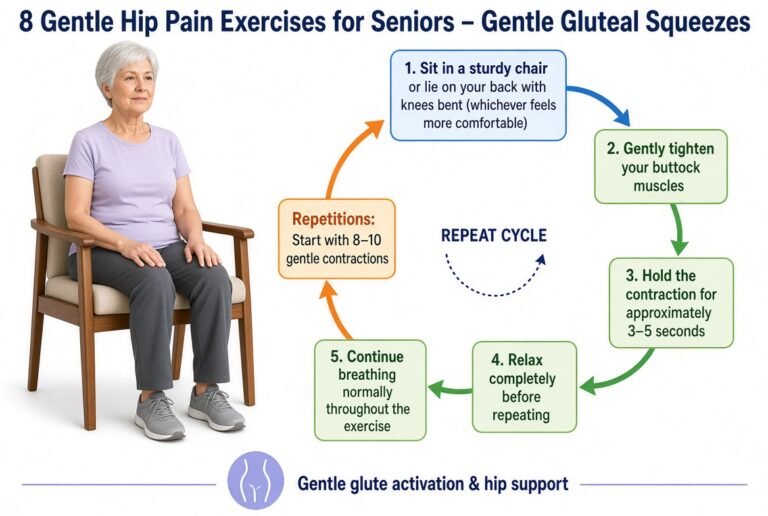
6. Gentle Gluteal Squeezes
Best for: Activating the buttock muscles without requiring much hip movement.
This simple exercise can be a practical starting point for people who cannot comfortably perform standing movements.
How to do it:
Sit in a sturdy chair or lie on your back with your knees bent, whichever position feels more comfortable.
Gently tighten your buttock muscles.
Hold the contraction for approximately 3–5 seconds.
Relax completely before repeating.
Continue breathing normally throughout the exercise.
Repetitions: Start with 8–10 gentle contractions.
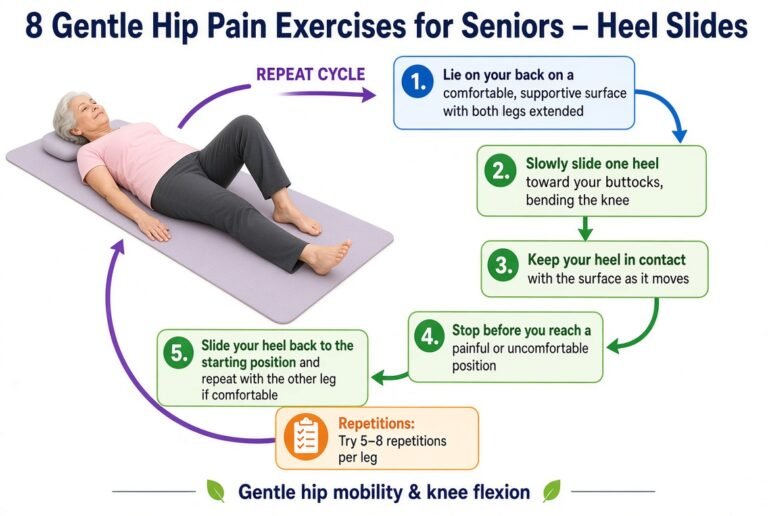
7. Heel Slides
Best for: Maintaining comfortable movement in the hip and knee.
Heel slides allow you to move your leg while supported by a bed or exercise mat. They can be useful when standing exercises are too demanding.
How to do it:
Lie on your back on a comfortable, supportive surface with both legs extended.
Slowly slide one heel toward your buttocks, bending the knee.
Keep your heel in contact with the surface as it moves.
Stop before you reach a painful or uncomfortable position.
Slide your heel back to the starting position and repeat with the other leg if comfortable.
Repetitions: Try 5–8 repetitions per leg.
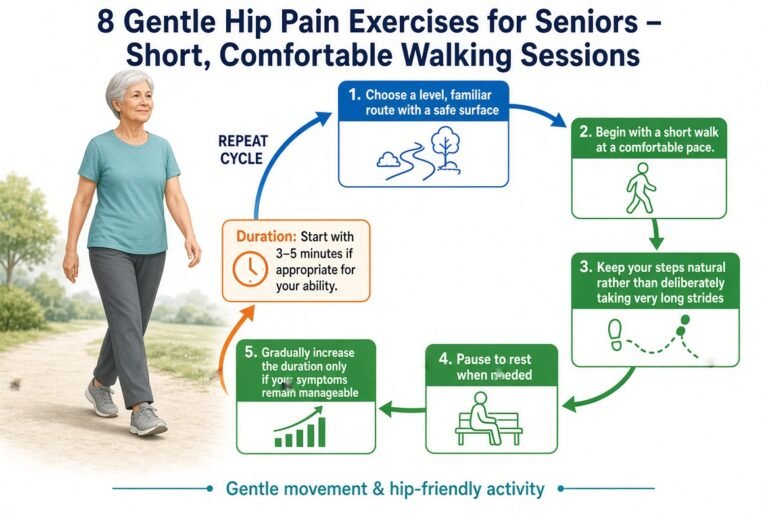
8. Short, Comfortable Walking Sessions
Best for: Maintaining general mobility and everyday physical activity.
Walking is not a stretching exercise, but appropriately paced walking can help many older adults maintain physical function and confidence with movement.
How to do it:
Choose a level, familiar route with a safe surface.
Begin with a short walk at a comfortable pace.
Keep your steps natural rather than deliberately taking very long strides.
Pause to rest when needed.
Gradually increase the duration only if your symptoms remain manageable.
Duration: Start with 3–5 minutes if that is appropriate for your current ability.
Hip Pain Exercises With Arthritis
Hip osteoarthritis can cause stiffness, discomfort during weight-bearing activities, and reduced mobility. Nevertheless, appropriately selected exercise is commonly recommended as part of conservative management for hip osteoarthritis.
The goal is not to eliminate every sensation of discomfort immediately. Instead, the aim is to improve strength and function without provoking a substantial or persistent symptom flare.
If you have arthritis, consider the following principles:
Start gently: Use fewer repetitions and a smaller movement range at first.
Prioritize control: Slow, controlled movements are generally easier to monitor than fast or forceful repetitions.
Build gradually: Increase repetitions or walking duration one step at a time.
Balance activity and rest: Avoid doing much more on a good day and then becoming inactive because of a flare-up.
Seek individualized advice: A physiotherapist can tailor strengthening and mobility work to your joint function and symptoms.
For more guidance, read our Knee Pain Relief Naturally With Gentle Exercises for Seniors. Although it focuses on the knee, it provides related information about gentle movement and managing discomfort during everyday activity.
Hip Pain Exercises for Women and Men
Hip pain can affect both women and men, and the most appropriate exercises depend more on the underlying condition, strength, mobility, and overall health than on sex alone.
Women may experience hip discomfort associated with osteoarthritis, tendon problems, previous injuries, or changes in bone health. Men can experience many of the same conditions, including osteoarthritis, muscle strains, and tendon irritation.
Therefore, both women and men can benefit from an individualized exercise program that focuses on comfortable mobility, progressive strengthening, and functional movement.
Age, previous injuries, osteoporosis risk, balance, and other medical conditions may influence which exercises are appropriate. If you have a history of hip fracture, a recent joint replacement, or a condition affecting your bones, seek guidance before starting a new routine.
What About Hip Pain Exercises for Runners?
Although this article focuses on seniors, older adults who continue running may experience hip pain related to training load, muscle weakness, tendon problems, or other conditions.
If running triggers pain, reduce or temporarily stop the activity that provokes it rather than attempting to run through worsening symptoms. Gentle exercises may help maintain movement, but the correct rehabilitation plan depends on the cause.
Persistent pain, limping, or pain that occurs at rest should be assessed before returning to running.
A Simple 10-Minute Hip Mobility Routine at Home
If your healthcare professional has confirmed that gentle exercise is suitable, you can use the following routine as a starting framework. You do not need to complete every exercise if your mobility or symptoms limit you.
| Exercise | Suggested amount |
|---|---|
| Seated marching | 1 minute |
| Seated knee extensions | 1–2 minutes |
| Gluteal squeezes | 1 minute |
| Heel slides | 1–2 minutes |
| Supported mini squats, if comfortable | 1 minute |
| Short, easy walking or rest breaks | Remaining time as tolerated |
Move slowly and take breaks whenever necessary. The routine is a guide, not a requirement to exercise for exactly 10 minutes.
During your first session, you may find that only two or three exercises are comfortable.
If symptoms become worse during exercise or remain significantly worse afterward, reduce the workload and consult a healthcare professional.
Can Home Exercise Equipment Help With Hip Pain?
You do not need expensive equipment to begin gentle hip mobility exercises. A stable chair, a clear floor space, and a sturdy counter for support may be enough.
However, some people find basic equipment useful when a clinician has recommended a suitable exercise program.
A resistance band: A light resistance band can be used for selected strengthening exercises. Start with low resistance and obtain guidance if you have significant pain or difficulty controlling the movement.
An exercise mat: A supportive mat may make floor-based exercises more comfortable, although a bed may be easier for people who have difficulty getting down to or up from the floor.
A supportive chair: A stable chair with a firm seat and appropriate height can help you perform seated exercises safely.
A walking aid: If pain or balance problems make walking difficult, a properly fitted cane or walker may improve safety. Ask a healthcare professional which option is appropriate and how to use it.
For home exercise equipment, choose products based on stability, comfort, ease of use, and suitability for your individual needs. Avoid buying a product on the assumption that it will treat the underlying cause of hip pain.
Visit My Amazon Storefront and purchase your home exercise equipment.
Affiliate disclosure: Senior Gentle Fitness may use affiliate links. If you purchase a product through an affiliate link, we may receive a commission at no additional cost to you.
Frequently Asked Questions About Hip Pain Exercises
1. What are the exercises for hip pain?
Exercises sometimes used for hip pain include seated marching, seated knee extensions, gentle heel slides, gluteal squeezes, and selected standing strengthening exercises. The best choices depend on the cause of your pain and your current mobility.
2. What exercises are good for hip pain?
Gentle mobility exercises and progressive strengthening can help many people with hip pain. Seated marching and heel slides may be suitable starting points, while supported mini squats or standing hip exercises may be appropriate for people who can perform them comfortably. A physiotherapist can help select the right movements for your condition.
3. What exercises can I do with hip pain?
If gentle movement is appropriate for your symptoms, you might begin with seated marching, seated knee extensions, or gluteal squeezes. Start with a small number of repetitions and avoid movements that cause sharp or increasing pain. If the pain is new, severe, unexplained, or getting worse, seek medical advice before exercising.
4. What are the best exercises for hip pain?
There is no single best exercise for every type of hip pain. For some people, gentle mobility work is a useful starting point; others benefit from progressive strengthening and walking. The most effective program is one that addresses the underlying problem and can be performed safely and consistently.
Final Thoughts
Hip pain can interfere with walking, sleep, and the everyday activities that help older adults maintain independence. Fortunately, the right combination of gentle movement, gradual strengthening, activity modification, and professional guidance may improve mobility and physical function.
Start with comfortable movements such as seated marching, heel slides, or gluteal squeezes if they are appropriate for your symptoms. Progress gradually, avoid forcing painful positions, and pay attention to how your hip responds during and after exercise.
Most importantly, do not assume that every hip problem can be solved with stretching. Persistent, worsening, or unexplained pain deserves professional assessment so that your exercise plan addresses the actual cause.
For more practical guidance, explore our Knee and Hip Pain Relief Exercises pillar page and related articles on gentle exercises for older adults. Together, these resources can help you make more informed decisions about safe movement, daily comfort, and maintaining an active lifestyle.
Visit My related blogpost: