
Chair Yoga for Balance: 8 Gentle Exercises for Seniors
Maintaining balance can become more challenging as we get older. Everyday movements such as getting up from a chair, turning around, reaching for something, or walking across the room all require a combination of strength, coordination, flexibility, and body awareness.
That doesn’t mean you need to start with difficult standing exercises.
Chair yoga for balance for seniors offers a gentler starting point. By performing yoga-inspired movements while seated, or using a sturdy chair for support when appropriate, you can work on controlled movement without immediately putting yourself into challenging balance positions.
Chair-based exercise can also provide a stable base for people who have difficulty balancing or standing for long periods. Harvard Health describes chair yoga as an accessible form of yoga for people who have difficulty with balance, standing, or getting down to the floor.
In this guide, you’ll learn simple chair yoga exercises for balance that you can practice at home.
Important: These exercises are intended for general fitness and education. Chair yoga is not a treatment for a balance disorder and cannot guarantee fall prevention. If you frequently lose your balance, have fallen recently, experience dizziness, or have a medical condition affecting your balance, talk with a healthcare professional before starting a new exercise routine.
What Is Chair Yoga for Balance?
Chair yoga for balance for seniors is a modified approach to yoga and gentle exercise that uses a chair as a stable base.
Many movements can be performed completely seated. Some exercises may eventually progress to standing beside the chair while holding it for support, depending on your ability and comfort.
Unlike traditional yoga, you don’t need to get down onto a floor or perform difficult poses.
Instead, chair yoga can combine:
- Gentle stretching
- Seated mobility exercises
- Controlled leg movements
- Posture exercises
- Breathing
- Body-awareness exercises
- Supported balance movements
This makes it particularly useful for seniors and beginners who want to introduce more movement into their daily routine.
Harvard Health notes that chair yoga modifies traditional yoga positions so they can be performed while seated or with a chair providing support.
If you’re completely new to chair yoga, start with our main guide to Chair Yoga Exercises for Seniors at Home before progressing to more specific routines.
Can Chair Yoga Help Improve Balance?
Balance is more than simply standing on one foot.
Your ability to stay steady depends on several factors, including leg strength, mobility, posture, coordination, body awareness, and your ability to control movement.
The National Institute on Aging recommends that older adults include balance activities as part of a varied exercise routine. Examples include yoga, standing exercises, heel-to-toe walking, and practicing standing from a seated position.
Chair yoga can be useful because many exercises begin from a supported seated position.
For example, seated marching encourages controlled leg movement. Seated leg extensions work on lower-body control. Gentle torso movements encourage mobility, while supported sit-to-stand exercises can introduce a functional movement used in everyday life.
However, chair yoga should be considered one part of a broader fitness routine, rather than a guaranteed solution for balance problems.
8 Chair Yoga Exercises for Balance
You don’t need to perform all eight exercises in your first session.
Start with three or four movements that feel comfortable. As you become more familiar with them, you can gradually add other exercises.
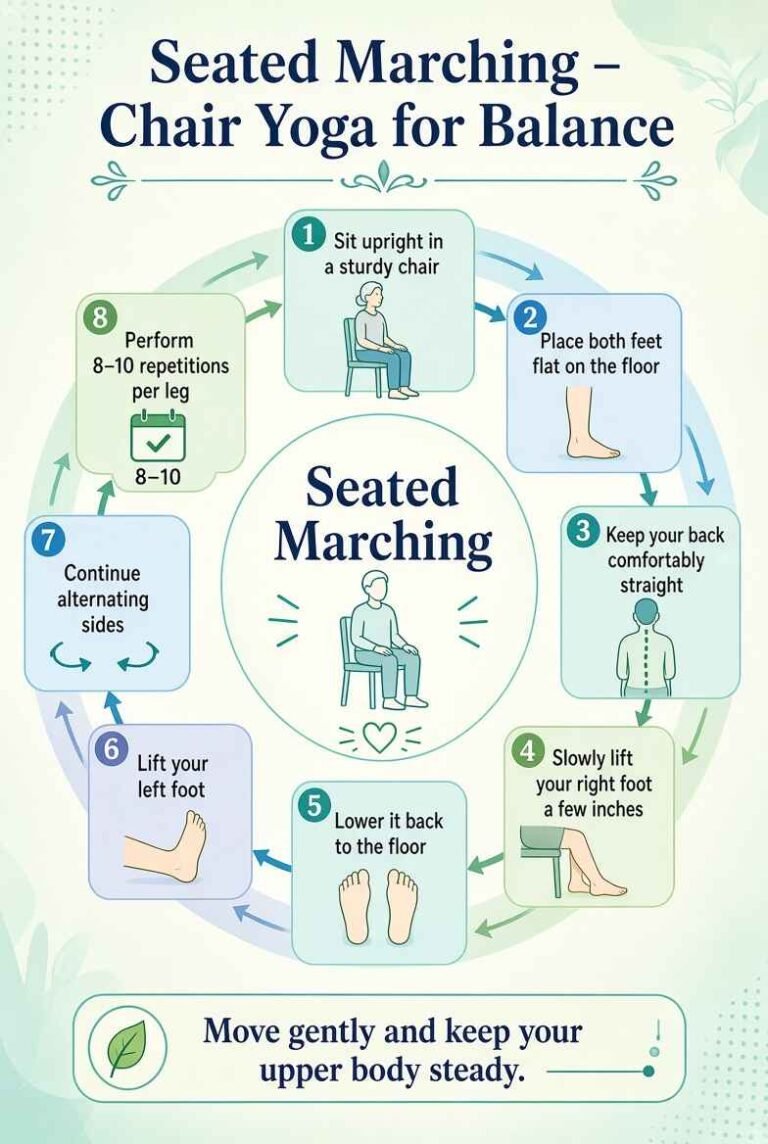
1. Seated Marching
Seated marching is one of the easiest ways to begin a balance-focused chair routine.
How to do it
- Sit upright in a sturdy chair.
- Place both feet flat on the floor.
- Keep your back comfortably straight.
- Slowly lift your right foot a few inches.
- Lower it back to the floor.
- Lift your left foot.
- Continue alternating sides.
- Perform 8–10 repetitions per leg.
Try not to lean backward or from side to side.
Why try it?
Seated marching encourages hip movement, coordination, and controlled leg movement. It can also serve as a gentle warm-up before other chair yoga exercises.
Harvard Health includes seated marching among chair-based exercises that can be used to add movement and cardiovascular activity to a routine.
2. Seated Knee Extensions
This simple exercise focuses on controlled movement of one leg at a time.
How to do it
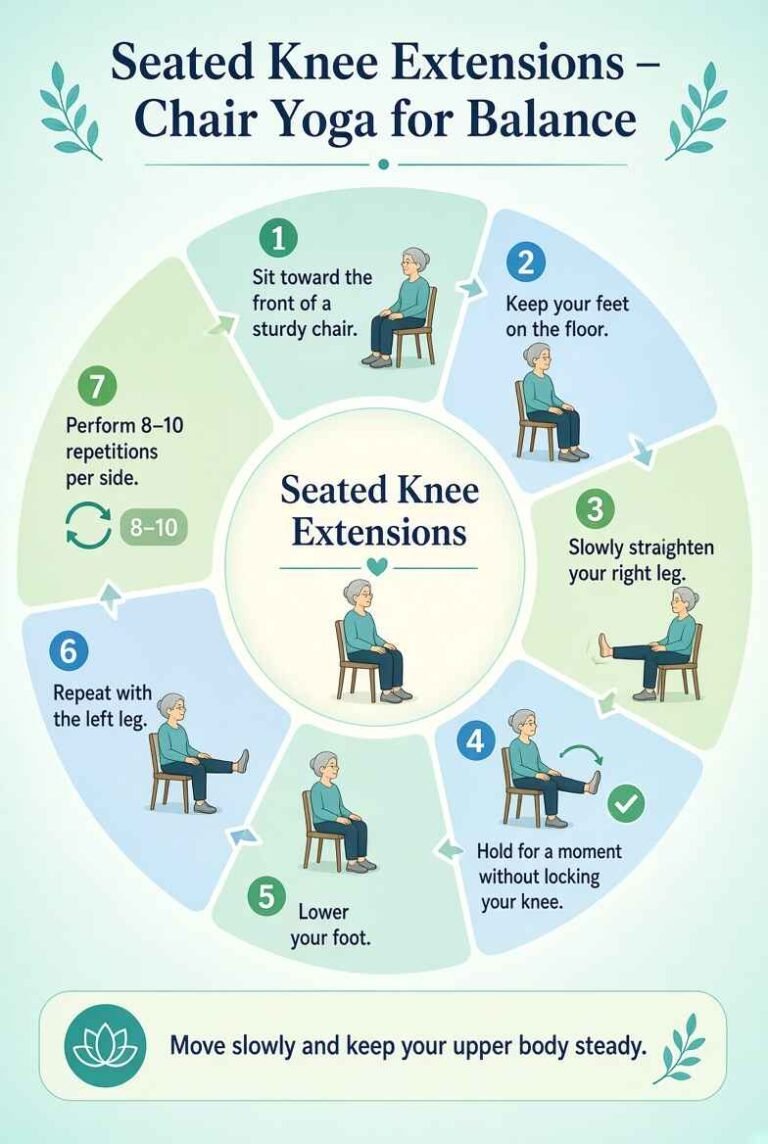
- Sit toward the front of a sturdy chair.
- Keep your feet on the floor.
- Slowly straighten your right leg.
- Hold for a moment without locking your knee.
- Lower your foot.
- Repeat with the left leg.
- Perform 8–10 repetitions per side.
Keep the movement comfortable. You don’t need to fully straighten your knee if that feels uncomfortable.
Why try it?
Controlled leg movements can help you practice coordination and lower-body control while remaining seated.
3. Seated Heel and Toe Raises
Your feet and ankles play an important role in everyday movement and stability.
How to do it
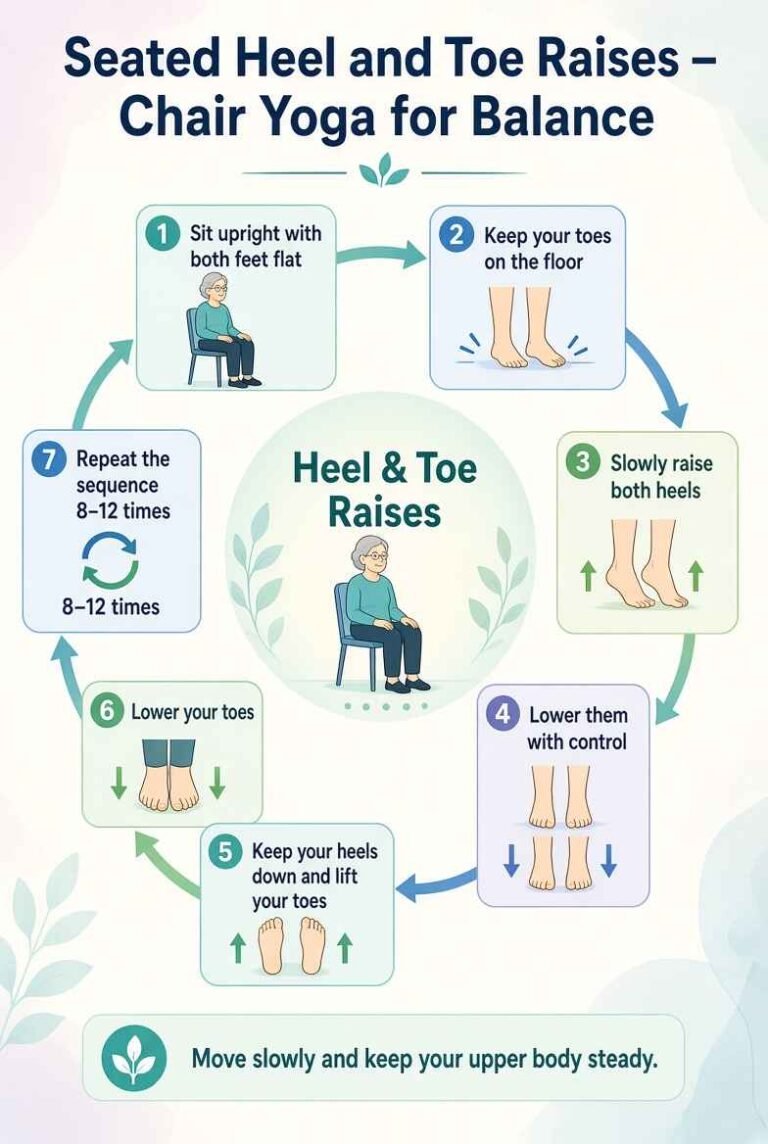
- Sit upright with both feet flat.
- Keep your toes on the floor.
- Slowly raise both heels.
- Lower them with control.
- Next, keep your heels down and lift your toes.
- Lower your toes.
- Repeat the sequence 8–12 times.
Move slowly instead of rushing through the repetitions.
Why try it?
This movement encourages gentle ankle and foot mobility and adds variety to your seated balance routine.
4. Seated Side-to-Side Weight Shifts
This exercise focuses on controlled movement and body awareness.
How to do it
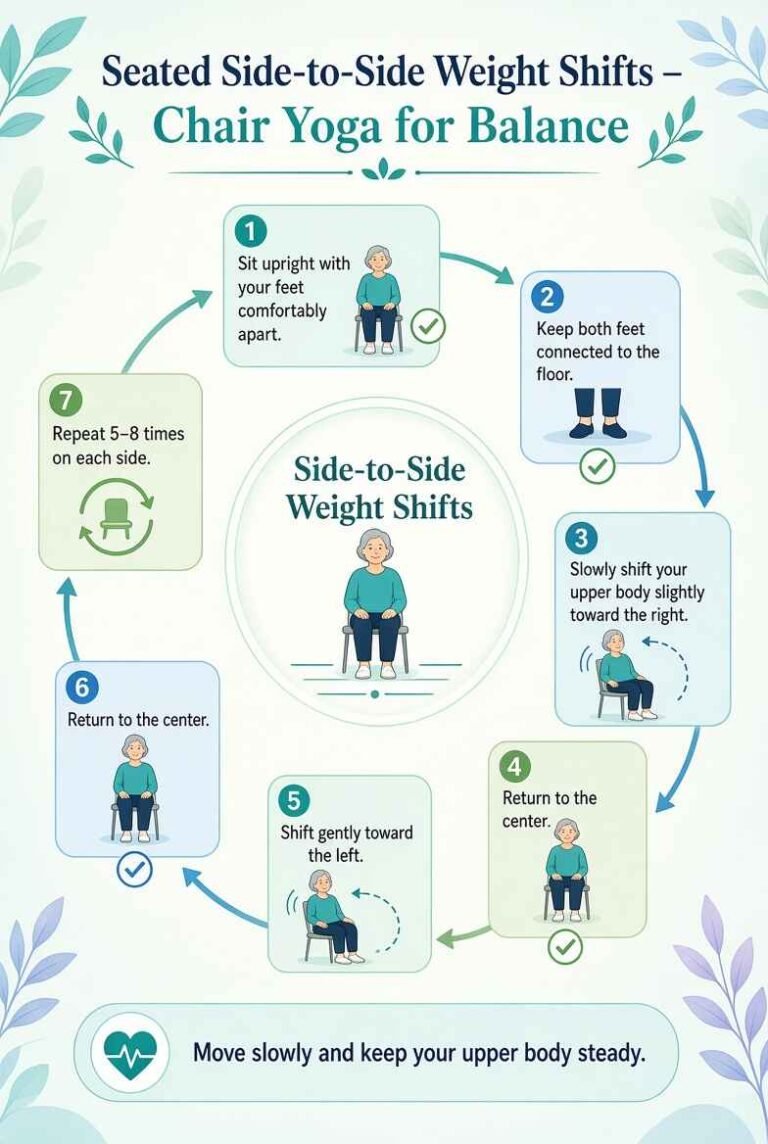
- Sit upright with your feet comfortably apart.
- Keep both feet connected to the floor.
- Slowly shift your upper body slightly toward the right.
- Return to the center.
- Shift gently toward the left.
- Return to the center.
- Repeat 5–8 times on each side.
Keep the movement small.
Why try it?
Learning to control your body as you move from one position to another is an important part of balance.
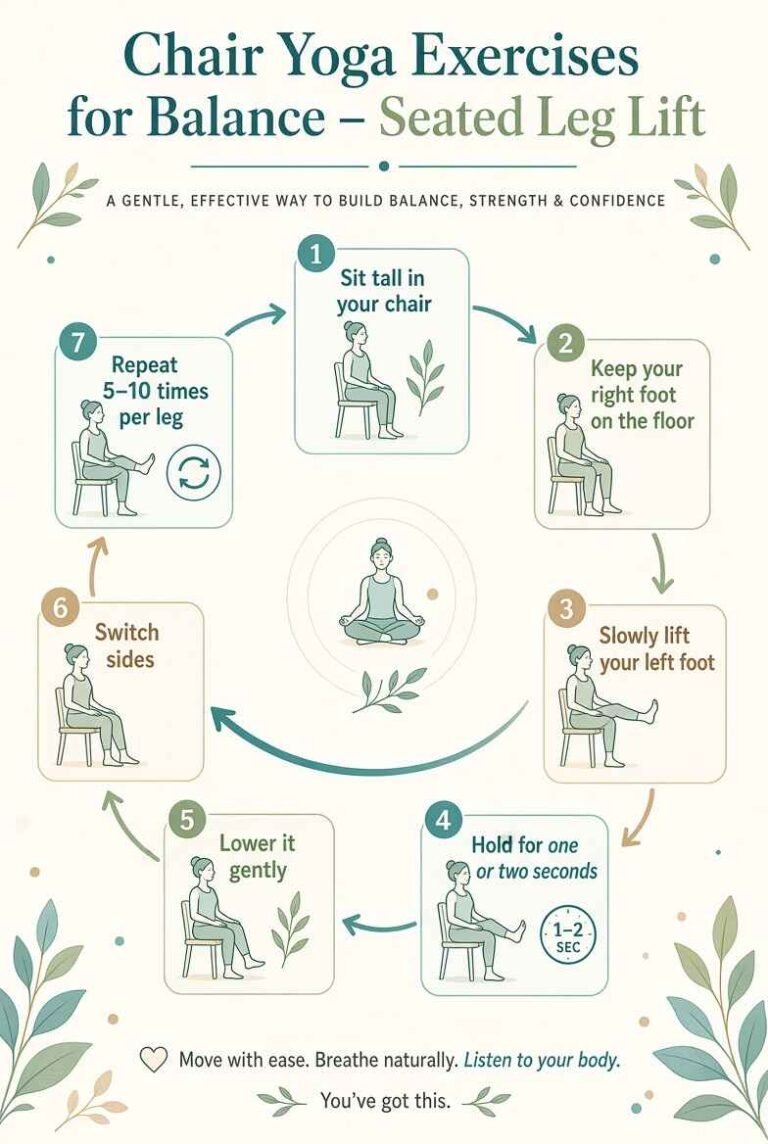
5. Seated Leg Lift
A seated leg lift provides another simple way to practice controlled lower-body movement.
How to do it
- Sit tall in your chair.
- Keep your right foot on the floor.
- Slowly lift your left foot.
- Hold for one or two seconds.
- Lower it gently.
- Switch sides.
- Repeat 5–10 times per leg.
If the movement feels difficult, lift your foot only slightly.
Why try it?
This exercise challenges your ability to lift and control one leg at a time without requiring you to stand.
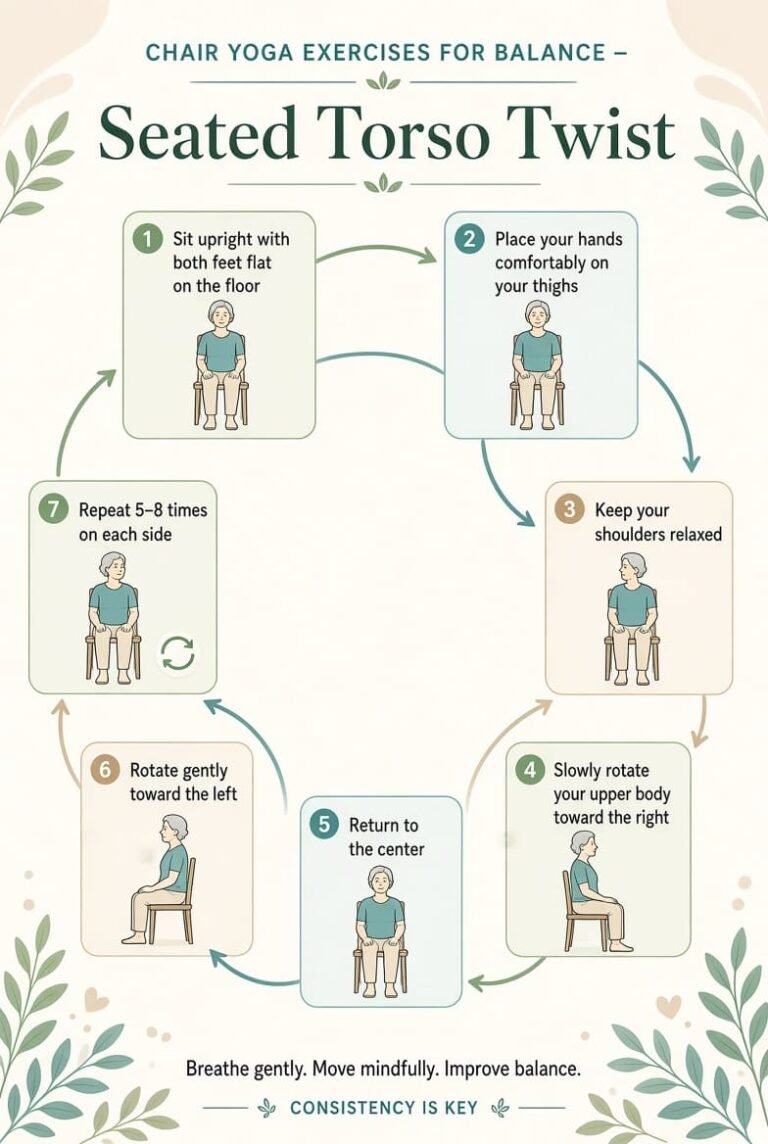
6. Seated Torso Twist
Gentle trunk mobility can complement a balance-focused exercise routine.
How to do it
- Sit upright with both feet flat on the floor.
- Place your hands comfortably on your thighs.
- Keep your shoulders relaxed.
- Slowly rotate your upper body toward the right.
- Return to the center.
- Rotate gently toward the left.
- Repeat 5–8 times on each side.
Avoid forcing the twist.
Why try it?
A comfortable range of trunk movement can make everyday activities such as turning, reaching, and looking around easier.
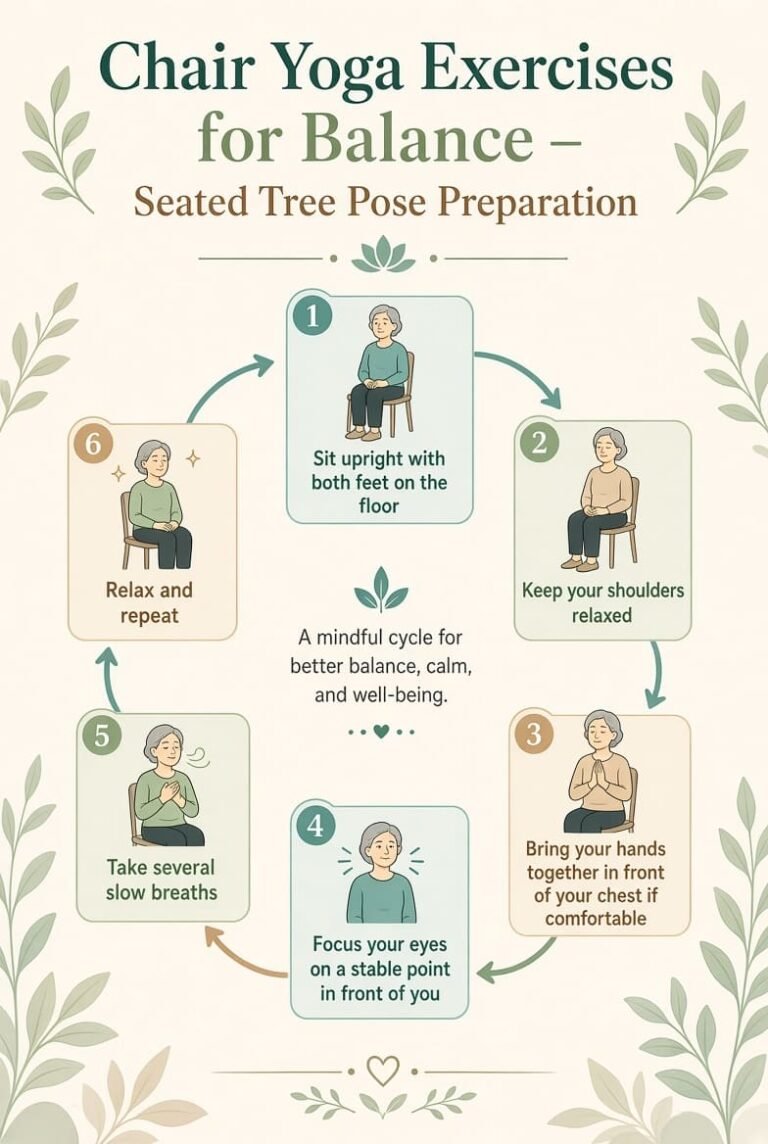
7. Seated Tree Pose Preparation
Traditional tree pose can be challenging because it involves standing on one leg. A seated variation allows you to practice some of the same ideas—posture, concentration, and body awareness—without requiring unsupported standing.
How to do it
- Sit upright with both feet on the floor.
- Keep your shoulders relaxed.
- Bring your hands together in front of your chest if comfortable.
- Focus your eyes on a stable point in front of you.
- Take several slow breaths.
- Relax and repeat.
If you eventually progress to a supported standing version, keep one or both hands on a sturdy chair.
Harvard Health describes chair yoga as an approach that can include standing positions performed with a chair for support.
Why try it?
The exercise encourages concentration, posture, and controlled positioning—all useful components of balance training.
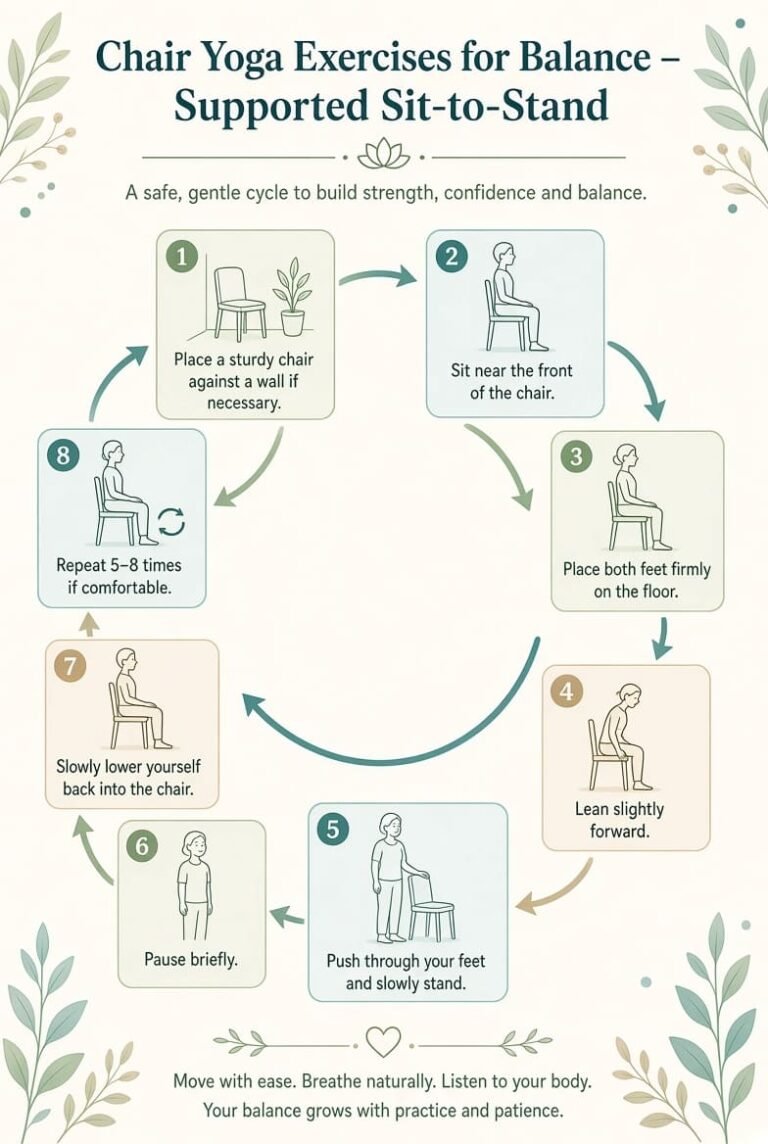
8. Supported Sit-to-Stand
Sit-to-stand is a functional movement because getting up from a chair is something we do throughout the day.
However, this exercise is more challenging than the seated movements above.
How to do it
- Place a sturdy chair against a wall if necessary.
- Sit near the front of the chair.
- Place both feet firmly on the floor.
- Lean slightly forward.
- Push through your feet and slowly stand.
- Pause briefly.
- Slowly lower yourself back into the chair.
- Repeat 5–8 times if comfortable.
Use your hands for support if needed.
The National Institute on Aging lists practicing standing from a sitting position among balance-related activities for older adults.
Important safety point
If standing without substantial support feels unsafe, skip this exercise. You don’t need to perform standing exercises to begin chair yoga.
A Simple Chair Yoga Balance Routine for Seniors
You can combine several of these movements into a short home routine.
Beginner routine
Warm-up — 3 minutes
- Gentle shoulder rolls
- Seated ankle movements
- Slow breathing
- Easy seated marching
Balance-focused movements — 8–10 minutes
- Seated marching
- Knee extensions
- Heel and toe raises
- Side-to-side weight shifts
- Seated leg lifts
Mobility — 3–5 minutes
- Seated torso twists
- Gentle seated stretches
Optional progression
- Supported sit-to-stand
You don’t need to rush.
Start with a short routine and focus on smooth, controlled movements. As your comfort improves, you can gradually increase the number of repetitions.
How Often Should Seniors Do Chair Yoga for Balance?
There isn’t one schedule that works for everyone.
A practical approach is to begin with short, manageable sessions and gradually build consistency.
The National Institute on Aging recommends incorporating balance activities into an older adult’s regular exercise routine and gives about three balance sessions per week as a general example.
However, your appropriate frequency depends on your fitness level, health status, and the type of exercises you’re doing.
If you’re just starting, even a short session can be a useful way to establish a routine.
The goal is consistent, controlled movement rather than trying to do as much as possible in one workout.
May Chair Yoga Help Seniors With Poor Balance?
It may be a useful starting point because many chair yoga movements can be performed while seated.
This is particularly helpful for someone who is uncomfortable standing for extended periods or who has difficulty getting down onto and back up from the floor.
Harvard Health describes chair yoga as particularly suitable for people who have difficulty with balance, prolonged standing, or floor-based exercise.
However, poor balance is not something to diagnose or manage through chair yoga alone.
Balance problems can have many possible causes. If you’re experiencing frequent falls, significant dizziness, unexplained instability, or a sudden change in balance, seek appropriate medical advice.
What Equipment Do You Need for Chair Yoga?
One of the advantages of chair yoga is that you don’t need an expensive home gym.
For most of the exercises in this article, you’ll need only:
- A sturdy chair
- Comfortable clothing & Towel
- Enough open space
- A stable floor
You may also choose optional accessories such as a
See the product on Amazon: yoga mat,
See the product on Amazon:yoga strap,
See the product on Amazon: light resistance band.
Optional: Resistance Bands for a Broader Senior Fitness Routine
Resistance bands aren’t necessary for the chair yoga exercises above. However, they can be useful when you want to add gentle strength exercises to your overall senior fitness routine.
Because balance is influenced by strength as well as mobility, combining chair yoga with appropriate strengthening exercises can create a more complete routine. The NIA recommends including aerobic, muscle-strengthening, and balance activities rather than focusing on only one type of exercise.
If you’re considering resistance bands, you can see resistance bands on Amazon and choose a set appropriate for your fitness level.
Amazon Associate Disclosure: As an Amazon Associate, I earn from qualifying purchases. If you purchase through an Amazon link on this page, I may earn a commission at no additional cost to you.
Chair Yoga for Balance and Your Overall Senior Fitness Routine
Balance is only one part of healthy aging.
A well-rounded routine can include:
- Chair yoga for gentle mobility and flexibility
- Strength training for maintaining muscle
- Balance exercises for stability and coordination
- Aerobic activity for cardiovascular fitness
- Stretching for comfortable range of motion
The National Institute on Aging recommends a combination of aerobic, muscle-strengthening, and balance activities for older adults.
If you’re new to chair yoga, visit our main Chair Yoga Exercises for Seniors at Home guide for a broader introduction.
You can then explore more targeted exercises, such as:
This approach allows you to choose exercises according to your particular goals rather than trying to follow one routine for everyone.
Frequently Asked Questions About Chair Yoga for Balance for Seniors
Is chair yoga good for balance?
Chair yoga can be a useful component of a balance-focused exercise routine. It allows many movements to be performed from a stable seated position while working on posture, mobility, coordination, and controlled movement.
It should not, however, be presented as a guaranteed way to prevent falls.
What are the best chair yoga exercises for balance?
There isn’t one exercise that is best for every person.
Seated marching, heel and toe raises, controlled leg lifts, side-to-side weight shifts, and supported sit-to-stand movements can all be incorporated into a balance-focused routine.
Choose exercises that match your current ability.
Do I need special equipment for chair yoga?
No. A sturdy chair and enough room to move are usually sufficient.
Optional equipment such as resistance bands can be added later if you want to incorporate strength exercises into your broader senior fitness routine.
Chair yoga for balance for seniors can be a practical way for seniors and beginners to introduce controlled movement into their daily routine.
You don’t need to begin with difficult standing poses. Start with simple movements such as seated marching, knee extensions, heel and toe raises, gentle weight shifts, and seated leg lifts.
As you become more comfortable, you can consider supported movements such as sit-to-stand exercises, provided they feel safe for you.
Most importantly, focus on slow, controlled, comfortable movement rather than trying to perform advanced poses.
For a complete introduction to chair-based exercise, continue with our main Chair Yoga Exercises for Seniors at Home guide.
And if you’re looking for a more targeted routine, explore our related Chair Yoga for Knee Pain and Chair Yoga for Hip Pain articles.